Listening to Hugh Willis of BlueBay Asset Management on a conference call on Monday I was struck that twice he mentioned that May was a very unusual month in markets. Indeed it was; and in equity markets it resulted in losses of 8% (SPX) to 10% (MSCI Emerging Markets). Willis noted that such monthly losses had occurred only 5 or 6 times in his career.
So how infrequent are such losses? To find out I looked at the S&P over the last three decades. There were 34 months for which the monthly loss was 5% or greater. Below is table showing all these losing months.
Monthly Losses of 5% or More on the S&P500 Index from 1980 and Onwards
(Note that the great bull market started in August 1982)
A few observations:
• There is increased clustering through time and far more observations of big losses in the neutral decade of the Noughties compared to the bull decades of the ‘80s and ‘90s.
• The frequency of subsequent 1 month positive returns was lower post-2000 than in the great bull market.
• For longer holding periods after a fall of 5% or more in stocks in a single month the outcomes have been distinctly worse in the Noughties than in the bull market decades. Holding stocks for a month or up to a couple of quarters after a 5% fall in stocks would tend to make you money in the ‘80s and ‘90s and lose you money in the last ten years or so.
• As a mechanistic strategy, buying for a month after a 5% fall in markets would have cost you money in the Noughties.
• As a mechanistic strategy, buying stocks after a monthly 5% fall in markets and holding for a quarter or two quarters would have cost you money in the Noughties, and made a ton of money in the ‘80s and ‘90s.
Wednesday, 16 June 2010
Tuesday, 8 June 2010
April saw Outflows - Negative Data Revisions Caused by Funds of Funds?
A month ago when I reported on industry fund flows I wrote:
"The flows at the industry level are unlikely to pick up in the next few months given the gyrations in the markets for traditional assets. Collective memory of falling markets is still strong at this point, only just over a year on from the market lows. The level of traded equity volatility has doubled in the last few weeks, and price levels in FX, commodities, equities and bonds have shifted quickly enough that the perceptions are that the markets are trading more emotionally. This is not the background against which most institutional investors can devote senior management time to making active decisions about allocations to hedge fund strategies, and still less about allocations to individual hedge fund managers."
My expectations were met in April, as TrimTabs Investment Research and BarclayHedge reported that the hedge fund industry posted an estimated outflow of $3.5bn in that month.
Industry Level Net Flows Per Month
Source: TrimTabs Investment Research and BarclayHedge
TrimTabs and Barclayhedge also reported that the April flows "were the third outflow in five months". This was not how the flows data were reported month by month - the table above gives the flows as originally reported in each month, and April was the first negative flow of the year for the industry. This suggests that the early estimates of (positive) flows were not backed up by the subsequent data reported to databases.
All hedge fund databases get a similar experience - the early reporting funds are usually those with better numbers to report. Also funds of hedge funds report to databases with a lag to single managers. The negative flows could be concentrated in the multi-manager hedge funds, which would be consistent with barely a month of positive inflows to funds of funds (in aggregate) since the middle of 2008.
So positive flows, such as there have been, have been concentrated in single manager hedge funds, and funds of hedge funds as a whole continue to have difficulty attracting net new assets.
"The flows at the industry level are unlikely to pick up in the next few months given the gyrations in the markets for traditional assets. Collective memory of falling markets is still strong at this point, only just over a year on from the market lows. The level of traded equity volatility has doubled in the last few weeks, and price levels in FX, commodities, equities and bonds have shifted quickly enough that the perceptions are that the markets are trading more emotionally. This is not the background against which most institutional investors can devote senior management time to making active decisions about allocations to hedge fund strategies, and still less about allocations to individual hedge fund managers."
My expectations were met in April, as TrimTabs Investment Research and BarclayHedge reported that the hedge fund industry posted an estimated outflow of $3.5bn in that month.
Industry Level Net Flows Per Month
Inflows in November 2009 $18.7bn
Inflows in December 2009 -$3.8bn
Inflows in January 2010 $7.1bn
Inflows in February 2010 $16.6bn
Inflows in March 2010 $7.6bn
Inflows in April 2010 -$3.5bn
Source: TrimTabs Investment Research and BarclayHedge
TrimTabs and Barclayhedge also reported that the April flows "were the third outflow in five months". This was not how the flows data were reported month by month - the table above gives the flows as originally reported in each month, and April was the first negative flow of the year for the industry. This suggests that the early estimates of (positive) flows were not backed up by the subsequent data reported to databases.
All hedge fund databases get a similar experience - the early reporting funds are usually those with better numbers to report. Also funds of hedge funds report to databases with a lag to single managers. The negative flows could be concentrated in the multi-manager hedge funds, which would be consistent with barely a month of positive inflows to funds of funds (in aggregate) since the middle of 2008.
So positive flows, such as there have been, have been concentrated in single manager hedge funds, and funds of hedge funds as a whole continue to have difficulty attracting net new assets.
Monday, 7 June 2010
Hedge Fund Takeovers - Martin Currie and Schroders Acquire
One of the themes I have written about for 2010 is that of M&A in the hedge fund business. The latest example is that of Martin Currie, the Scotland-based manager, taking over the Sofaer Capital European long/short equity business. So this deal is not for the whole of Sofaer's hedge fund business, just the European equity part of it, and no price details have been disclosed.
Citywire report that Martin Currie Investment Management has agreed to acquire the $280 million (£190.6 million) Sofaer Capital European long/short equity business as of July 1.
The two principals in charge of the fund, Michael Browne and Steve Frost, will move to Martin Currie and continue to run the $140 million vehicle. The pair has worked together on European equities for more than 20 years and began to co-manage the Sofaer Capital European hedge fund, which has delivered an annualised return of 8% versus -0.6% by the MSCI European benchmark, in January 2001.
Addidtion:
Subsequent to this posting Schroders has acquired a 49% interest in RWC Partners, a London-based hedge fund management firm. At the date of completion of the transaction, RWC had gross business assets of approximately £10 million and its total assets under management are just over €2 billion.
There are a couple of points of interest in this. Schroders acquired a minority, and have no formal agreement in place to acquire the balance of RWC Partners. This suggests that the sellers were negociating from a strong position.
The other point of interest is that the two fund managers of Schroders Income Fund (the top performing income over 3 years) who recently resigned from Schroder Investment Management were to join RWC in August! The managers concerned, Nick Purves and Ian Lance, were given the opportunity to veto the deal between RWC and Schroders, but declined to do so.
The momentum at RWC has been maintained by the addition of a team to run absolute return and currency funds - Peter Allwright and Stuart Frost will join from Threadneedle, where they ran the £2bn Threadneedle Absolute Return Fund. The pair have experience running global and European bond funds, so it is natural to expect more bond products to follow.
Citywire report that Martin Currie Investment Management has agreed to acquire the $280 million (£190.6 million) Sofaer Capital European long/short equity business as of July 1.
The two principals in charge of the fund, Michael Browne and Steve Frost, will move to Martin Currie and continue to run the $140 million vehicle. The pair has worked together on European equities for more than 20 years and began to co-manage the Sofaer Capital European hedge fund, which has delivered an annualised return of 8% versus -0.6% by the MSCI European benchmark, in January 2001.
Addidtion:
Subsequent to this posting Schroders has acquired a 49% interest in RWC Partners, a London-based hedge fund management firm. At the date of completion of the transaction, RWC had gross business assets of approximately £10 million and its total assets under management are just over €2 billion.
There are a couple of points of interest in this. Schroders acquired a minority, and have no formal agreement in place to acquire the balance of RWC Partners. This suggests that the sellers were negociating from a strong position.
The other point of interest is that the two fund managers of Schroders Income Fund (the top performing income over 3 years) who recently resigned from Schroder Investment Management were to join RWC in August! The managers concerned, Nick Purves and Ian Lance, were given the opportunity to veto the deal between RWC and Schroders, but declined to do so.
The momentum at RWC has been maintained by the addition of a team to run absolute return and currency funds - Peter Allwright and Stuart Frost will join from Threadneedle, where they ran the £2bn Threadneedle Absolute Return Fund. The pair have experience running global and European bond funds, so it is natural to expect more bond products to follow.
Wednesday, 2 June 2010
Rough May and YTD for Domestic Equity Hedge Funds
Equity markets have been a switchback this year – a series of rises and troughs like a sinewave. The markets had a normal interim correction after a good start to January. The correction took equity markets down nearly 10% at the low in early February, and then we had a rally of above-average strength – a gain of nearly 17% in two-and-a-half months.
The Euro and commodity inspired fall since the start of May has been very aggressive to the downside. As is typically seen, volatility has risen with falling prices from as low as 5% on 10 day basis to over 30% currently. Share prices fell 8.2% in the calendar month.
At the aggregate level, looking at hedge fund indices as a proxy, and for equity hedge funds as a whole, the equity market background has been perfect to trap equity hedge fund managers. Hedgies tend to manage their balance sheet (net and gross) on the feedback their P&L gives them about their current positioning. As the P&L gets more positive the net fund exposure bias tends to be reinforced the same way, and vice versa.
Of course, some managers are skilled market-timers and they will add value for their investors by raising and cutting the net exposure to markets around turning points, or adding aggressively to exposures in trending markets. But such market timers are a rarity, and as there are over four thousand equity hedge funds in the United States it is fair to say that the typical hedge fund manager there will not have enjoyed this year’s markets because of the directional changes.
Hedge Fund Research of Chicago tracks equity hedge fund returns of domestic (US based managers) via a daily-priced investible hedge fund index. The HFRX Index for Equity Hedge Funds was up 1.29% from the end of 2009 to the end of April, compared to the S&P500 up 6.4% (ex dividends). So far so dull.
But May was extremely difficult for equity hedge funds on the back of rising net exposures – created because of a trending market from mid-February to mid-April. The HFRX Index for Equity Hedge Funds lost 3.4% in May, putting the year-to-date return at the hedge fund index level at minus 2.1%.
This is the index level return, around which there will be a particularly wide dispersion of performance delivered from individual hedge funds. So expect May 2010 returns from equity hedge dedicated to US markets to be anything from +2% to -7%. Emerging market equity hedge funds and those in Asia will have done worse than -3.4% on average in May. Ouch..
The Euro and commodity inspired fall since the start of May has been very aggressive to the downside. As is typically seen, volatility has risen with falling prices from as low as 5% on 10 day basis to over 30% currently. Share prices fell 8.2% in the calendar month.
At the aggregate level, looking at hedge fund indices as a proxy, and for equity hedge funds as a whole, the equity market background has been perfect to trap equity hedge fund managers. Hedgies tend to manage their balance sheet (net and gross) on the feedback their P&L gives them about their current positioning. As the P&L gets more positive the net fund exposure bias tends to be reinforced the same way, and vice versa.
Of course, some managers are skilled market-timers and they will add value for their investors by raising and cutting the net exposure to markets around turning points, or adding aggressively to exposures in trending markets. But such market timers are a rarity, and as there are over four thousand equity hedge funds in the United States it is fair to say that the typical hedge fund manager there will not have enjoyed this year’s markets because of the directional changes.
Hedge Fund Research of Chicago tracks equity hedge fund returns of domestic (US based managers) via a daily-priced investible hedge fund index. The HFRX Index for Equity Hedge Funds was up 1.29% from the end of 2009 to the end of April, compared to the S&P500 up 6.4% (ex dividends). So far so dull.
But May was extremely difficult for equity hedge funds on the back of rising net exposures – created because of a trending market from mid-February to mid-April. The HFRX Index for Equity Hedge Funds lost 3.4% in May, putting the year-to-date return at the hedge fund index level at minus 2.1%.
This is the index level return, around which there will be a particularly wide dispersion of performance delivered from individual hedge funds. So expect May 2010 returns from equity hedge dedicated to US markets to be anything from +2% to -7%. Emerging market equity hedge funds and those in Asia will have done worse than -3.4% on average in May. Ouch..
Friday, 28 May 2010
Growth in Absolute Return Products Reflects Some Retail Interest in Hedge Fund Strategies
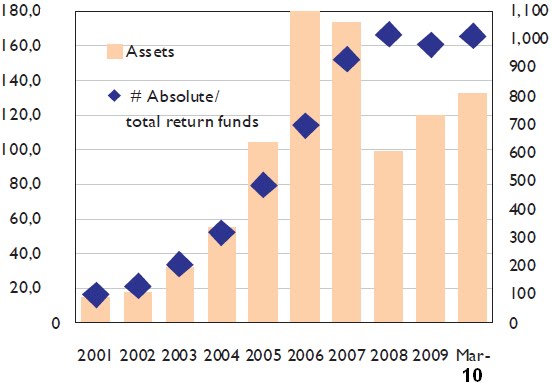
There is further evidence this week that absolute return funds are finding increasing acceptance. Lipper has written about sales of the products (in combination with total return funds) in the first quarter, and the trends suggest some good growth.
Assets Under Management (in €bns. lhs) and Numbers of Absolute Return
and Total Return Funds (rhs)
As a group absolute return funds aim to achieve positive returns in all market conditions, but they can have different types of exposure in order to achieve it. They invest through a variety of investment strategies in domestic equity or bond markets, or sectors such as commodities, while others have a global spread and hold a broad range of assets. It is particularly noteworthy that absolute return bond funds sold particularly well during the first quarter as investors sought out higher yields. Indeed seven of the best-selling absolute return funds in the first quarter were bond funds.
The popularity of bond absolute return funds suggests that these are retail and/or distributor/advisor products. The top selling products were from, in order, Standard Life, Julius Baer, UBI Pramerica, JPMorgan, Schroder, and in aggregate the largest asset managers in absolute return and total return funds are shown in the table below:
Top Five Groups by Assets in Absolute Return/ Total Return Products
as at End March 2010
The names that have cropped up each have strong branding, and excellent distribution capability, providing supporting evidence that these are retail products rather than products that are invested in by institutions. This point is reinforced by the fact that the UK and Italy together make up 40% of the sales by end market – territories with strong IFA and bank networks for distribution, respectively.
Some absolute return funds are described as Newcits, principally those launched by hedge fund managers. Lipper suggest that more than half of European hedge fund managers have launched, or are planning to launch a Newcits product. Given that the market is for retail products, the sales represent a new end-market for hedge fund groups and therefore represent incremental business. The power of branding in retail channels would itself reinforce the concentration in the hedge fund business – the bigger funds taking an increasing share of the industry through time.
Assets Under Management (in €bns. lhs) and Numbers of Absolute Return
and Total Return Funds (rhs)
In the first quarter, they attracted net inflows of €9.7bn compared to €11bn during the whole of last year. According to Lipper, for investors, the attraction of the funds has been boosted by a combination of low interest rates, economic uncertainty and stock market volatility. “Among product providers, hedge fund managers see absolute return funds as an opportunity to move into the mainstream mutual fund market, though figures show that the most successful funds are from fund managers with a foot in both camps,” states Lipper.
As a group absolute return funds aim to achieve positive returns in all market conditions, but they can have different types of exposure in order to achieve it. They invest through a variety of investment strategies in domestic equity or bond markets, or sectors such as commodities, while others have a global spread and hold a broad range of assets. It is particularly noteworthy that absolute return bond funds sold particularly well during the first quarter as investors sought out higher yields. Indeed seven of the best-selling absolute return funds in the first quarter were bond funds.
The popularity of bond absolute return funds suggests that these are retail and/or distributor/advisor products. The top selling products were from, in order, Standard Life, Julius Baer, UBI Pramerica, JPMorgan, Schroder, and in aggregate the largest asset managers in absolute return and total return funds are shown in the table below:
Top Five Groups by Assets in Absolute Return/ Total Return Products
as at End March 2010
The names that have cropped up each have strong branding, and excellent distribution capability, providing supporting evidence that these are retail products rather than products that are invested in by institutions. This point is reinforced by the fact that the UK and Italy together make up 40% of the sales by end market – territories with strong IFA and bank networks for distribution, respectively.
Some absolute return funds are described as Newcits, principally those launched by hedge fund managers. Lipper suggest that more than half of European hedge fund managers have launched, or are planning to launch a Newcits product. Given that the market is for retail products, the sales represent a new end-market for hedge fund groups and therefore represent incremental business. The power of branding in retail channels would itself reinforce the concentration in the hedge fund business – the bigger funds taking an increasing share of the industry through time.
Wednesday, 26 May 2010
One Step Beyond for Lipper on Hedge Funds
We are well used to output from Thomson Reuters reporting on factual stories on the hedge fund industry. Through the Lipper subsidiary they are going a step further. Up to this point Global Head of Hedge Fund Research Aureliano Gentilini has published research looking backwards. He has gone from exhaustive analysis on dispersions of hedge fund returns and returns by strategy to something altogether less certain – forecasting.
What he has produced is the kind of output you see from funds of funds managers as they describe the macro environment and how it may suit/hurt the returns from the various hedge fund strategies.
Here are some edited extracts from Lipper Hedge Funds Insight Report, “Hedge Funds Outlook”, May 2010
The global macro-scenario, macro-information flow arrival, and volatility clustering are expected to continue dominating market sentiment in the short run.
In the current trading environment macro and systematic traders are expected to benefit the most from trading across diverse asset classes.
Looking at the recent past, historical patterns occurring in 2007 might materialize again. Several macro-driven "crowded trades" are about to appear again in hedge portfolios.
Concerns about absorption of new government bond issuance of PIIGS countries and low bid-to-cover ratios at government debt auctions will affect the intermediate-to-long sector of the yield curve in those countries.
The Dedicated Short-Bias strategy will be a bright spot as market fears resume. The ten-day exponential moving average of the CBOE Equity Put/Call Ratio—a gauge of the sentiment of speculative traders, which hit a multi-year record low of 0.472 on April 15—appears to be close to a reversal to the downside.
FX strategies will continue offering attractive opportunities to lock in profits in the short term. Of interest is the change in positioning that large speculators executed in the euro foreign exchange futures markets in the week ending May 18.
In the current market scenario gold and the U.S. dollar are expected to again trend higher in tandem, with the precious metal trending to record highs after a temporary pause.
What he has produced is the kind of output you see from funds of funds managers as they describe the macro environment and how it may suit/hurt the returns from the various hedge fund strategies.
Here are some edited extracts from Lipper Hedge Funds Insight Report, “Hedge Funds Outlook”, May 2010
Selected hedge fund strategies are expected to successfully navigate current market turmoil as the risk/return profile of hedge fund managers remains intact
The global macro-scenario, macro-information flow arrival, and volatility clustering are expected to continue dominating market sentiment in the short run.
In the current trading environment macro and systematic traders are expected to benefit the most from trading across diverse asset classes.
Looking at the recent past, historical patterns occurring in 2007 might materialize again. Several macro-driven "crowded trades" are about to appear again in hedge portfolios.
Concerns about absorption of new government bond issuance of PIIGS countries and low bid-to-cover ratios at government debt auctions will affect the intermediate-to-long sector of the yield curve in those countries.
The Dedicated Short-Bias strategy will be a bright spot as market fears resume. The ten-day exponential moving average of the CBOE Equity Put/Call Ratio—a gauge of the sentiment of speculative traders, which hit a multi-year record low of 0.472 on April 15—appears to be close to a reversal to the downside.
FX strategies will continue offering attractive opportunities to lock in profits in the short term. Of interest is the change in positioning that large speculators executed in the euro foreign exchange futures markets in the week ending May 18.
In the current market scenario gold and the U.S. dollar are expected to again trend higher in tandem, with the precious metal trending to record highs after a temporary pause.
Monday, 24 May 2010
Chart of The Week - Increasing Significance of Chinese Growth
I haven’t posted a chart of the week for some months. It has to be very telling; it has to be important.
This graphic qualifies on both counts:
Monthly change since January in real retail sales (in January 2007, US$ bn)
Source: Goldman Sachs Global ECS Research
What does it show? Over the period of the recent downturn in global economies, the loss of US real retail sales through recession was about the same in absolute Dollars as the gain in retail sales in absolute Dollars in China.
If ever there was a way of capturing the increased global significance of Chinese economic growth this is it. Chinese growth is so large that it rivals in absolute dollars the significance of the United States in changes in marginal contributions to real global growth, at least as far as the consumer is concerned.
Of course we already had on board that China’s growth in commodity consumption can overwhelm the significance of that of the rest of the world. But it is not just through industrialisation that China is making it’s impact.
Tuesday, 11 May 2010
Hedge Fund Training in London - I'm a Course Leader
Why Imperial College Business School?
This course is delivered by a leading academic in the field of hedge funds from Imperial College Business School and two experienced practitioners.
Consistently rated amongst the world’s best universities, Imperial College is a science-based institution with a reputationfor excellence in teaching and research. It has a well established
Executive Education programme. The Risk Management Lab (RML), headed by Dr Robert Kosowski, acts as the umbrella for all research on risk within Imperial College Business School’s Finance Group. The Centre for Hedge Fund Research within the RML develops research on the performance, investment behaviour and risk management of hedge funds. Further information on the Centre can be found at www.imperial.ac.uk/riskmanagementlaboratoryWho should attend?
• Trustees, Institutional Investors, Private Bankers, Consultants and Financial Advisors
• Regulators, Compliance Officers, Junior Fund Managers
and Trainees, and Business Development Staff
• Service Providers to Hedge Funds
The course provides answers to key questions
• What are the Determinants of Funds of Hedge Funds Performance?
• How useful is hedge fund replication for benchmarking and risk management?
• Which hedge fund strategies are likely to outperform in different economic environments?
• What does the future hold for hedge fund replication?
• What role do hedge funds play in asset allocation for pension funds and high net worth individuals
• Do listed hedge funds, UCITS III compliant funds and managed accounts present benefits for hedge fund investors that are demanding increasing liquidity and transparency?
• How useful is hedge fund replication for benchmarking and risk management?
• Which hedge fund strategies are likely to outperform in different economic environments?
• What does the future hold for hedge fund replication?
• What role do hedge funds play in asset allocation for pension funds and high net worth individuals
• Do listed hedge funds, UCITS III compliant funds and managed accounts present benefits for hedge fund investors that are demanding increasing liquidity and transparency?
Monday, 10 May 2010
Rate of Inflows to Hedge Fund Industry Fail to Accelerate in 2010
TrimTabs Investment Research and BarclayHedge reported that the hedge fund industry posted an estimated inflow of $7.6 billion, or 0.5% of assets, in March 2010. The firms estimate that hedge fund assets stand at a 16-month high of $1.64 trillion. Hedge fund third-party marketers have not seen much of these flows - they say that they have seen subscriptions static or even slightly lower than at the end of last year.
It could be that these statements are not incompatible: much of the net inflows to date have been to large well-established funds who do not feel the need to use 3PMs. The external marketers will see their share of flows when the scale of flows pick up further, and when industry flows broaden out across the strategies, and broaden across the maturity and scale range seen in the industry.
In terms of strategies in receipt of these flows the trends of last year have continued: Event Driven funds have done best, having had an inflow in March equivalent to 1.5% of assets, on the back of industry leading returns of 6.6% in the first four months of the year. The largest outflows from an investment strategy in March 2010 were from the Multi-Strategy Funds – a strategy that had net outflows through last year.
Industry Level Net Flows Per Month
Inflows in November 2009 $18.7bn
Inflows in December 2009 -$3.8bn
Inflows in January 2010 $7.1bn
Inflows in February 2010 $16.6bn
Inflows in March 2010 $7.6bn
Source: TrimTabs Investment Research and BarclayHedge
The flows at the industry level are unlikely to pick up in the next few months given the gyrations in the markets for traditional assets. Collective memory of falling markets is still strong at this point, only just over a year on from the market lows. The level of traded equity volatility has doubled in the last few weeks, and price levels in FX, commodities, equities and bonds have shifted quickly enough that the perceptions are that the markets are trading more emotionally. This is not the background against which most institutional investors can devote senior management time to making active decisions about allocations to hedge fund strategies, and still less about allocations to individual hedge fund managers.
Thursday, 29 April 2010
Major New York Hedge Funds Join Lawsuit v Porsche
Eighteen investment funds today joined the lawsuit against Porsche Automobil Holding SE asserting fraud and securities manipulation in relation to Porsche SE’s failed 2008 attempt to take over Volkswagen AG. With the addition of the new plaintiffs, the now 35 funds seek to recover more than $2 billion dollars in losses. The 18 funds that joined the lawsuit are part of 6 fund families: Canyon Capital, D.E. Shaw, Greenlight Capital, Ironbound Partners, Royal Capital, and Tiger Global.
The Amended Complaint, filed this morning in Manhattan federal court, explains in greater detail how Porsche SE manipulated the price of VW stock as it secretly cornered the market in VW shares. According to the Amended Complaint, Porsche SE hid that it was cornering the market in VW’s freely traded shares by repeatedly issuing misleading statements about its activities and by spreading purchases of call options around to several counterparties to avoid detection of its increasing control. The scheme induced the plaintiff funds to establish short positions on VW stock. When Porsche SE suddenly revealed the extent of its true control of VW shares on October 26, 2008, a massive short squeeze ensued. The price of VW shares skyrocketed several hundred percent, briefly topping 1,000 Euros. Investors who had shorted VW lost billions covering their positions in the squeeze. Porsche SE collected outrageous profits at the expense of plaintiffs and others by releasing some of its shares into the market at artificial prices.
Today’s filing reveals previously unknown details of Porsche SE’s plan. The new allegations include that:
The case is pending in the Southern District of New York, where it is captioned as Elliott Associates, L.P., et al, v. Porsche Automobil Holding SE, et al, No. 10-civ-532 (HB)(THK).
The funds are represented by Bartlit Beck Herman Palenchar & Scott LLP (see www.bartlit-beck.com) and Kleinberg, Kaplan, Wolf & Cohen, P.C. (www.kkwc.com).
The Amended Complaint, filed this morning in Manhattan federal court, explains in greater detail how Porsche SE manipulated the price of VW stock as it secretly cornered the market in VW shares. According to the Amended Complaint, Porsche SE hid that it was cornering the market in VW’s freely traded shares by repeatedly issuing misleading statements about its activities and by spreading purchases of call options around to several counterparties to avoid detection of its increasing control. The scheme induced the plaintiff funds to establish short positions on VW stock. When Porsche SE suddenly revealed the extent of its true control of VW shares on October 26, 2008, a massive short squeeze ensued. The price of VW shares skyrocketed several hundred percent, briefly topping 1,000 Euros. Investors who had shorted VW lost billions covering their positions in the squeeze. Porsche SE collected outrageous profits at the expense of plaintiffs and others by releasing some of its shares into the market at artificial prices.
- Less than a week before Porsche SE revealed the truth—that it had amassed control of more than 74 percent of VW’s shares— it conducted phone calls with investment advisors in New York during which Porsche SE sought to reassure the New York-based investment advisors that it was nowhere near 75 percent control. Among the false statements Porsche SE made was that although it would acquire a simple majority of VW shares, "going to 75% is not on the agenda." Porsche SE told another fund that it would stop acquiring shares after achieving 50–55% control.
- Porsche SE admitted to at least one plaintiff that it was spreading its options trades around to multiple counterparties to avoid detection.
- Porsche SE’s fraudulent strategy deliberately targeted short sellers. In order to secretly obtain 75 percent ownership in VW, Porsche needed short sellers to borrow stock from owners who would not or could not sell the stock themselves and then to sell it to Porsche or Porsche's call-option counterparties. Without the additional supply created by short sellers, Porsche could never have gained control of 75 percent.
- Porsche SE financed its call-option strategy in part through selling put options. As the price of VW declined in the third week of October 2008, Porsche SE’s liability on the puts it had sold threatened to force the company into bankruptcy. It avoided this threat by forcing the price of VW up, which it accomplished by announcing its call-option position on October 26, triggering the squeeze.
The case is pending in the Southern District of New York, where it is captioned as Elliott Associates, L.P., et al, v. Porsche Automobil Holding SE, et al, No. 10-civ-532 (HB)(THK).
The funds are represented by Bartlit Beck Herman Palenchar & Scott LLP (see www.bartlit-beck.com) and Kleinberg, Kaplan, Wolf & Cohen, P.C. (www.kkwc.com).
Wednesday, 28 April 2010
Race for FoF Acquisitions Starts with Thames River Capital
The increasing likelihood of hedge fund M&A has been a theme of this blog since it launched in October last year: the first podcast was on that topic (http://simonkerrhfblog.blogspot.com/2009/10/test-podcast.html) and a recent post was on M&A in the fund of hedge funds sector (http://simonkerrhfblog.blogspot.com/2010/04/fund-of-hedge-funds-consolidation-gun.html).
The most significant deal in Europe to date was announced today, as Thames River Capital, a stalwart of the London hedge fund industry, is to be acquired by institutional money manager F&C Asset Management plc (F&C). F&C had assets under management of £101.5 billion as at 31 March 2010,a rise of 3.8% over the first three months of the year. Thames River Capital had £4.2bn AUM at the end of the last quarter, a rise of 5.1% from the start of the year.
Some details of the acquisition are given below, and in terms of indications for further deal flow it should be born in mind that the mix of the business at Thames River is now biased towards long-only - the hedge fund element is mostly in a successful (£0.92bn) and growing fund of hedge fund business unit. Thames River also has a very effective sales and maketing team - F&C has potential to make good mileage fron further utlisation of this prime asset of Thames River's if F&C management see it the same way, and if the boutique nature of the target acquired can be broken down some.
The gun really has been fired for fund of hedge fund takeovers.
Release Extract:
F&C Asset Management plc (“F&C” or the “Group”) is pleased to announce that it has entered into a conditional agreement to acquire the Thames River Capital group (“Thames River Capital”) for consideration of up to £53.6 million (comprising initial consideration of £33.6 million and conditional consideration of up to a further £20 million) payable in cash, loan notes and/or F&C shares as described below. Thames River Capital is a London-based, specialist asset management business with an estimated £4.2 billion of assets under management as at 31 March 2010.
Highlights of the Acquisition:
• Acquisition of a UK-based specialist asset management business providing products principally to wholesale and wealth management investors through nine investment teams (the “Investment Teams”)
• Established sales and marketing capability within Thames River Capital comprising a team of 24 individuals with a proven track record of delivering new business flows
• Initial consideration of £33.6 million payable in cash or loan notes at completion and up to a further £20
million of conditional consideration payable in F&C shares or loan notes if Thames River Capital meets
certain financial performance targets at 31 December 2011 and 30 June 2012
• Initial consideration for the Acquisition to be funded through a combination of a cash placing of F&C
ordinary shares equal to approximately 5% of F&C’s issued share capital (the “Placing”), F&C’s existing cash resources and new indebtedness of £15 million
• F&C will acquire, through Thames River Capital (UK) Limited (“Thames River Capital UK”), an economic interest in the management fee profits and performance fee profits generated by the Investment Teams, which for the 11 month period ended 28 February 2010 amounted to approximately 40%2 in aggregate of those total profits
• F&C has also agreed terms under which its economic interest in the share of management fee profits of all of the Investment Teams can be increased over time (the “Commutation Arrangements”)
• Retention and incentive plans have been agreed for Thames River Capital’s key personnel under which
conditional awards will be granted over F&C shares with a value equal to £35 million that will be subject, in the case of the incentive plan, to the achievement of certain financial targets and vest between 30
months and six years after completion of the Acquisition (the “Management Share Plans”)
• F&C to follow the same post-acquisition integration strategy for Thames River Capital as it adopted for its recent successful acquisition of REIT Asset Management. Appropriate governance and monitoring
procedures will be implemented whilst allowing Thames River Capital to retain the distinctive investment
style and culture that has made it successful
• Acquisition to exclude Nevsky Capital LLP, a current associated undertaking of Thames River Capital.
Prior to completion of the Acquisition, Thames River Capital’s interest in Nevsky Capital LLP will be
demerged and will, thereafter, be directly held by the current Thames River Capital shareholders
• Acquisition is anticipated to close in or before the third quarter of 2010
footnote: Based on the total management fee profits and performance fee profits of the Investment Teams for the specified period after deduction of costs and partners' base drawings. The interest that F&C will acquire, through Thames River Capital UK, in the management fee profits and performance fee profits generated by the Investment Teams differs in the case of each Investment Team.
The most significant deal in Europe to date was announced today, as Thames River Capital, a stalwart of the London hedge fund industry, is to be acquired by institutional money manager F&C Asset Management plc (F&C). F&C had assets under management of £101.5 billion as at 31 March 2010,a rise of 3.8% over the first three months of the year. Thames River Capital had £4.2bn AUM at the end of the last quarter, a rise of 5.1% from the start of the year.
Some details of the acquisition are given below, and in terms of indications for further deal flow it should be born in mind that the mix of the business at Thames River is now biased towards long-only - the hedge fund element is mostly in a successful (£0.92bn) and growing fund of hedge fund business unit. Thames River also has a very effective sales and maketing team - F&C has potential to make good mileage fron further utlisation of this prime asset of Thames River's if F&C management see it the same way, and if the boutique nature of the target acquired can be broken down some.
The gun really has been fired for fund of hedge fund takeovers.
Release Extract:
F&C Asset Management plc (“F&C” or the “Group”) is pleased to announce that it has entered into a conditional agreement to acquire the Thames River Capital group (“Thames River Capital”) for consideration of up to £53.6 million (comprising initial consideration of £33.6 million and conditional consideration of up to a further £20 million) payable in cash, loan notes and/or F&C shares as described below. Thames River Capital is a London-based, specialist asset management business with an estimated £4.2 billion of assets under management as at 31 March 2010.
Highlights of the Acquisition:
• Acquisition of a UK-based specialist asset management business providing products principally to wholesale and wealth management investors through nine investment teams (the “Investment Teams”)
• Established sales and marketing capability within Thames River Capital comprising a team of 24 individuals with a proven track record of delivering new business flows
• Initial consideration of £33.6 million payable in cash or loan notes at completion and up to a further £20
million of conditional consideration payable in F&C shares or loan notes if Thames River Capital meets
certain financial performance targets at 31 December 2011 and 30 June 2012
• Initial consideration for the Acquisition to be funded through a combination of a cash placing of F&C
ordinary shares equal to approximately 5% of F&C’s issued share capital (the “Placing”), F&C’s existing cash resources and new indebtedness of £15 million
• F&C will acquire, through Thames River Capital (UK) Limited (“Thames River Capital UK”), an economic interest in the management fee profits and performance fee profits generated by the Investment Teams, which for the 11 month period ended 28 February 2010 amounted to approximately 40%2 in aggregate of those total profits
• F&C has also agreed terms under which its economic interest in the share of management fee profits of all of the Investment Teams can be increased over time (the “Commutation Arrangements”)
• Retention and incentive plans have been agreed for Thames River Capital’s key personnel under which
conditional awards will be granted over F&C shares with a value equal to £35 million that will be subject, in the case of the incentive plan, to the achievement of certain financial targets and vest between 30
months and six years after completion of the Acquisition (the “Management Share Plans”)
• F&C to follow the same post-acquisition integration strategy for Thames River Capital as it adopted for its recent successful acquisition of REIT Asset Management. Appropriate governance and monitoring
procedures will be implemented whilst allowing Thames River Capital to retain the distinctive investment
style and culture that has made it successful
• Acquisition to exclude Nevsky Capital LLP, a current associated undertaking of Thames River Capital.
Prior to completion of the Acquisition, Thames River Capital’s interest in Nevsky Capital LLP will be
demerged and will, thereafter, be directly held by the current Thames River Capital shareholders
• Acquisition is anticipated to close in or before the third quarter of 2010
footnote: Based on the total management fee profits and performance fee profits of the Investment Teams for the specified period after deduction of costs and partners' base drawings. The interest that F&C will acquire, through Thames River Capital UK, in the management fee profits and performance fee profits generated by the Investment Teams differs in the case of each Investment Team.
Friday, 23 April 2010
Moore Capital's Bacon Tops the UK Hedge Fund Rich List
Each year "The Sunday Times" profiles the 1,000 richest people and families in the UK and the wealthiest 250 in Ireland. The list is based on identifiable wealth (land, property, other assets such as art and racehorses, or significant shares in publicly quoted companies), and excludes bank accounts (to which the paper has no access). The table below ranks the UK domiciled hedge fund managers in the List.
The big hedge fund winners, or at least gainers, in the last year have been:
- London resident and macro maven Louis Bacon is the first hedge fund manager to be credited in this List with a net worth in excess of a billion Pounds. George Soros, who maintains a house in London, has only failed to make the List now and previously because he is not domiciled here.
- Global macro clearly had a good period recently because Alan Howard (of Brevan Howard) is credited with an increase in wealth of half a billion pounds since the last ranking was compiled.
- The other investment strategy that is strongly represented at the top of the hedge fund List is CTA. BlueCrest founders Mike Platt and Bill Reeves are ranked equal fifth, coming just after David Harding of Winton Capital.
- Perhaps the only surprise is a calculation that the net worth of Arpad Busson of EIM has jumped by 71% in the last year.
Wednesday, 14 April 2010
Fund of Hedge Fund Dis-intermediation - Evidence from Japan
Following up on the prospects for funds of hedge funds, which I have covered earlier in the month, I neglected to mention dis-intermediation by investing institutions. This is a natural phase of development for institutional investors of scale.
First the institutions use small allocations as a percentage of assets and tap into third party expertise to implement the strategic allocation. This first toe-dipping willl typically utilise a fund of hedge funds, or for the larger institutions, several funds of funds to keep them all honest. A minority of new investors in hedge funds will use a third party advisor, like Albourne Partners, and allocate directly to single managers, or these days look to use replication, like USS of the UK.
The investing institution then gets used to working with hedge funds, gains experience and understanding, and they often move onto increased strategic allocations and change to a new mode of implementation. This may involve making strategic bets on particular hedge fund investment strategies, say emerging managers, credit hedge funds, or directional managers. Moving from diversified mandates to using more specialised mandates (in addition) might also be implemented via specialist funds of hedge funds, but is as likley to involve active selection of single managers.
So it is natural for investing institutions of scale, with sufficient in-house expertise, to progress to selecting hedge funds individually. There is an extra incentive to do this, a negative motivation, when the foundation exposure to hedge funds (via funds of funds) is seen as disappointing. To a significant degree this has been the case for the last two years, to the downside and then the upside, by turns. There are good reasons for the significant under-performance of funds of hedge funds, particularly in 2009, but it can have commmercial impacts through changes in underlying investor attitudes. A recent example was the change in approach of the South Carolina Retirement System. Formerly the allocation to hedge fund strategies was 70% in funds of funds and 30% directly in single manager funds: that split is to be reversed in future. This trend to dis-intermediation is also being reflected in Japan.
Japanese life comapnies have amongst the longest experience of exposure to hedge funds amongst investing institutions. In the middle of the last decade Japanese pension funds allocated to hedge funds too. The core of the exposure has always been by fund of hedge funds. The status of funds of hedge funds as the core means of obtaining exposure is under threat. For the last five years Daiwa Institute of Research has surveyed Japanese pension funds regularly on their hedge fund investment intentions. Historically the most common intended allocations to hedge funds were to funds of hedge funds in the surveys. In the lastest survey, and for the first time, the most common intended allocations were to a hedge fund strategy other than fund of funds, in fact more pension funds of Japan intend to allocate to managed futures funds than funds of funds.
There is some anecdotal evidence that Japanese investing institutions intend to allocate more directly to single manager hedge funds, but the key point is that the share of capital in the hedge fund industry that has been routed via fund of funds will only continue to decline. Funds of funds willl increasingly be dis-intermediated at the industry level, though individual firms may grow through taking market share.
First the institutions use small allocations as a percentage of assets and tap into third party expertise to implement the strategic allocation. This first toe-dipping willl typically utilise a fund of hedge funds, or for the larger institutions, several funds of funds to keep them all honest. A minority of new investors in hedge funds will use a third party advisor, like Albourne Partners, and allocate directly to single managers, or these days look to use replication, like USS of the UK.
The investing institution then gets used to working with hedge funds, gains experience and understanding, and they often move onto increased strategic allocations and change to a new mode of implementation. This may involve making strategic bets on particular hedge fund investment strategies, say emerging managers, credit hedge funds, or directional managers. Moving from diversified mandates to using more specialised mandates (in addition) might also be implemented via specialist funds of hedge funds, but is as likley to involve active selection of single managers.
So it is natural for investing institutions of scale, with sufficient in-house expertise, to progress to selecting hedge funds individually. There is an extra incentive to do this, a negative motivation, when the foundation exposure to hedge funds (via funds of funds) is seen as disappointing. To a significant degree this has been the case for the last two years, to the downside and then the upside, by turns. There are good reasons for the significant under-performance of funds of hedge funds, particularly in 2009, but it can have commmercial impacts through changes in underlying investor attitudes. A recent example was the change in approach of the South Carolina Retirement System. Formerly the allocation to hedge fund strategies was 70% in funds of funds and 30% directly in single manager funds: that split is to be reversed in future. This trend to dis-intermediation is also being reflected in Japan.
Japanese life comapnies have amongst the longest experience of exposure to hedge funds amongst investing institutions. In the middle of the last decade Japanese pension funds allocated to hedge funds too. The core of the exposure has always been by fund of hedge funds. The status of funds of hedge funds as the core means of obtaining exposure is under threat. For the last five years Daiwa Institute of Research has surveyed Japanese pension funds regularly on their hedge fund investment intentions. Historically the most common intended allocations to hedge funds were to funds of hedge funds in the surveys. In the lastest survey, and for the first time, the most common intended allocations were to a hedge fund strategy other than fund of funds, in fact more pension funds of Japan intend to allocate to managed futures funds than funds of funds.
There is some anecdotal evidence that Japanese investing institutions intend to allocate more directly to single manager hedge funds, but the key point is that the share of capital in the hedge fund industry that has been routed via fund of funds will only continue to decline. Funds of funds willl increasingly be dis-intermediated at the industry level, though individual firms may grow through taking market share.
Woke up in Early 2007?
Today’s Bloomberg headlines includes a classic time-warp headline: “AIG’s ILFC Unit Sells 53 Planes to Macquarie for $2 Billion”
So it is game on – if everyone is not quite back to where they where in risk assumption, then at least it is possible to discern a resumption of normal investment bank activities with the usual suspects doing what we know them for.
Should equity markets advance much further or stay at these levels much longer then the next phase should be more secondaries for takeovers and increasing IPOs. ..which is good for investment banks…
So it is game on – if everyone is not quite back to where they where in risk assumption, then at least it is possible to discern a resumption of normal investment bank activities with the usual suspects doing what we know them for.
Should equity markets advance much further or stay at these levels much longer then the next phase should be more secondaries for takeovers and increasing IPOs. ..which is good for investment banks…
Sunday, 11 April 2010
Clarium Redux - Still Arguing with Markets, Still Losing
I am grateful to the website market folly (www.marketfolly.com) for this input on Clarium Capital, the global macro fund manager.
Peter Thiel, source:Bloomberg
" Even more shocking perhaps is that the downward spiral at Peter Thiel's hedge fund Clarium Capital has continued. ZeroHedge noted that Clarium lost 6.1% in the first three weeks of March and was now down 5.4% for the year. This all comes as US equity markets are up over 6.4% for 2010. We're not quite sure what's going on over there but after a fantastic start to the fund, the last few years have been quite rough on them, to put it politely. They were down 25% in 2009 according to our hedge fund performance numbers post. However, as of the recent performance data, they were still up 210% since inception.
Returns from Special Situations to Become Special Again?
A few months ago I was a guest on the hedge fund radio show "The Naked Short Club" on Resonance FM. A question for the panel was "which hedge fund strategies did we each prefer this year?" My choice then and now are the event-driven strategies. I chose those strategies partly because the evidence of surveys of investors have not mentioned event-driven as a favourite (except for distressed), and on the basis of the market environment I see unfolding this year. Distressed securities funds posted the biggest inflow as a percentage of AUM in February this year (at 4.2% of assets) according to TrimTabs Investment Research and BarclayHedge - so they are hardly being ignored.
It still remains the case that investors compiling survey responses cite what has done well for the last six months, but what has changed over a shorter time-frame is the outlook for the special situations component of the event driven set of strategies. At the turn of the year it was somewhat fanciful to suggest that the market environment would be suitable for special sits investors - up to that point corporate activity was very limited in publicly traded markets. From a UK perspective we had a clear landmark takeover in the acquisition of Cadbury's by Kraft Inc, but other forms of M&A activity have taken place and there is activity in sectors beyond those that are consumer-related. The stock markets have reached recovery highs, retracing all of the fall from the second week of January into mid February. This has revived the animal spirits that drive markets, and primary and secondary issuance has picked up and will increase from here.
IPOs Spin-outs and Buy-ins as well as Takeovers
The issuance will be for a range of purposes- IPOs, spin-outs, and buy-ins as well as takeovers. IPOs that were scheduled to take place in February and were postponed will now be back under active consideration. The recovery in valuations in markets will encourage managements to listen to the sum-of-the-parts arguments and enhance shareholder value through spin-outs like that of Enquest from Petrofac. Just last week there was an example of a buy-in, as Agnico-Eagle Mines stepped up to the plate and elected to offer to acquire all the shares it does not already own in Comaplex Minerals.
M&A is back in the revived energy sector, and will come back in other resource-based sectors. The Chinese have stated their desire to acquire strategic resources on a global basis, and their activities will spark the attention of other acquirers on a game theory basis. In upstream energy in 2009 alone, China spent $16 billion gaining footprints in Canadian oil sands, the Gulf of Mexico, Nigeria, Gabon, Trinidad and Tobago, Ecuador, Syria, Iraq, Iran, Indonesia and Kazakhstan. There are expected to be more National Oil Company acquisitions this year in unconventional oil and gas production primarily sourced from gas shales, tight gas sands and oil sands according to industry consultants. Energy M&A will not be confined to NOCs and producing assets as shown by the acquisition of Smith International by Schlumberger.
In mining the secondary and tertiary stocks amongst the miners and mineral exploration stocks have started to out-perform the global major mining stocks as interest warms up. Before Easter there was corporate activity in gold (Newcrest's proposal to merge with Lihir Gold) and in the coal sector, and further deals in zinc.
Not Just Resources
He continued, "We have seen a large number of deals where the average premium over the market price has been approximately 40%. When Air Products (APD, Fortune 500) bids $5 billion in cash for AirGas (ARG), which is 38% over market price, Air Products is telling us they feel sufficiently comfortable about their own business that they are willing to take on a lot of debt to do the deal. It's the same thing with Merck AG's $7 billion offer to buy Millipore (MIL) and Simon Property's (SPG) $10 billion bid to acquire General Growth Properties (GGP). When you buy a share in a business, you're buying a share of its brick, mortar, machinery, and earning power. What corporations are saying is that the equity market is not overvalued."
The corporate buyer has not been absent from the market, but should be more evident in the rest of this year. The pressures resulting from the "shareholder value" mantra is still there, and the continuing recovery of the banking sector will allow some debt financing this year, which was largely absent last year. For similar reasons it would not come as a surprise to see more activity by private equity in the second half of the year, both disposals and acquisitions. This combination of factors will present an increasingly rich environment for managers of special situations capital, both on a dedicated basis and as part of a multi-strategy offering. Better returns will result for special sits strategies.
*The article won't link directly but can be found at http://money.cnn.com/, using search term "Leon Cooperman"
Friday, 9 April 2010
Fund of Hedge Funds Consolidation: The gun has been fired
For just about all of the last decade it has been consistently suggested that the fund of hedge funds sector was just about to consolidate.
Industry watchers suggested that the three different size categories had very different profiles - as potential acquirers and takeover targets. The medium-sized players were going to snap-up their smaller brethren. The larger players were going to add to their assets under management by picking up medium-sized funds, and small funds of funds looked out-moded and should merge or fade away, so it was said and written.
The rationale for consolidation had several arguments:-
1. The industry was mature, as shown by the declining average fees charged.
2. Assets under management in funds of hedge funds as a percentage of the whole hedge fund industry peaked as long ago as the middle of 2008.
Graphic 1. Global Fund of Funds Industry
Source:IFSL estimates
3. In 2009 the attrition rate amongst funds of funds was twice the rate of single manager funds at times.
4. The costs of being in the business were on the rise as staff remuneration and the costs of compliance were only going up.
5. Institutional investors were increasingly dominating flows into the industry, and only large scale fund of funds organisations looked of institutional quality.
6. Brand names and critical mass were important to institutional investors and furthermore this client base required high-end (and therefore expensive) risk management systems and risk management professionals.
7. Assets are still leaving funds of hedge funds - according to TrimTabs they lost $17.4 billion in the three months to February 2010.
In short, for five years it has been widely held that the margins of funds of hedge funds could only contract, and that the prevailing business models couldn’t be sustained.
Serial acquirer Aberdeen Asset Management has added to its string of acquisitions of long-only businesses by acquiring some alternative asset management contracts. In November of last year Aberdeen picked up the management contract for Bramdean Alternatives, giving it an opportunity to look at the fund of hedge funds business at close hand. It must have liked what it saw because in February 2010 Aberdeen paid £84.7 million to RBS for assets under management of £13.5 billion (as at 30 September 2009), comprising an established, award-winning fund of hedge funds business (that of Coutts), a long-only multi-manager business and certain private equity and real estate funds of funds. Aberdeen has built good distribution, and plugging-in alternative investment strategies should further diversify the revenue streams, and the fund of funds product can be pushed into existing channels when appropriately packaged.
Several hedge fund firms ran in-house funds of funds that they hoped to commercialise, following the template of Renaissance Technologies’ Meritage Fund, the West Coast fund of funds that was founded to invest partners’ capital in single manager hedge funds. But these “natural extensions” of the business can find it as hard as unconnected funds of funds to get traction. For example, London based money manager Millennium Global closed down its small fund of funds run by Hamlin Lovell in the middle of last year, and Brevan Howard had a good-hard-look at entering the fund of funds business before deciding against it in 2009.
Second, and maybe the larger surprise of the two deals announced for funds of funds last month, was the purchase of a 75.1% stake in Aida Capital by Standard Life Investments. Aida Capital is a London based, FSA registered, fund of hedge funds manager. Aida currently manages the Aida Open-Ended Fund, a Guernsey listed investment vehicle and the Aida Closed-Ended Fund, an investment fund listed on the London Stock Exchange. In total AUM at Aida are around $50m, whilst Standard Life manages around $207bn. A “modest upfront fee” will be paid for the stake. At that scale it is all upside for Standard Life – it will have access to a wider range of alternative investments than before, and new fund of hedge fund products will be created specifically for Standard Life, which may be distributed through recognised life company channels. It is also open for the life company assets to be invested in funds of hedge funds, particularly when the issues of legal structure are resolved in the UCITS III format.
Industry watchers suggested that the three different size categories had very different profiles - as potential acquirers and takeover targets. The medium-sized players were going to snap-up their smaller brethren. The larger players were going to add to their assets under management by picking up medium-sized funds, and small funds of funds looked out-moded and should merge or fade away, so it was said and written.
The rationale for consolidation had several arguments:-
1. The industry was mature, as shown by the declining average fees charged.
2. Assets under management in funds of hedge funds as a percentage of the whole hedge fund industry peaked as long ago as the middle of 2008.
Graphic 1. Global Fund of Funds Industry
Source:IFSL estimates
3. In 2009 the attrition rate amongst funds of funds was twice the rate of single manager funds at times.
4. The costs of being in the business were on the rise as staff remuneration and the costs of compliance were only going up.
5. Institutional investors were increasingly dominating flows into the industry, and only large scale fund of funds organisations looked of institutional quality.
6. Brand names and critical mass were important to institutional investors and furthermore this client base required high-end (and therefore expensive) risk management systems and risk management professionals.
7. Assets are still leaving funds of hedge funds - according to TrimTabs they lost $17.4 billion in the three months to February 2010.
In short, for five years it has been widely held that the margins of funds of hedge funds could only contract, and that the prevailing business models couldn’t be sustained.
In such an environment it became logical for founders of businesses, particularly of the boutique “family-office-plus”, to sell out and capitalise on the growth of their funds of funds businesses. But somehow it never quite happened to the extent expected.
However, a coincidence of recent events suggests that maybe, at last, we are about to see some M&A activity amongst funds of hedge funds. Here is a sample of some of the recent deals done.
In the last year
In January 2010 the Swiss based quoted multi-strategy firm Gottex bought the three Constellar funds of funds run by Ted Wong. The assets under management, at $150m, were not significant relative to the rest of Gottex, which manages over $8bn, mostly in market-neutral products. But they diversify the product mix into directional multi-strategy funds of funds offerings and, maybe more significantly, increase the firm’s knowledge of the US onshore and offshore markets.
Serial acquirer Aberdeen Asset Management has added to its string of acquisitions of long-only businesses by acquiring some alternative asset management contracts. In November of last year Aberdeen picked up the management contract for Bramdean Alternatives, giving it an opportunity to look at the fund of hedge funds business at close hand. It must have liked what it saw because in February 2010 Aberdeen paid £84.7 million to RBS for assets under management of £13.5 billion (as at 30 September 2009), comprising an established, award-winning fund of hedge funds business (that of Coutts), a long-only multi-manager business and certain private equity and real estate funds of funds. Aberdeen has built good distribution, and plugging-in alternative investment strategies should further diversify the revenue streams, and the fund of funds product can be pushed into existing channels when appropriately packaged.
It is true that the long tail of fund of hedge funds businesses has shrunk somewhat in the last 18 months. Ansbacher left the business, as did Commerzbank via its COMAS subsidiary, and tiddlers like Collingham Capital Management undertook an organised retreat from the business.
Several hedge fund firms ran in-house funds of funds that they hoped to commercialise, following the template of Renaissance Technologies’ Meritage Fund, the West Coast fund of funds that was founded to invest partners’ capital in single manager hedge funds. But these “natural extensions” of the business can find it as hard as unconnected funds of funds to get traction. For example, London based money manager Millennium Global closed down its small fund of funds run by Hamlin Lovell in the middle of last year, and Brevan Howard had a good-hard-look at entering the fund of funds business before deciding against it in 2009.
In the last month
That hesitation shown by Brevan Howard has been overcome by a couple of buyers of fund of funds businesses in the last month. First, Collins Stewart, the stockbroking and wealth management firm, has bought discretionary investment management firm Corazon Capital which has £382 million in assets under management with offices in Guernsey and Geneva. Corazon Capital was itself a management buy-out from Dawnay Day in 2008. Curiously the deal with Collins Stewart has been done for only £1m cash paid. As much as a further £6m worth of shares could be paid as the balance of the consideration over three years, dependent on performance in the next 12 months. In January 2009 Corazon had $1.2bn AUM, so the shape of the deal may be explained by the drop in assets alone. As for strategic rationale, Collins Stewart has long had a Guernsey presence and a small Geneva office itself, so there is a clear scope to reduce costs – as long as they hold onto the assets.
Second, and maybe the larger surprise of the two deals announced for funds of funds last month, was the purchase of a 75.1% stake in Aida Capital by Standard Life Investments. Aida Capital is a London based, FSA registered, fund of hedge funds manager. Aida currently manages the Aida Open-Ended Fund, a Guernsey listed investment vehicle and the Aida Closed-Ended Fund, an investment fund listed on the London Stock Exchange. In total AUM at Aida are around $50m, whilst Standard Life manages around $207bn. A “modest upfront fee” will be paid for the stake. At that scale it is all upside for Standard Life – it will have access to a wider range of alternative investments than before, and new fund of hedge fund products will be created specifically for Standard Life, which may be distributed through recognised life company channels. It is also open for the life company assets to be invested in funds of hedge funds, particularly when the issues of legal structure are resolved in the UCITS III format.
Neither of the two deals done last month, nor the deals done over the last year in the fund of hedge fund sector are large or involve major firms in the business. So how can there be an idea that the starting gun has been fired for acquisitions of fund of hedge fund businesses? It is partly the passage of time from the financial disaster of the 2H of 2008, and the condition of the financial markets now, and the turnaround in flows to hedge funds. Unlike during previous rallies from bear market lows in the early Noughties there are now hedge fund businesses with listings. The value of their shares as takeover currency has been rising, and a number of them have existing fund of hedge fund businesses. Merger and acquisition activity was muted last year but has risen this year in other sectors: as market levels have risen so entrepreneurial spirits have been able to get funded. The same should apply to quoted alternative asset management and hedge fund businesses.
The flows into single manager hedge fund businesses re-started in the middle of last year. The sales cycle for funds of funds is longer than ever, but the commitment of institutional investors to their hedge fund investment programmes should mean that funds of funds will see positive flows on a net basis by the middle of this year. And so top line growth is an additional consolidation driver. There is also scope to do deals to leverage a fund of funds infrastructure that has a lot of capacity for capital growth and margin expansion, like Aida Capital.
So there are a number of motivations and corporate strategies at play in the new environment for takeovers of funds of funds businesses. The gun has been fired.
The bulk of this article first appeared on The Hedge Fund Journal website
Wednesday, 24 March 2010
The Shrinkage of Hedge Fund Seeding Capital
I have written in the past (http://simonkerrhfblog.blogspot.com/2009/11/gathering-assets-still-difficult-for.html , http://simonkerrhfblog.blogspot.com/2010/01/excess-supply-of-emerging-managers-to.html ) that my expectation is that emerging manager hedge funds will find raising capital difficult. Part of the reason for this view is the shrinkage of seeding capital providers. Infovest21 is the source for this overviewing of the status quo in hedge fund seeding:
The size of assets committed in the overall seeding industry dropped in 2008/2009 as has the number of seeders actively providing seeding capital.
Seeding is very resource-intensive. It requires sourcing a wide range of proposals, having the skills and resources to analyze diverse strategies, having negotiating skills and helping put businesses together. This cuts down on the number of firms that can do it, says Patric de Gentile- Williams of FRM’s Capital Advisors. “People are getting out of seeding business because it is a very hard business - you need to find the talent, be a risk manager of the talent and have a disciplined marketing plan for the business,” adds Anthony Scaramucci of Skybridge Capital.
In 2007, there were 50-90 seeders. Today, there are just a handful of active seeders. Many of the active seeders don’t expect the seeding activity to get back to 2007 levels. Many key personnel at some of the larger seeders have left. Many are virtually out of the business but not publicly admitting to that, says one seeder.
The vast majority of seeders were a part of larger businesses. Those businesses became stressed by events in 2008 and had to refocus on their core business at the expense of their peripheral business. “Where seeding was a peripheral activity, it had to be sacrificed even though this is the one of the best times for seeding. In addition, some seeders were within investment banks and were using capital from the bank’s balance sheet. When 2008 arose, much of that capital was withdrawn,” adds Gentile-Williams.
It may be tough for some of the fund of funds’ seeders to come back. Scaramucci says, “If they don’t have the right resources in their organization, then they think they’re in the funds of funds business as a seeder. They’re not in the funds of funds business: they’re in the private equity/intellectual capital management business…When a fund of funds goes into the seeder business, they approach it the way funds of funds would. They don’t get deal terms right. They’re not partnering as tightly with the manager.”
In terms of seeing new candidates to be seeded, seeders say they haven’t seen a better environment. There are large numbers of talented people who want to be entrepreneurs who have been displaced by either the collapse of the firms they were with, whether hedge funds or investment banks, or are in an existing platform where they can’t supply enough capital.
Outlook
Gentile-Williams observes that the first quarter of 2010 has been more active than last year. “The pipeline is very strong; eight or nine managers are in [our] pipeline which could lead to a transaction in the next few months.”
Asset raising at the seed level i.e. raising a new fund is still challenging, say a number of seeders.As general interest for hedge funds picks up, emerging managers will benefit. The challenging piece is that some of the established largest managers, who had been closed, opened up to new investment following the financial crisis. Some of the largest allocators are currently going directly to the larger funds.
If the hedge fund situation improves and liquidity returns to the market, former seeders could return but they will probably do one-off deals rather than a dedicated fund. It could be done as a side letter not as a cookie cutter fund, says a former seeder.
There will be more capital committed and new players. There will be a small number of large players. Some family offices and some institutions are seeding. On the family office side, seeding is often viewed opportunistically. For example, The Koffler Group seeds only one manager or so a year. It seeded EchoBridge with $20 million in 2008. Another example is Parly Company which has seeded about 25 funds in the past.
Some larger pensions are also entering the seeding arena. CalPERS is considering providing start-up money to hedge funds similar to what it has done with private equity. The UK pension fund Railpen is expected to start a hedge fund seeding operations in order to gain greater control of alternative assets. Details haven’t been publicly disclosed yet but sources expect the model will follow the CalPERS and Hermes’ models.
In 2010, New York State Common Retirement Fund seeded London-based Finisterre’s emerging market hedge fund with $250 million.
The size of assets committed in the overall seeding industry dropped in 2008/2009 as has the number of seeders actively providing seeding capital.
Seeding is very resource-intensive. It requires sourcing a wide range of proposals, having the skills and resources to analyze diverse strategies, having negotiating skills and helping put businesses together. This cuts down on the number of firms that can do it, says Patric de Gentile- Williams of FRM’s Capital Advisors. “People are getting out of seeding business because it is a very hard business - you need to find the talent, be a risk manager of the talent and have a disciplined marketing plan for the business,” adds Anthony Scaramucci of Skybridge Capital.
In 2007, there were 50-90 seeders. Today, there are just a handful of active seeders. Many of the active seeders don’t expect the seeding activity to get back to 2007 levels. Many key personnel at some of the larger seeders have left. Many are virtually out of the business but not publicly admitting to that, says one seeder.
The vast majority of seeders were a part of larger businesses. Those businesses became stressed by events in 2008 and had to refocus on their core business at the expense of their peripheral business. “Where seeding was a peripheral activity, it had to be sacrificed even though this is the one of the best times for seeding. In addition, some seeders were within investment banks and were using capital from the bank’s balance sheet. When 2008 arose, much of that capital was withdrawn,” adds Gentile-Williams.
It may be tough for some of the fund of funds’ seeders to come back. Scaramucci says, “If they don’t have the right resources in their organization, then they think they’re in the funds of funds business as a seeder. They’re not in the funds of funds business: they’re in the private equity/intellectual capital management business…When a fund of funds goes into the seeder business, they approach it the way funds of funds would. They don’t get deal terms right. They’re not partnering as tightly with the manager.”
In terms of seeing new candidates to be seeded, seeders say they haven’t seen a better environment. There are large numbers of talented people who want to be entrepreneurs who have been displaced by either the collapse of the firms they were with, whether hedge funds or investment banks, or are in an existing platform where they can’t supply enough capital.
Outlook
Gentile-Williams observes that the first quarter of 2010 has been more active than last year. “The pipeline is very strong; eight or nine managers are in [our] pipeline which could lead to a transaction in the next few months.”
Asset raising at the seed level i.e. raising a new fund is still challenging, say a number of seeders.As general interest for hedge funds picks up, emerging managers will benefit. The challenging piece is that some of the established largest managers, who had been closed, opened up to new investment following the financial crisis. Some of the largest allocators are currently going directly to the larger funds.
If the hedge fund situation improves and liquidity returns to the market, former seeders could return but they will probably do one-off deals rather than a dedicated fund. It could be done as a side letter not as a cookie cutter fund, says a former seeder.
There will be more capital committed and new players. There will be a small number of large players. Some family offices and some institutions are seeding. On the family office side, seeding is often viewed opportunistically. For example, The Koffler Group seeds only one manager or so a year. It seeded EchoBridge with $20 million in 2008. Another example is Parly Company which has seeded about 25 funds in the past.
Some larger pensions are also entering the seeding arena. CalPERS is considering providing start-up money to hedge funds similar to what it has done with private equity. The UK pension fund Railpen is expected to start a hedge fund seeding operations in order to gain greater control of alternative assets. Details haven’t been publicly disclosed yet but sources expect the model will follow the CalPERS and Hermes’ models.
In 2010, New York State Common Retirement Fund seeded London-based Finisterre’s emerging market hedge fund with $250 million.
Monday, 15 March 2010
HF Counterparties: Collateral Arbitrage Benefitting Banks with Large OTC Books
Following up the posting on investment bank rehypothecation of their clients’ assets (http://simonkerrhfblog.blogspot.com/2010/01/rehypothecation-banks-and-hedge-funds.html), there is a great story today on Bloomberg. It highlights further changes in the balance of power in the relationships between hedge funds and the prime brokerage operations of investment banks.
By Michael J. Moore and Christine Harper
March 15 (Bloomberg) -- Goldman Sachs Group Inc. and JPMorgan Chase & Co., two of the biggest traders of over-the-counter derivatives, are exploiting their growing clout in that market to secure cheap funding in addition to billions in revenue from the business.
Both New York-based banks are demanding unequal arrangements with hedge-fund firms, forcing them to post more cash collateral to offset risks on trades while putting up lesson their own wagers. At the end of December this imbalance furnished Goldman Sachs with $110 billion, according to a filing. That’s money it can reinvest in higher-yielding assets.
“If you’re seen as a major player and you have a product that people can’t get elsewhere, you have the negotiating power,” said Richard Lindsey, a former director of market regulation at the U.S. Securities and Exchange Commission who ran the prime brokerage unit at Bear Stearns Cos. from 1999 to 2006. “Goldman and a handful of other banks are the places where people can get over-the-counter products today.”
The collapse of American International Group Inc. in 2008 was hastened by the insurer’s inability to meet $20 billion in collateral demands after its credit-default swaps lost value and its credit rating was lowered, Treasury Secretary Timothy F. Geithner, president of the Federal Reserve Bank of New York at the time of the bailout, testified on Jan. 27. Goldman Sachs was among AIG’s biggest counterparties.
Goldman Sachs Chief Financial Officer David Viniar has said that his firm’s stringent collateral agreements would have helped protect the firm against a default by AIG. Instead, a $182.3 billion taxpayer bailout of AIG ensured that Goldman Sachs and others were repaid in full.
Extracting Collateral
Over the last three years, Goldman Sachs has extracted more collateral from counterparties in the $605 trillion over-the-counter derivatives markets, according to filings with the SEC.
The firm led by Chief Executive Officer Lloyd C. Blankfein collected cash collateral that represented 57 percent of outstanding over-the-counter derivatives assets as of December 2009, while it posted just 16 percent on liabilities, the firm said in a filing this month. That gap has widened from rates of 45 percent versus 18 percent in 2008 and 32 percent versus 19 percent in 2007, company filings show.
“That’s classic collateral arbitrage,” said Brad Hintz, an analyst at Sanford C. Bernstein & Co. in New York who previously worked as treasurer at Morgan Stanley and chief financial officer at Lehman Brothers Holdings Inc. “You always want to enter into something where you’re getting more collateral in than what you’re putting out.”
Using the Cash
The banks get to use the cash collateral, said Robert Claassen, a Palo Alto, California-based partner in the corporate and capital markets practice at law firm Paul, Hastings, Janofsky & Walker LLP.
“They do have to pay interest on it, usually at the Fed funds rate, but that’s a low rate,” Claassen said.
Goldman Sachs’s $110 billion net collateral balance in December was almost three times the amount it had attracted from depositors at its regulated bank subsidiaries. The collateral could earn the bank an annual return of $439 million, assuming it’s financed at the current Fed funds effective rate of 0.15 percent and that half is reinvested at the same rate and half in two-year Treasury notes yielding 0.948 percent.
“We manage our collateral arrangements as part of our overall risk-management discipline and not as a driver of profits,” said Michael DuVally, a spokesman for Goldman Sachs.
He said that Bloomberg’s estimates of the firm’s potential returns on collateral were “flawed” and declined to provide further explanation.
JPMorgan, Citigroup
JPMorgan received cash collateral equal to 57 percent of the fair value of its derivatives receivables after accounting for offsetting positions, according to data contained in the firm’s most recent annual filing. It posted collateral equal to 45 percent of the comparable payables, leaving it with a $37 billion net cash collateral balance, the filing shows.
In 2008 the cash collateral received by JPMorgan made up 47 percent of derivative assets, while the amount posted was 37 percent of liabilities. The percentages were 47 percent and 26 percent in 2007, according to data in company filings.
By contrast, New York-based Citigroup Inc., a bank that’s 27 percent owned by the U.S. government, paid out $11 billion more in collateral on over-the-counter derivatives than it collected at the end of 2009, a company filing shows.
Brian Marchiony, a spokesman for JPMorgan, and Alexander Samuelson, a spokesman for Citigroup, both declined to comment.
Derivatives Market
The five biggest U.S. commercial banks in the derivatives market -- Citigroup, Goldman Sachs, JPMorgan, Morgan Stanley and Wells Fargo & Co. -- account for 97 percent of the notional value of derivatives held in the banking industry, according to the Office of the Comptroller of the Currency.
In credit-default swaps, the world’s five biggest dealers are JPMorgan, Goldman Sachs, Morgan Stanley, Frankfurt-based Deutsche Bank AG and London-based Barclays Plc, according to a report by Deutsche Bank Research that cited the European Central Bank and filings with the SEC. Goldman Sachs and JPMorgan had combined revenue of $29.1 billion from trading derivatives and cash securities in the first nine months of 2009, according to Federal Reserve reports.
The U.S. Congress is considering bills that would require more derivatives deals be processed through clearinghouses, privately owned third parties that guarantee transactions and keep track of collateral and margin. A clearinghouse that includes both banks and hedge funds would erode the banks’ collateral balances, said Kevin McPartland, a senior analyst at research firm Tabb Group in New York.
‘Level Playing Field’
When contracts are negotiated between two parties, collateral arrangements are determined by the relative credit ratings of the two companies and other factors in the relationship, such as how much trading a fund does with a bank, McPartland said. When trades are cleared, the requirements have “nothing to do with credit so much as the mark-to-market value of your current net position.”
“Once you’re able to use a clearinghouse, presumably everyone’s on a level playing field,” he said.
Still, banks may maintain their advantage in parts of the market that aren’t standardized or liquid enough for clearing, McPartland said. JPMorgan CEO Jamie Dimon and Goldman Sachs’s Blankfein both told the Financial Crisis Inquiry Commission in January that they support central clearing for all standardized
over-the-counter derivatives.
“The percentage of products that are suitable for central clearing is relatively small in comparison to the entire OTC derivatives market,” McPartland said.
Bilateral Agreements
A report this month by the New York-based International Swaps & Derivatives Association found that 84 percent of collateral agreements are bilateral, meaning collateral is exchanged in two directions.
Banks have an advantage in dealing with asset managers because they can require collateral when initiating a trade, sometimes amounting to as much as 20 percent of the notional value, said Craig Stein, a partner at law firm Schulte Roth & Zabel LLP in New York who represents hedge-fund clients.
JPMorgan’s filing shows that these initiation amounts provided the firm with about $11 billion of its $37.4 billion net collateral balance at the end of December, down from about $22 billion a year earlier and $17 billion at the end of 2007. Goldman Sachs doesn’t break out that category.
A bank’s net collateral balance doesn’t get included in its capital calculations and has to be held in liquid products because it can change quickly, according to an executive at one of the biggest U.S. banks who declined to be identified because he wasn’t authorized to speak publicly.
Counterparty Demands
Counterparties demanding collateral helped speed the collapse of Bear Stearns and Lehman Brothers, according to a New York Fed report published in January. Those that had posted collateral with Lehman were often in the same position as unsecured creditors when they tried to recover funds from the bankrupt firm, the report said.
“When the collateral is posted to a derivatives dealer like Goldman or any of the others, those funds are not segregated, which means that the dealer bank gets to use them to finance itself,” said Darrell Duffie, a professor of finance at Stanford University in Palo Alto. “That’s all fine until a crisis comes along and counterparties pull back and the money that dealer banks thought they had disappears.”
‘Greater Push Back’
While some hedge-fund firms have pushed for banks to put up more cash after the collapse of Lehman Brothers, Goldman Sachs and other survivors of the credit crisis have benefited from the drop in competition.
“When the crisis started developing, I definitely thought it was going to be an opportunity for our fund clients to make some headway in negotiating, and actually the exact opposite has happened,” said Schulte Roth’s Stein. “Post-financial crisis, I’ve definitely seen a greater push back on their side.”
Hedge-fund firms that don’t have the negotiating power to strike two-way collateral agreements with banks have more to gain from a clearinghouse than those that do, said Stein. Regulators should encourage banks to post more collateral
to their counterparties to lower the impact of a single bank’s failure, according to the January New York Fed report. Pressure from regulators and a move to greater use of clearinghouses may mean the banks’ advantage has peaked.
“Before the financial crisis, collateral was very unevenly demanded and somewhat insufficiently demanded,” Stanford’s Duffie said. A clearinghouse “should reduce the asymmetry and raise the total amount of collateral.”
By Michael J. Moore and Christine Harper
March 15 (Bloomberg) -- Goldman Sachs Group Inc. and JPMorgan Chase & Co., two of the biggest traders of over-the-counter derivatives, are exploiting their growing clout in that market to secure cheap funding in addition to billions in revenue from the business.
Both New York-based banks are demanding unequal arrangements with hedge-fund firms, forcing them to post more cash collateral to offset risks on trades while putting up lesson their own wagers. At the end of December this imbalance furnished Goldman Sachs with $110 billion, according to a filing. That’s money it can reinvest in higher-yielding assets.
“If you’re seen as a major player and you have a product that people can’t get elsewhere, you have the negotiating power,” said Richard Lindsey, a former director of market regulation at the U.S. Securities and Exchange Commission who ran the prime brokerage unit at Bear Stearns Cos. from 1999 to 2006. “Goldman and a handful of other banks are the places where people can get over-the-counter products today.”
The collapse of American International Group Inc. in 2008 was hastened by the insurer’s inability to meet $20 billion in collateral demands after its credit-default swaps lost value and its credit rating was lowered, Treasury Secretary Timothy F. Geithner, president of the Federal Reserve Bank of New York at the time of the bailout, testified on Jan. 27. Goldman Sachs was among AIG’s biggest counterparties.
Goldman Sachs Chief Financial Officer David Viniar has said that his firm’s stringent collateral agreements would have helped protect the firm against a default by AIG. Instead, a $182.3 billion taxpayer bailout of AIG ensured that Goldman Sachs and others were repaid in full.
Extracting Collateral
Over the last three years, Goldman Sachs has extracted more collateral from counterparties in the $605 trillion over-the-counter derivatives markets, according to filings with the SEC.
The firm led by Chief Executive Officer Lloyd C. Blankfein collected cash collateral that represented 57 percent of outstanding over-the-counter derivatives assets as of December 2009, while it posted just 16 percent on liabilities, the firm said in a filing this month. That gap has widened from rates of 45 percent versus 18 percent in 2008 and 32 percent versus 19 percent in 2007, company filings show.
“That’s classic collateral arbitrage,” said Brad Hintz, an analyst at Sanford C. Bernstein & Co. in New York who previously worked as treasurer at Morgan Stanley and chief financial officer at Lehman Brothers Holdings Inc. “You always want to enter into something where you’re getting more collateral in than what you’re putting out.”
Using the Cash
The banks get to use the cash collateral, said Robert Claassen, a Palo Alto, California-based partner in the corporate and capital markets practice at law firm Paul, Hastings, Janofsky & Walker LLP.
“They do have to pay interest on it, usually at the Fed funds rate, but that’s a low rate,” Claassen said.
Goldman Sachs’s $110 billion net collateral balance in December was almost three times the amount it had attracted from depositors at its regulated bank subsidiaries. The collateral could earn the bank an annual return of $439 million, assuming it’s financed at the current Fed funds effective rate of 0.15 percent and that half is reinvested at the same rate and half in two-year Treasury notes yielding 0.948 percent.
“We manage our collateral arrangements as part of our overall risk-management discipline and not as a driver of profits,” said Michael DuVally, a spokesman for Goldman Sachs.
He said that Bloomberg’s estimates of the firm’s potential returns on collateral were “flawed” and declined to provide further explanation.
JPMorgan, Citigroup
JPMorgan received cash collateral equal to 57 percent of the fair value of its derivatives receivables after accounting for offsetting positions, according to data contained in the firm’s most recent annual filing. It posted collateral equal to 45 percent of the comparable payables, leaving it with a $37 billion net cash collateral balance, the filing shows.
In 2008 the cash collateral received by JPMorgan made up 47 percent of derivative assets, while the amount posted was 37 percent of liabilities. The percentages were 47 percent and 26 percent in 2007, according to data in company filings.
By contrast, New York-based Citigroup Inc., a bank that’s 27 percent owned by the U.S. government, paid out $11 billion more in collateral on over-the-counter derivatives than it collected at the end of 2009, a company filing shows.
Brian Marchiony, a spokesman for JPMorgan, and Alexander Samuelson, a spokesman for Citigroup, both declined to comment.
Derivatives Market
The five biggest U.S. commercial banks in the derivatives market -- Citigroup, Goldman Sachs, JPMorgan, Morgan Stanley and Wells Fargo & Co. -- account for 97 percent of the notional value of derivatives held in the banking industry, according to the Office of the Comptroller of the Currency.
In credit-default swaps, the world’s five biggest dealers are JPMorgan, Goldman Sachs, Morgan Stanley, Frankfurt-based Deutsche Bank AG and London-based Barclays Plc, according to a report by Deutsche Bank Research that cited the European Central Bank and filings with the SEC. Goldman Sachs and JPMorgan had combined revenue of $29.1 billion from trading derivatives and cash securities in the first nine months of 2009, according to Federal Reserve reports.
The U.S. Congress is considering bills that would require more derivatives deals be processed through clearinghouses, privately owned third parties that guarantee transactions and keep track of collateral and margin. A clearinghouse that includes both banks and hedge funds would erode the banks’ collateral balances, said Kevin McPartland, a senior analyst at research firm Tabb Group in New York.
‘Level Playing Field’
When contracts are negotiated between two parties, collateral arrangements are determined by the relative credit ratings of the two companies and other factors in the relationship, such as how much trading a fund does with a bank, McPartland said. When trades are cleared, the requirements have “nothing to do with credit so much as the mark-to-market value of your current net position.”
“Once you’re able to use a clearinghouse, presumably everyone’s on a level playing field,” he said.
Still, banks may maintain their advantage in parts of the market that aren’t standardized or liquid enough for clearing, McPartland said. JPMorgan CEO Jamie Dimon and Goldman Sachs’s Blankfein both told the Financial Crisis Inquiry Commission in January that they support central clearing for all standardized
over-the-counter derivatives.
“The percentage of products that are suitable for central clearing is relatively small in comparison to the entire OTC derivatives market,” McPartland said.
Bilateral Agreements
A report this month by the New York-based International Swaps & Derivatives Association found that 84 percent of collateral agreements are bilateral, meaning collateral is exchanged in two directions.
Banks have an advantage in dealing with asset managers because they can require collateral when initiating a trade, sometimes amounting to as much as 20 percent of the notional value, said Craig Stein, a partner at law firm Schulte Roth & Zabel LLP in New York who represents hedge-fund clients.
JPMorgan’s filing shows that these initiation amounts provided the firm with about $11 billion of its $37.4 billion net collateral balance at the end of December, down from about $22 billion a year earlier and $17 billion at the end of 2007. Goldman Sachs doesn’t break out that category.
A bank’s net collateral balance doesn’t get included in its capital calculations and has to be held in liquid products because it can change quickly, according to an executive at one of the biggest U.S. banks who declined to be identified because he wasn’t authorized to speak publicly.
Counterparty Demands
Counterparties demanding collateral helped speed the collapse of Bear Stearns and Lehman Brothers, according to a New York Fed report published in January. Those that had posted collateral with Lehman were often in the same position as unsecured creditors when they tried to recover funds from the bankrupt firm, the report said.
“When the collateral is posted to a derivatives dealer like Goldman or any of the others, those funds are not segregated, which means that the dealer bank gets to use them to finance itself,” said Darrell Duffie, a professor of finance at Stanford University in Palo Alto. “That’s all fine until a crisis comes along and counterparties pull back and the money that dealer banks thought they had disappears.”
‘Greater Push Back’
While some hedge-fund firms have pushed for banks to put up more cash after the collapse of Lehman Brothers, Goldman Sachs and other survivors of the credit crisis have benefited from the drop in competition.
“When the crisis started developing, I definitely thought it was going to be an opportunity for our fund clients to make some headway in negotiating, and actually the exact opposite has happened,” said Schulte Roth’s Stein. “Post-financial crisis, I’ve definitely seen a greater push back on their side.”
Hedge-fund firms that don’t have the negotiating power to strike two-way collateral agreements with banks have more to gain from a clearinghouse than those that do, said Stein. Regulators should encourage banks to post more collateral
to their counterparties to lower the impact of a single bank’s failure, according to the January New York Fed report. Pressure from regulators and a move to greater use of clearinghouses may mean the banks’ advantage has peaked.
“Before the financial crisis, collateral was very unevenly demanded and somewhat insufficiently demanded,” Stanford’s Duffie said. A clearinghouse “should reduce the asymmetry and raise the total amount of collateral.”
Update of Dec 2011
For an update on rehypothecation of hedge fund assets have a look at this article on nakedcapitalism.com
Tuesday, 9 March 2010
Gartmore Results for 2009 - Absolute Return Products Attract Capital
Gartmore's hedge fund range is well known, and indeed well-regarded as a whole. The reasons for that are evident from the table below which shows performance :
Note:Data is based on published NAV returns. Returns denominated in currency of the primary share class.
(1) AUM is net of performance fees accrued
(2)Annualised returns net of fees and commissions with dividends re-invested to December 2009
What is also interesting in the Gartmore results for 2009 is the growth in Absolute Return Funds
From a corporate perspective that 11 out of 14 hedge funds produced positive returns in 2009 bodes well, and that the funds in negative teritory for the year are the smaller ones also helps.
Gartmore categorises absolute return funds as part of their mutual fund range. In 2009 the absolute return funds drew in £903m net, and the positive flows continued into 2010. In the first two months of this year Gartmore's absolute return funds had net inflows of £195m, and the company has launched two new absolute return funds in 2010. From a recent beginning the absolute return funds are now 5% of the firm's AUM, and importantly for cash flow, the absolute retun funds crystalise their perfromance fees quarterly. Last year absolute return fund contributed 10% of the firm's performance fees. Quite useful those absolute return funds, eh?
Note:Data is based on published NAV returns. Returns denominated in currency of the primary share class.
(1) AUM is net of performance fees accrued
(2)Annualised returns net of fees and commissions with dividends re-invested to December 2009
What is also interesting in the Gartmore results for 2009 is the growth in Absolute Return Funds
From a corporate perspective that 11 out of 14 hedge funds produced positive returns in 2009 bodes well, and that the funds in negative teritory for the year are the smaller ones also helps.
Gartmore categorises absolute return funds as part of their mutual fund range. In 2009 the absolute return funds drew in £903m net, and the positive flows continued into 2010. In the first two months of this year Gartmore's absolute return funds had net inflows of £195m, and the company has launched two new absolute return funds in 2010. From a recent beginning the absolute return funds are now 5% of the firm's AUM, and importantly for cash flow, the absolute retun funds crystalise their perfromance fees quarterly. Last year absolute return fund contributed 10% of the firm's performance fees. Quite useful those absolute return funds, eh?
Thursday, 4 March 2010
PODCAST FOUR – CTA Beach Horizon
A Discussion with Head of Research of Beach Horizon, Dr. Paul Netherwood.
Dr. Netherwood spent four years in the Nineties in trading systems research and development at AHL (Adams, Harding and Lueck, now part of Man Group), and for the last 9 years he has been at Beach Capital Management and Beach Horizon LLP, a systematic fund management partnership. Beach Horizon is based in the City of London.
Clicking on the link will open a page containing the sound file - download or play in your browser
Part One (Link Here) (15 minutes)
0.00 Introduction to Beach Horizon and sytematic CTAs
5.50 Portfolio construction and diversification including milk and pork bellies
9.20 Targets for outputs return and volatility
10.50 Upside volatility
11.55 Margin-to-equity as a proxy for risk
Part Two (Link Here) (13 minutes)
0.00 The team - an advantage in being able to tap into a trader with a discretionary background for idea creation and assessing research ideas.
4.45 An FX research project
6.20 Prioritising research, co-opting the sciences
7.35 Research productivity
10.00 People power - intellect is not scalable
12.05 Beyond trend-following - different frequencies
Part Three (Link Here) (8 minutes)
0.00 Different time horizons of investors - a dominant frequency
1:06 Performance of CTAs in 2008
3.40 Performance in 2009
5.06 Current Drawdown - when will we see outperformance of CTAs? Influence of QE?
Drawdown Analysis for Beach Horizon May 2005 to December 2009
Source: Beach Horizon Database
My thanks go to Dr. Paul Netherwood for his contribution to this podcast.
Subscribe to:
Comments (Atom)