Showing posts with label portfolio construction. Show all posts

Wednesday, 7 December 2011

Hedge Fund Returns Are Path Dependent - As 2011 Illustrates

One of the things that is attempted on this website is to look at market action to help explain, or comprehend hedge fund returns. For example, two years ago a commentary was distributed on the significance of the quality factor in explaining returns in 2009 (see this article), and the impact of high correlation this year was explored  (here) too. This year has been a very unusual year in the macro background and in how markets have moved - year three of a recovery does not normally look like this one in economics or markets. 

The market events of this year have been a slalom course for hedge fund managers to negotiate (risk on/risk off), and the hedge fund indices reflect that. The HFRX Global Hedge Fund Index was down 8.58% for the year up to Monday (the 5th of December), and directional funds have fared a lot worse than non-directional strategies (the former are down 18% on an index basis).

Manager letters can be a good source of market context for hedge fund returns. In particular managers taking a quantitative approach are risk aware by nature and typically have a numerically stronger way of expressing the market conditions, and the suitability of their own methodology for extracting value from them.The overview reproduced below comes from Quant Asset Management of Singapore, managers of a portfolio of global equities.


Dear Investor,
It is unusual for us to add any written text to our monthly email other than the standard text in the newsletter. Since we apply a consistent, systematic investment methodology, once familiar with the methodology, the newsletter is normally self-explanatory. But because we are currently witnessing the biggest draw-down since the inception of the QAM Global Equities fund, 71/2 years ago, we’d like to use this opportunity to share some of our thoughts on this.

We now had a period of seven consecutive negative months with the fund being down 22% for the year. The main reasons for the negative performance are:
1) We use mostly fundamental factors when selecting our stocks from a global universe of over 6000 stocks. Fundamentals haven’t been driving markets in the past seven months. Macro-economic factors were driving markets and correlations have been at an all time high.
2) We use a trend following methodology that adjust factor weightings each period for what worked well in a certain past period (dynamic) before. This didn’t work well in the past seven months due to volatility spikes and trend reversals.
3) We use a hedging methodology whereby we are either 0% or 50% net exposed mostly based on aggregate earnings revisions number and some price performance related techniques. This hasn’t added value in the past seven months.

So the question arises if our methodology is still valid and when will it work again?          

First of all; all good investment methodologies go through periods where they struggle but as long as they add value over time and make logical sense, it makes sense to stick with them in order to achieve above average returns.

Furthermore we believe that systematically picking a large number of stocks on the basis of fundamentals (valuations, earnings growth and earnings revisions) combined with a factor adaption methodology, whilst hedging out a large part of the market risk, does add lots of value. Remember that the fund is up 154% since inception. This compares to 16% for the MSCI World in the same period.

We have always allowed volatility in our funds (around 20%, which is much more than most of our peers) in order to achieve higher returns than our peers. These high returns have been achieved and we have a strong belief that they can be achieved again. In order for this to happen one has to allow certain periods of under-performance. Draw downs are pretty natural and frequent in fundamental factor adaptation systems and one should be reminded that they can create opportunities too.

Kind regards,


The QAM Team


The letter is reproduced here to give some insight to market drivers of return this year, not to point fingers at a style or a particular manager. The general point is that the vast majority of managers take a specific approach to markets that they hope works most of the time and for most market conditions. The marketing conceit of an "all weather" hedge fund or strategy died in 2008. The returns delivered by a manager are a function of their own style and the opportunity set available from the market over the period. It is very striking  that the gyrations of markets in 2010 and 2011 made it very difficult for equity hedge fund managers to make positive absolute returns except when the equity market letter was written by the Fed and other central banks through the mechanism of QE2 (from August 2010 to March 2011). 

Hedge fund returns are path dependent, not independent of the direction of markets, nor independent of changes to intra-market or inter-market correlation, nor unaffected by the extent to which markets trend. The specific sequence of ups and downs, step-wise shifts in volatility, and how long a market regime lasts impacts the ability of the manager to harvest alpha in the way they are set up to address markets. So, for example, it would not just be relevant that markets were down 5% over a six month period, but in understanding outcomes it is more relevant that they appreciated by 11% over six weeks before losing 15-16% over 4 months (with specific volatility and correlation conditions). 

It is up to the investor in hedge funds to put together portfolios of funds which take account of the various market conditions which may occur, in full knowledge of the manager style. Building such an efficient portfolio of funds can only be achieved when investors truly understand how their capital is being applied to markets by their managers. Provided the managers stick to their expressed style, there should be a limited number of surprises to investors in hedge funds given market conditions, and how market conditions change (the specific path markets follow). For any given market conditions and sequences the better investors in hedge funds will have a range of expected return per manager in which they are invested. As yet, the path dependency of hedge fund returns is not sufficiently well appreciated  - spread the word.


UCITS III Footnote - the offshore fund from QAM was down 23.49% over the period end Feb 2011 to the end of November. The onshore equivalent  - Quant Global Equities fund, a sub-fund of the Quant AM SICAV (a UCITS III type fund) - was down  27.77% over the same period. The onshore version launched in March this year.

Friday, 26 August 2011

Chart of the Day - Extremely High Correlation of Stocks - Implications for Hedge Funds

I'm doing some work on risk measurement/management at a hedge fund management company. The investment strategy of the hedge fund is long/short equity. Most of the work revolves around measurements at the portfolio level, and the aim of measuring and controlling risk is to produce steady returns for investors. This is only possible on a sustainable basis with a diversified portfolio, unless the hit-rate is unusually high. Whilst  I have met managers with very concentrated portfolios based on very stringent selection criteria, and who have very high career hit-rates (as high as over 90% in one case), most mangers (probably more than the 80:20 rule would suggest) run portfolios diversified by stock, sector and to some extent theme.

Effective risk management is partly about being aware what has a high probability of working and when. One of the lessons of the Credit Crunch for many in hedge fund land is that there are market circumstances in which the previously assumed risk controls will not work. That is, the manager has a series of limits and stops and processes which in combination will produce the desired outcomes for most market conditions. The rub, as revealed in 2008-9, is in the conditional "most". Managers have to be aware of in what market circumstances their approach to markets will not work.

For most equity long/short managers most of the time the key decision variables at the portfolio level are about managing the net exposures to market, and specifically about managing the net beta-adjusted exposure to the market. There is a sub-set of equity managers for whom this is not true - those which have a limit on their net exposure to markets, and are structurally close to net neutral, say a band of 0-20% net long. Often the latter funds are quantitatively-driven equity long/short funds, but some discretionary managers choose to be close to net neutral. For these net-constrained funds returns have to come from stock selection to a much greater extent than funds with wider investment powers. The corollary is often a larger gross exposure to markets - consistent with the formulation of information ratios of managers. Typically, funds with a small net exposure limit target lower absolute returns, and implicitly rank risk-adjusted returns as a higher goal than absolute returns. 

The majority of managers in equity long/short try to use the additional degrees of freedom they have in balance sheet disposition to produce higher absolute returns (than a net-neutral manager) though nearly always with higher volatility of returns. The tactical shape of the fund should be a function of two things: the market regime and the opportunity set for the particular investment style of the manager. There is a considerable range of understanding amongst managers of the necessity of taking these two dimensions into account in setting the net exposure of equity hedge funds. The best managers are good at both, but the majority of equity hedge fund managers are not. Yes, the majority.

The successful shaping of the hedge fund balance sheet requires two attributes in the manager: an ability to read the market regime in multi-dimensions, and a high degree of self knowledge about the applicability (and effectiveness) of their investment processes. Around the time of the Tech Bubble the first required ability was demonstrated a lot by equity hedge fund managers. The monetary stimulus provided by Greenspan on fears of the Millennium bug was read by managers as a bull market condition green light, and most managers were very net long in 1999, and investors were gorged on the excellent returns produced. The reverse happened from March 2000 onwards. By the 3Q 2000 many equity hedge funds were net short on a tactical basis, i.e . the managers jobbed from the short side.  From 2003 to mid 2008 a net long bias and a buy-the-dips mentality were positive attributes for managers. Over the same period many new hedge fund managers joined the industry, and several big names closed down, citing the lack of shorting opportunities as a reason.

So coming into the Credit Crunch phase of 2008 only a minority of equity hedge fund managers expressed an ability to read the market regime by going net neutral or net short. A majority of managers had never been net short to that point, and many did not have that available as a choice because of their offering memoranda, or because the operational limits they gave themselves precluded it.  

Current market conditions have echoes of 2008-9: large daily declines in equity prices, volatility and rising fear gauges in the price of gold and the cost of interbank borrowing. These are difficult conditions in which to manage an equity hedge fund. Quite how difficult is in part reflected in today's chart of the day. Every manager can tell you about the level of market volatility reflected in the Vix Index. This captures the current level of volatility in the market on a traded basis. The actual volatility experienced in the market is lower than the traded level, though intra-day measured volatility can be higher than that indicated by the Vix.

All equity hedge fund managers are aware of how volatility shifts impact their style because they can see it in the daily P&L changes per position, and the same at the portfolio level, and they are aware of the Vix. Those managers who take risk measurement more seriously will be aware of the Value-at-Risk of their portfolios. The same portfolio will have a different measured risk dependent on market conditions - when markets are more volatile measured risk goes up for the same portfolio. What is less well explored is the other element that feeds into the risk measure VaR, that of correlation.

The inter-relatedness of positions has an impact on measured risk. The more related the positions the less diversification there is in a portfolio. Consequently managers structurally build diversification into their portfolios by having limits on sectors/industries/macro-related themes as well as limits to specific stock risk by constraining holding size. But correlation is not stable. Cross-sectional correlation varies through time. In up-trending markets (scenario 1) volatility drops and stocks tend to become less correlated. For sideways moving markets (scenario 2) two stocks in the same sector could quite feasibly act differently - one going up and the other staying the same price, or even falling. Scenario 1 is better for producing returns from net market exposure, and scenario 2 is a richer market opportunity for returns purely from idiosyncratic stock risk (selection).

However when markets fall for a period volatility rises and correlation increases. The correlation coefficients of stocks' betas go up - the market component of stock price changes goes up, and the sector effect increases and the idiosyncratic component of stock price changes declines. The chart of the day below illustrates that we are at an extreme for measured correlation amongst S&P500 constituents.


In such a market environment portfolio returns become a product of the net market exposure, driven by the weighted average of the portfolio betas. The extreme case illustrates the point - bank shares and commodity stocks have had the highest betas in the market for some years now. The return to the net exposure to these two sectors plausibly could have been the largest component of the return of individual equity hedge funds over the last three years. For net neutral equity hedge funds the net exposure decision on these two sectors over the last three years could have even been the decision that determined return outcomes.

For market conditions with high correlation between stocks it is just about impossible to drive returns from stock selection (idiosyncratic risk) alone. This has recently been explicitly recognised by one management team -  Ralph Jainz and Jonathan Sharpe of Ratio Asset Management wrote to their investors on closing their European equity hedge fund this month that "this year stock selection has not proved profitable." History suggests that it is difficult for diversified net neutral funds to make money when there is high correlation between stocks, and only managers who are adept at shaping the balance sheet of their hedge funds will actually make money, as opposed to defending their capital.  

Given that nowadays few managers can demonstrate an ability to read the market regime in multi-dimensions, and have a high degree of self knowledge about the applicability of their investment processes, I expect negative returns from the strategy for the current market. What is particularly disappointing is that the number of managers who can show they truly learned lessons from 2008-9, and can make money now, are so few. Maybe investors have to exhort their managers to take some off some of the net exposure restrictions - or do investors doubt that their managers have sufficient skills to handle wider investment powers?


Friday, 29 April 2011

Syz’s Altin Zigs When Others Zag

ALTIN AG (LSE:AIA) (SWX:ALTN), the Swiss alternative investment company listed on the London and Swiss stock exchanges, discloses quarterly its entire hedge fund portfolio holdings as part of its policy of full transparency to investors initiated in 2009. Looking at the strategy allocation shifts of the fund of funds managed by Banque Syz makes an interesting contrast with the expressed biases of investors in hedge funds given in the Deutsche Bank Alternative Investment Survey.


Graphic 1. Net Allocation Plans by Strategy of Hedge Fund Investors


Source: 2011 Deutsche Bank Alternative Investment Survey

Asked in January this year, the respondents to the survey ranked as the top three strategies for receiving allocations of capital in 2011 as equity long/short, event driven and global macro. So it was striking that the Alternative Asset Advisors SA, the subsidiary of Syz that manages ALTIN AG, had acted in exactly the opposite way over the first three months of the year. As the fourth column in graphic 2 shows the largest reductions in strategy allocations made by 3A were in equity long/short, event driven and global macro.

Sometimes reductions in allocations in portfolios of hedge funds are effected through a passive route. That is as flows come in, net new subscriptions are allocated to preferred strategies, and the strategies or managers with sufficient allocations at that point are diluted. But ALTIN is a closed-ended investment company, so the capital available to invest changes with new capital raisings on the stock exchange and with leverage. There have been no capital raising (in fact shares in ALTIN AG have been bought back), and leverage at the portfolio level is broadly the same over the first three months of the year. So in this case the reductions in allocations to strategy are active decisions based on a number of possible factors. The factors are views on prospective returns at the strategy or individual hedge fund level, and (fund of funds) portfolio composition issues. That is reductions may be driven by bottom-up factors (marginally high allocations to a single fund that needs to be trimmed after very strong performance or changes at the firm), or driven at the highest level of management (portfolio level leverage as a function of hedge fund returns across all strategies), as well as at the intermediate level of strategy allocation. In this case the changes seem to have been made at the intermediate level because two funds have been added that invest using investment strategies that were not represented in the portfolio at year end.


Graphic 2. Breakdown of Capital by Investment Strategy of ALTIN AG


Source: Regulatory News Service of the London Stock Exchange

The two new funds are ZLP Offshore Utility Fund Ltd (an equity market-neutral fund) and Providence MBS Offshore Fund Ltd (a fund investing in mortgage backed securities (MBS), under Fixed Interest Strategy in table above). The first of the new funds is a sector specialist fund that adds value by the application of deep knowledge of one industry. The market-neutral fund, managed by Zimmer Lucas Capital of New York, should produce a return stream with a low correlation with traded markets. The managers of ALTIN know the managers of the fund very well – 3A were early backers of Zimmer Lucas Capital as far back as the year 2000.

The Providence MBS Offshore Fund Ltd is managed by Russell Jeffrey, founder of Providence Investment Management LLC of Providence RI. The $895m fund takes a relative value approach to residential MBS, and capitalizes on price dislocations in the agency MBS and related fixed income markets. The fund has a CAGR of 23.44 % since inception in 2004, and over the last 3 years it is ranked in the top 0.1% of all hedge funds for absolute returns.

The Deutsche Bank survey of investors in hedge funds showed no net interest in investing in either equity market-neutral or dedicated fixed income strategies in 2011. So it is not just in reductions in allocation to strategies that the managers of ALTIN zig when others zag, but also in new subscriptions to hedge fund investment strategies.

Tuesday, 26 April 2011

Selecting the Best Managers – a natural bias to hedge fund managers?

I carried out manager research for an American fund of hedge funds for several years early last decade. Manager research and portfolio construction is a team effort so I had to find a way to put across to my colleagues the merits of the managers I followed. We use a lot of inputs to understand how managers manage capital, so in our heads each of us has a multi-faceted view of the portfolio manager and his process, but it is not feasible to put it all across to someone else. So we have to find ways to summarise and capture the essence of our take on the hedge fund manager.

In my case I used a numeric score of what I considered then, and still do now, the key drivers of performance. So I gave each manager a score between 1 and 10 for each of source of alpha and for risk management. Risk management included portfolio construction, position sizing, diversification, risk measurement, downside risk and use of stops. The source of alpha score took into consideration the added value of the specific person/people pulling the trigger, the breadth and depth of research, whether there was a unique or unusual information source being used, the sustainability of the manager's edge, how adaptable the approach was to change, and the richness of the opportunity set being addressed. A mid-ranking manager would score 6 for each, in the way I used the scales, but this was a closed marking system. No manager ever got 10 for either metric. I never gave any manager a score less than 4 for alpha or risk management in the time I carried out manager research. At the bottom end it is easy to understand why: managers setting up a hedge fund have nearly always has significant success previously in trading or investing. They are not neophytes; and though some learn on the job about managing capital in the hedge fund format, they have all managed capital before.

After a while meeting managers, and hearing how they do what they do, I realised that whilst the alpha score was important, risk management was a bigger differentiator. So getting into risk management issues early in the process saved a lot of time and effort: if a manager didn't have discipline and a consistent process in risk management it was time to move on to another hedge fund.

A legacy of this time is that I remain interested in how to assess managers – it is useful in my consultancy work, at the least. In the book I am reading at the moment – "Investing with the Grand Masters" by James Morton – I am engaged to see what criteria the author used for selection of the managers.

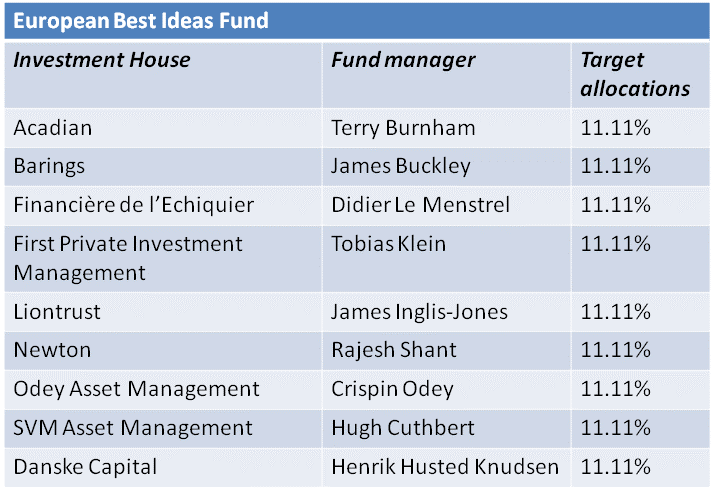
So I was interested to read about the Skandia Investment Group's Best Ideas fund range. Skandia has a fund platform and operates multi-manager funds, but the Best Ideas funds are not a standard fund of funds. Neither are they portfolios of pure hedge funds. These are portfolios of funds (mostly long-only funds) run by well-regarded portfolio managers who have been given the freedom to invest in their highest conviction investment ideas on a dedicated basis.


The lead manager on Skandia Investment Group's Best Ideas fund range, Lee Freeman-Shor, applies four key pieces of academic investment research to his selection process. These are:

1. High conviction investing: Research from Randy Cohen of the Harvard Business School, Christopher Polk and Bernhard Silli of the London School of Economics suggests that the bulk of fund manager's returns come from their highest conviction ideas. As a result the Best Ideas managers are limited to holding only ten stocks, their ten highest conviction ideas.

 2. Kelly Criterion: a formula first described in 1956 by John Larry Kelly to determine the optimal betting size to maximise wealth. Perhaps the most famous Kelly practitioner is Warren Buffet who once said: 'Why not invest your assets in the companies you really like? In 1972 Buffet had 42% of Berkshires assets in American Express. Freeman-Shor allows the managers to apply Kelly to the extent that they can invest up to 25% in a single stock.

3. High Active Share: this measures the proportion of a fund's assets that differ from the benchmark index. In their 2009 paper 'How Active is your fund manager? A new measure that predicts performance' Martijn Cremers and Anti Petajisto indicated that running a fund with a high 'active share' delivers the highest and most repeatable returns. The European Best Ideas Fund has a high active share, currently 83%.

4. Behavioural science: Research by Andrea Frazzini in 2006 showed that the best performing managers realise the highest proportion of losing trades. Freeman-Shor's job as overall portfolio manager is to be a coach and work with the Best Ideas managers to ensure they do not succumb to, amongst other things, sunken cost bias when they are losing and are thus executing their ideas appropriately.


In a good hedge fund there is a competition for capital between the investment ideas – that is, all full sized positions are conviction ideas. So the concept of high conviction investing is seen in the hedge fund world. The Kelly Criterion applies in several hedge fund strategies – event driven investing, activist investing, and to a lesser extent in global macro investing. The third piece of applied research might just say why hedge funds have inherent qualities relative to long only strategies, as 100% of many hedge fund portfolios are active bets. There are no index constraints in hedge fund portfolios, though the presence of positions held only to hedge impacts the percentage of the portfolio applied to seek alpha.

The fourth piece of academic research applied to the Skandia Best Ideas funds has a very strong resonance for me. The conclusion from Frazzini is that the best performing managers realise the highest proportion of losing trades. From my work with traders I know that this can be applied with minor tweaks in hedge funds: the best traders realise their losses either early, or in line with their stated stop-loss policies. This allows winners to run, and losers to be cut. This characteristic is also often seen in systematic approaches to markets, particularly by CTAs. With good money management it is feasible to run a successful CTA with a hit-rate (percentage of winning trades) of only 35%. The hit-rate in a discretionary money manager has to be a lot higher, and for a fundamentally driven manager with a long holding period the hit-rate can get into the high 80's as a percentage.

The fruit of the application of these concepts has been good – the Skandia European Best Ideas Fund has shown some strong out-perfromance. On the third anniversary since launch the fund was 17% ahead of the MSCI Europe index and 15% ahead of its peer group (Morningstar European Large Cap Blend), putting it in the top 5% of European funds since inception and 1st quartile over all time periods.

There are a number of hedge fund managers and managers of absolute return funds amongst the roster of managers employed by Skandia in the Best Ideas Funds. In fact I would go so far as to say that there is a disproportionate number of such managers amongst the portfolio managers used (see tables below). Would that be because hedge fund managers tend to apply the best portfolio management practices given by Skandia more than long-only managers?


Friday, 21 January 2011

Chart of the Day – Funds of Hedge Funds Flat-line in Asset Flows in North America

My Chart of the Day comes from The Eurekahedge Report which looks at 2010 hedge asset flows and investment returns. The chart compares the monthly asset flows to North American hedge funds and funds of hedge funds since the start of 2008. The contrast in flows in the recovery phase is very striking: single manager hedge funds net redemptions stopped four months earlier than net redemptions to funds of funds; and there have been net subscriptions to single manager funds in most months since April 2009, and net subscriptions to funds of funds have flat-lined over the same period.

Monthly asset flows to North American hedge funds vs North American funds of hedge funds

The North American component of the hedge fund story is very constructive at the single manager level. Not only have NAVS recovered well since the Credit Crunch but in doing so last year the Eurekahedge North American Hedge Fund Index was ahead of the S&P 500 until the last month of the year. Over the last three years North American single manager hedge funds produced annualised returns of just over 7 1/2 %, versus 5 1/2 % for the Global Eurekahedge Index. Indeed American hedge funds produced better returns than funds managed from other developed regions in each of the last three years. So American single manager hedge funds have done better in performance terms than those in other regions.

The three year annualised returns of North American funds of funds are negative according to Eurekahedge, just as the MSCI North America had negative returns over the same period (to end November 2010). Further the 3-year annualised standard deviation of returns of funds of funds is the same as that for single manager hedge funds. So that on a three year basis funds of funds have not delivered absolute returns, and the volatility of returns over that period has not been lower than single manager funds (which historically had previously always been the case). So the return-for-risk argument is weak for funds of funds relative to single manager funds in North America.

As a source of capital for the whole hedge fund industry American investing institutions have become dominant. Survey evidence shows some recovery of appetite amongst institutional investors in hedge funds – questions on investment intentions produce a net positive balance from respondents on a consistent basis since the end of 2009, with US investors more positive than investors in other regions. But the "intentions" have turned into net positive flows only for single manager hedge funds in aggregate (though around 30% of funds of hedge funds report net inflows in the second half of last year). There several plausible explanations for the contrast in flows depicted in the chart.

The gap in performance between single manager hedge funds and funds of funds may have got too wide for investing institutions to bear. Historically there were a few years, over the course of decades, in which multi-manager hedge funds out-performed single manager hedge funds. So in those years there was a (relative) pay-off for strategy allocation and avoiding the under-performers and blow-ups – which is for what investors pay funds of funds. It was commercially crucial that funds of funds did that in the key year of 2008, and they didn't, as a whole. It is now many years since funds of funds in aggregate even got near single manager returns.

Given the return records for single manager and multi-manager hedge funds the additional layer of fees in the latter cannot be justified in the minds of institutional investors. Fund of funds' management fees have been falling for more than a decade, reflecting the balance of supply and demand over that time. In contrast single manager fees have held up much better, with the exception of the immediate post Credit Crunch period. Indeed Eurekahedge record that the average management fees for single manager start-ups in 2010 was higher than for 2009's start-ups.

A third plausible explanation for the difference in asset flows to the two hedge fund sectors in North America is the increased accumulated knowledge and experience of the investing institutions there. The model seems to have shifted. For most of the last decade funds of funds were the mechanism for investing institutions to allocate to hedge funds, but a knowledge transfer has taken place. The senior staff at institutions now have a familiarity with hedge fund concepts and can interpret hedge fund data readily. Whilst funds of funds companies can demonstrate advantages in due diligence process, depth of understanding of investment strategies, and risk management and portfolio construction of funds of funds compared to the dedicated resources available to most investing institutions, the latter can now comfortably find these capabilities on an out-sourced basis. External advisors for strategic decision making and tactical monitoring of hedge funds have usurped the role of the dedicated funds of funds. The same tasks are being carried out, but maybe by a combination of a very small dedicated in-house team with input from an external advisor on a fixed fee basis. A number of funds of funds companies may be retained by investing institutions to give a plurality of opinion and form of analysis, for benchmarking, but experienced investing institutions may not feel the need to pay the old fee scales. Plus the marginal increases in allocations to hedge funds by pension plans is increasingly going to direct investing in single manager funds.

In each of these regards the North American part of the industry is in the vanguard. Most of the assets of the hedge fund industry are managed by managers in the United States. For a U.S. investor to visit (and allocate to) an American hedge fund manager is a lot easier than for a Japanese investing institution – hence there will always be a place for funds of funds for Japanese investors in hedge funds. American investing institutions are the largest contributors of capital to the hedge fund industry at the moment, and will be for some time. Given all the above - relative performance, regional strengths, fee structures etcetera - plus the fact that large, branded hedge fund groups are highly likely to be American, is it any wonder that 85% of the global flows into hedge funds are going into American single manager hedge funds? 


To see more postings on multi-manager hedge funds click on "funds of hedge funds" in the LABELS gadget on the lhs of the page.
 

Friday, 7 January 2011

Consulting One - Team Working in Hedge Funds

There is no such thing as a perfect hedge fund – we are all trying. So in my role as a consultant to hedge fund portfolio managers (PMs), I am usually carrying out remedial work in some dimension. Sometimes it can be about the positioning of hedge funds commercially, but usually it is about what the portfolio managers are doing. I'm going to write a series of articles about my consulting work – this is the first.

One of the key elements I have to investigate in my consulting work is the relationship between team members. I'm going to discuss one project I did with two joint-portfolio managers of an equity long/short hedge fund. This discussion is to raise issues and to describe ways of working. The team in this case comprised two members, PM "A" and PM "B", and they ran reasonably successful long-only products. There are three topics in this snapshot – the ground rules were not well established in this example, there were some important differences in style (personal and investment style) that got in the way of successful team working, and one of the portfolio managers had an unusual trait which had a bearing on his money management style. Finally I have included some of the solutions I gave to the portfolio managers and their boss.


Ground Rules

It is not unusual for a team to move from running long-only money together to managing a hedge fund. In doing so there will, of necessity, have to be new rules of engagement. Clarity of the decision making process is very important, for internal purposes (for accountability and reward), and for external parties like potential investors. It is important that there is agreement about the specific roles to be taken, and that there is a buy-in from the off of the structure adopted. A successful agreement or understanding will have a level of detail in it that may surprise some.

One of the most basic areas not made explicit in this case was the fund's objectives and the consequences that follow from that. The two portfolio managers did not have a common, agreed understanding of what returns would make the fund they both ran commercially attractive. Therefore they did not feel the need to measure their portfolio level risk and monitor it - where they taking too much or too little risk? They just didn't know.

Another consequence of this lack of commerciality in terms of return profile is that they had no notion of what was a the worst monthly loss they could sustain without putting themselves out of active consideration by investors. The worst monthly loss is a key metric both internally and externally. Internally the metric gives an implication of where portfolio level stops should kick in. Externally it is one of a number of measures that give investors an idea of what the whole risk profile should be like – number of winning-to-losing months, drawdown, recovery period, and what is a good and bad month for the style of investment.

One of the issues which provoked some tension in the relationship between the managers was how they split between them the sectors of the equity market they worked on. It was fine, and indeed seen commonly elsewhere, that the market was split into two – one half invested in by one portfolio manager. The tension, such as it was, arose because PM B did not want to be excluded from investing in some of the sectors covered by PM A. It was never satisfactorily covered in discussion at inception in the mind of manager B, and that oversight hung over discussions in the ensuing two or three years.

It is quite usual for a PM in a team of portfolio managers to be able to initiate positions without reference to their partners. But how the team will react to change for the positions (in size or price) does need to be covered in the ground rules. Is there any right of veto, is there a different scale of decision made when the partners don't agree? Once a position is owned is it subject to hard or soft stops – do both partners have to adhere to review and exit levels? For the fund and team under discussion one of the partners was much more engaged in challenging the positions initiated by the other partner. Whilst the partners whose positions were under discussion saw this as a personal style point (one partner was just more vocal/forthright than the other), the other partner saw such challenging discussions as part of the investment process. This difference in perception and therefore activity could easily undermine a relationship under pressure because of returns.


Differences Between the Portfolio Managers

Having had some preliminary discussions for an overview, and discussed at some length how the two portfolio managers spent their time and what structure they had in place in their investment process, some clear points of difference came through. To explore these further I conducted separate structured interviews – asking the same questions to each portfolio manager gave a chance to compare attitudes, preferences, and perceptions of the two team members. To put the following list of differences into context I quote from my written report on the managers: "The managers have fantastically complementary philosophies on the market. They get on very well on a personal basis. In fact they have worked incredibly well together with some quite significant differences in tactical approaches (strategy being broadly agreed)."


Differences in Time-Frame

PM B is more comfortable with the shorter term time-frame that running a L/S hedge fund usually requires. Specifically B is much more willing to incorporate the current implications of market action into his market view by stock than PM A.


Differences in seeing Companies and Stocks

They have a similar level of respect for each other's views on companies (specifically differentiating between stocks and companies). However, when looking at equities of companies (shares) portfolio manager B can be as dispassionate about shares as he can about companies. This is in contrast to PM A – who is still prepared to argue with markets when he likes the company, even when the share price action is saying that the market does not agree with the positive (or negative) view of the company in the short term. So the feedback loop from owning the shares – the P&L – is negative for the position and getting worse (e.g. if it is a short the shares are going up) and that message from the markets, even if it is just about short term timing of the position, is being ignored.


The Fall-back Input - is it Technical or Fundamental?

(or to put it another way "short-term or long-term" or even "stock market or real world")?

Through the structured interviews of the portfolio managers it is possible to tease out where there are differences between the team members on research time. For example, in this case PM A suggested that they needed to have 300 company meetings a year, PM B thought that 100 meetings a year with company management was enough. The different perceptions of what was needed fed through to the weighting given to the fundamentals. Or, as likely, reflected the biases the managers brought into the discussion. Under pressure PM A will rely on the fundamentals to win out, whilst PM B will listen to the message of the markets and will be prepared to cut losing positions.


Conviction or Confidence?

Operators in markets, particularly traders, but to a significant degree portfolio managers as well, bring with them the baggage from their previous life experience to their decision making. So sometimes in analysing a team it is not that there are subtle style differences so much as one of the team is coming from somewhere else attitudinally (or characteristically). There can be a one-sided difference, if you like. Portfolio manager X brings with them epsilon, whilst portfolio manager Y has acquired a trait of zeta.

Through the structured interview it came through very strongly that PM A (or the Alpha member!) had a strong conviction that the most important characteristic of a successful portfolio manager was confidence. It is true that someone operating in markets has to have the belief in themselves sufficient to take on the markets, but the very strong emphasis on confidence manifested itself in the investment process in this case. This happened in two ways.

The first expression of individual confidence, if you like an assertion of confidence of an investment view, was in position sizing. Having done the analytical work PM A would take what I would consider a large position for his initial holding in a stock. Almost by definition the stock was bound to be perceived as under-valued by the market at the point of taking the initial position. If the market further under-valued that (long) position by marking the shares down (causing a loss) this would create a "better" (cheaper) buying opportunity, so PM A would have some bias to expressing confidence in his initial view of the shares by buying more. But the more important point is the size of the initial holding – he may or may not add to the position. Portfolio manager B would take an initial position of less than half the size of that taken by PM A, and look to add to it.

The second expression of confidence was the maintenance of positions of large size. PM A would always look for a further up leg in longs he owned for fundamental medium-term reasons. PM B would have a bias to trim successful positions as the positive momentum waned (to top and tail the positions). There was clear anchoring by PM A in sticking to previously successful positions, and to cut them would, in his mind, be an expression of a lessening confidence in the initial research.


Recommendations and Suggestions to Address the Issues Raised

In this particular case I wrote a 30-odd page report to the CIO of the firm as well as presented my conclusions to the portfolio managers that ran the equity long/short hedge. In the report I made a series of tiered written proposals – key recommendations, other recommendations, and finally at a more elective level, some suggestions. In response to the issues raised above here are some of the Recommendations and Suggestions forwarded:


  • You should select what you consider to be "high potential" company meetings for both PMs to attend. This will enable higher conviction positions to be established at an earlier stage with a common background on the company.
  • Be very clear and explicit (shared between you) on the reasons for having a position in a stock. Indeed there may be five potential drivers for a stock to go up (or down), but you must be clear why you own it (are short of it). The stock position should be in a portfolio for reason of how it will contribute to the portfolio characteristics (factor bets) as much as any stock specific reason (factor). This allows you to control portfolio shape in an informed way. Drift in any one position may not matter, but when aggregated across a portfolio, factors like capitalisation effects will turn you into heroes or zeroes promptly in the hedge fund format. Own positions for a reason and stick to it.
  • You both have to have the capacity to invest in all sectors of the market.
  • You need a few mechanistic rules that you can apply to take even more of the emotion out of decision making:
  1. Automatic locking in profit/reducing exposure after a stated return. So a trading position that gives a 15% plus return in two weeks is completely sold, an investment position that gives 25%-plus return in a couple of months is halved automatically. The trading position can be bought again if it is equally attractive at some point. If the fundamentals still justify a larger position (they have improved since original position taken) then the investment position can be made larger.
  2. You need a review level and hard-stop level per position. I suggest a 10% loss on book should be a review level, and 15% is a hard stop level (sell whole position, no exceptions). As a reminder the ABC Large Cap Fund has a hard stop at 8% for non-core positions and a hard stop of 10% for core positions, and the ABC Europe Fund has 5 and 10% respectively.
  • Either can initiate a position, as at present. However there must be a vote before ADDING to a position – both PMs must agree.
  • Just as you need to know yourself to be an investor, you need to know your partner if you have joint and several decision-making, rather than having a presiding genius. Because you demonstrate some differences in personal style, there are times when you don't understand where your partner is coming from. I suggest that you complete a Myers-Briggs Model™ (Extravert, Introvert, Intuitive, Sensor, Thinker, Feeler, Judger, Perciever) questionnaire. This is particularly relevant for times of stress – we each revert to a fall-back way of operating and this is the kernel of what you need to know of each other for managing money as a team. If you understand more about where each other is coming from (not intellectually but in personal style) then you will be able to tolerate the differences more easily.

Friday, 10 December 2010

Bob Prince, Co CEO of Bridgewater, on Alpha and Beta in HF Portfolios

Bob Prince
Now, if you look back at the history of Bridgewater, for the average market that we trade, we made 1 percent return with 3 percent risk. We've had a .3 ratio for each market. Our overall ratio is about 1. The difference between these two is diversification and portfolio structuring. So, two thirds of our performance has come from balancing risks well, and only one third has come from trying to get the bets right. Of course, if you don't get the bets right, you don't have anything to balance, so you have to start there, right? Okay. So, that's point number one. You can get a lot more mileage out of risk reduction than return enhancement.


Number two is don't believe the numbers. Now, I'm going to make an assertion here. I don't know if you've ever heard this assertion before. My assertion is that correlation is unknowable. So, we talk about portfolio mean variance, about, correlation. My assertion is that correlation is unknowable. I'm talking about the correlation of any two assets – it is unknowable. Now, I'm going to try to prove that to you on a chalkboard.


So, let's just say that I have stocks and I have bonds. Okay? And the question is, what is the correlation between stocks and bonds? Well, correlation is the way that the returns co-relate. It's how the returns relate to one another. In order to understand how the returns relate to one another, you have to really understand something about what drives returns. Okay? Well, there is more than one thing typically driving the return of any one asset. Let's just say I've got economic growth here as a factor that drives the return of stocks and bonds. Now, if the economy is strong, that will be good for stocks - generally speaking if the economy is stronger than expected. If the economy is strong, it will generally be bad for bonds. But the economy's not the only thing that drives their returns. Let's say I've got inflation here as the factor that drives their returns. If inflation falls, that will generally be good for stocks. If inflation falls, that will generally be good for bonds. So, inflation is working the same direction for stocks and bonds. Economic growth is working opposite directions for stocks and bonds.

   
So, now the question is, what is going to be the correlation of stocks to bonds? I don't think you can possibly know. You can't know unless you know what kind of environment you're going to be in. Will I be in an environment that's dominated by inflation? If I am, they'll probably have a positive correlation. If I'm in an environment that's dominated by economic growth, they'll probably have a negative correlation. But if I knew what kind of environment I was going to be in, I'd just go bet on that. But if I'm trying to passively structure a portfolio that's balanced, I don't have any idea what the correlation between stocks and bonds is going to be. And what it was in the past really has no bearing on what it will be in the future. So, now what do you do? How do we do mean variance optimization when you can't possibly know the correlation of two assets?


So, what I'm saying is you can't do this. So, what we try to do is we don't pay any attention to the numbers. We never try to look at the correlation between any two assets. What we try to do is balance our exposure to economic growth and inflation. So, given the structural characteristics of assets, they will perform a certain way given a certain economic environment. And you can look across your assets and start to think about how you're balanced against the economic environment through your asset holdings.

   
The last point is that you need to understand the fundamental characteristics of the returns that you're operating with. And the most important characteristic of those returns is the derivation of the return: is the return derived from beta or from alpha? Beta means the return is derived from the risk premium embedded in the asset. Risk premiums over time will be positive in order for the capital system to function. Risk premiums will be positive over a very long period of time, but it's very easy to buy a risk premium, so it's not a really good returning source of return. It's not a very consistent source of return because it's very attractive. A lot of people buy it and they bid up the prices, maybe has a ratio of .25 return to risk ratio. So, beta is one kind of return. It's one type or category of return. There are lots of betas.


Alpha

Alpha is totally different. Alpha is a bet. I've got a view. There's timing involved. I'm long. Now I'm short. Now over time, people might make bets, but they might on average be long. Then on average they have a beta in their return, right? But ... so the question is, are you generating your return through beta or through alpha, through risk premiums or through timing of bets? Because the characteristics of those is radically different, and the ability to produce a very high return is inherently limited if you're basically holding betas because betas tend to be pretty expensive. You've only got about a .25 ratio. No matter what the historical numbers are ... don't believe the numbers. No matter what the historical numbers are, the return to risk ratio of a beta is probably not above .3. It may have an option characteristic that makes it look that way, but it's not above a .3.

   
And they tend to be very highly correlated because betas are all related to the same economic environment, so it's hard to get a lot of diversification in betas. Therefore, it's hard to get a really high ratio -- high consistent return -- from betas. On the other hand, alphas are very uncorrelated, but you never know if you're going to make or lose money because alpha is a zero sum game. So, it's entirely a bet of can you bet on and find the right manager who can take money from somebody else. And if you know ... if you think you can, you probably should ... as a test, you might want to think about who they're taking money from as a cross check on your process because somebody's got to take money from somebody else when it comes to alpha. For every winner there's got to be a loser.


Beta in Hedge Fund Returns

Now, I just want to show you a quick example of the importance of understanding the composition of beta in the returns of a manager that you might hire. One of the things that we did was that we looked at our database of 2,700 hedge fund managers - we ran the calculations for how much beta is approximately in the returns of these various managers. Well, we did that up to the beginning of the crisis in July 2007, quantified how much beta was in every single one of these 2700 managers. And then, we looked at how those managers then performed over the crisis period.


And so, what this work shows is the managers with more beta lost a lot of money, and that those with not very much beta in their portfolio up to July 2007 lost less. Hardly anybody made money. And the observations are right on the line of best fit (though you should also look at their return to risk ratio).

So, the amount of beta in a hedge fund's portfolio was something like, 96 percent correlated to what their performance has been since July 2007. So, if you just knew that one thing -- how much beta is in their portfolio -- you would have been able to identify with a 96 percent correlation how they would have done it through the financial crisis. The same thing is happening going forward because if you actually monitor this through the crisis for those managers, that beta hasn't changed. They still have that beta.

Now, so if their particular beta does well now, they are going to look good. But it's because that beta is in there. So, are you betting on the manager or are you betting on the market that they're involved in? It's absolutely crucial for you to understand that. And if you're betting on the market they're involved in, no matter what their historical ratio is, the beta ... the ratio of the beta is inherently limited, so something like .25, .3.


So if you look at what Bridgewater does, right now we're long bonds. There's risk premium there that we're earning today by being in a long bond position. But if you look back at what we've done historically, we're long half the time and we're short half the time. There's no systematic bias to be long bonds. And if you understood our process, you would know how hard we try to make sure we don't have that in there, right? So, literally indicator by indicator, market by market, we are approaching it with an expressed purpose of not having beta in our alpha. And we try hard to not let it get in there.

At any point in time, we could be long or short a market. Funds don't have to always be market neutral. But what I'm referring to is a systematic orientation toward beta. What I'm saying is that the amount of beta that was in those 2700 manager's returns was measured by a statistic, that a static holding of asset classes over many years was 80 percent correlated to their return, so that they are, over time, largely in a beta position.


Bridgewater Equity Mandates

I think the question of relative versus absolute is always trying to get at the real question of "what is value added?". And there's a lot focus on the industry on the quest for alpha, so to speak. But I think if you were to ask three people in a room of experts what the definition of alpha is, you'd probably get about four answers.


So, the real question is, what are you trying to do in getting value add other than exceed a simple passive benchmark? And, secondly, how is that going to influence people behaviorally?


That tend to lead you in a couple of directions, one in terms of more complexity -- I'll give you an example of that- our equity mandates. Our benchmark not against an overall equity index, but every security selection decision is against a sector in a country. So, you get six major countries, ten S&P sectors. So, we have something called a 60 cell matrix; you can imagine the operational complexity behind that. But every active choice is done against a very specific subsector so that the sector's taken out.


The question is, though -- and it gets back to that behavioral one -- how is that going to influence people, and can you even think intuitively about that when you're in 60 different dimensions? And so, there is something to be said for simplicity because the reality is that the very best tech fund manager in 2002 might have exceeded his peer group by 5 percent, but that meant they were only down 90 percent as opposed to 95 percent. And that's not going to solve anybody's problem.


Edited Transcript from The Greenwich Roundtable

Tuesday, 23 November 2010

Strategy Allocation in Funds of Hedge Funds - IAM as an example

International Asset Management Limited is Investment Manager for Alternative Investment Strategies Limited, a Channel Islands Listed diversified portfolio of hedge funds. Through the Channel Islands Stock Exchange some top level information is made available.

For example, the strategy allocation as at 30 September 2010 was

Long/Short Equity
30.7
Macro
18.4
Credit
11.4
Fixed Income Rel Val
10.9
Event Driven
10.3
Multi-Strategy
9.4
Trend Followers / CTAs
5.3
Cash & Receivables
3.5
Fund of Funds
0.1
Source: International Asset Management Limited

Strategy allocation at a fund of hedge funds at any one time is a function of a range of factors covering the practical and the structural:
forecast returns per strategy, fund, and underlying market;
macro factor forecasts;
correlation and variance forecasts (or at least assumptions of stability);
fund historic performance compared to peer groups and strategy index returns;
benchmark weightings, normal allocation range per strategy;
strategic biases, and tactical shifts; 
cash flows, and liquidity of the underlying funds (notice period for redemption); 
frictional costs (spread on fund dealing, forward pricing, spread on underlying securities, redemption fees, premium or discount on traded funds, commissions);
and illiquid security constraints (side pockets and side cars).

In addition managers have the subjective influences to cope with - there will be anchoring to the selections made previously, both by strategy and by manager. There are relationships with managers to maintain, and not a single hedge fund manager likes receiving redemption notices, even if they are described to the fund manager by the investor as "rebalancing" or "just trimming an overweight". One investor I know told me that when he tried to diversify away from his very large holding in Soros' Quantum Fund by recycling just some of his gains in the fund, Soros told him it was all or none. He could take it all out or leave it all in but could not limit his exposure at the margin.This is where rationality meets a business man overseeing a business, and it is not seen as constructive in any way by the latter.

Still and all, the fund of funds managers have to manage. In former times, when positive fund flows extended to funds of funds as well as single manager hedge funds, the job of strategy/fund allocation was a lot more simple. The new inflows could be directed to the currently preferred funds and those that were being de-emphasised could be diluted down without any need for redemption notices.  That all stopped in mid 2008. Since then strategy allocation in funds of funds has required (for most funds of funds for most of the time) a redemption for every subscription. Given that there was a persistence of net redemptions as a businesss background for funds of funds well into this year it has been very challenging to activelly allocate to strategies and individual hedge funds since.

One of the advantages of the Listed (funds of) hedge funds is that they are closed-ended vehicles: the capital, if not permanent capital, is there for a finite medium-to-long-term period. This does not get over the need to redeem from one fund to subscribe to another, but at least for the Listed funds of hedge funds there has not been a wall of redemptions to cope with. And if market demand allows there may be tranches of new capital raised for quoted vehicles, to mimic the positive allocation/dilution tactic of open ended funds of funds that have positive flows.

The way that International Asset Management (IAM) has used this capacity to allocate to strategies is shown in the following table.


Strategy Allocation at Quarter End through 2010

3Q
2Q
1Q
4Q’09
Long/Short Equity
30.7
27.4
38.2
35.4
Macro
18.4
17.7
16.9
17.2
Credit
11.4
9.5
9.2
8.3
Fixed Income Rel Val
10.9
11.4
8.9
8.2
Event Driven
10.3
11.9
9.5
12.1
Multi-Strategy
9.4
10.3
6.9
6.9
Trend Followers / CTAs
5.3
7.6
10.5
9.5
Cash & Receivables
3.5
4.1
-0.2
2.1
Fund of Funds
0.1
0.1
0.1
0.3


Source: International Asset Management Limited


A couple of strategy shifts are clear from this time series. In early 2010 capital was taken from Event Driven funds and allocated to Long/Short Equity. After the first quarter CTAs and Equity managers were used as sources of capital for additions to weightings in Multi-Strategy, Credit and to raise cash.


Rather like the approach to hedge fund investing taken by the Common Fund in the U.S., it seems that IAM used a core/satellite approach to portfolio construction, as the Top 10 holdings in Alternative Investment Strategies Limited has been very stable over the last year. The funds listed at the latest data point are shown below.

The Top 10 Holdings as at 30 September
Cobalt Offshore
5.82%
IAM Trading Fund
5.25
Claren Road Credit
4.87
SCP Ocean
4.86
Capula Global Relative Value
4.72
Arrowgrass International
4.71
WCG Offshore
4.66
York European Opportunities
4.64
Prologue
4.41
Diamondback
4.40
Source: International Asset Management Limited

The funds are the same as at the start of the year with only one exception (highlighted). The Top 10 funds accounted for 48.34% of the capital at the three-quarter stage.

The Top 10 Holdings of Alternative Investment Strategies Limited as at 31st December 2009
Cobalt Offshore
5.5%
SCP Ocean
4.75
IAM Trading Fund
4.74
Plainfield
4.62
York European Opportunities
4.20
Capula Global Relative Value
4.15
WCG Offshore
4.13
Claren Road Credit
4.11
Diamondback
4.06
Prologue
4.01
Source: International Asset Management Limited

There is a continual battle in reality and in marketing pitches about the relative contribution of the top-down (strategy allocation) and bottom-up (manager selection) in funds of hedge funds. The long list of practical difficulties given here shows that specifically since mid-2008 funds of funds have had less degrees of freedom in both of those regards than they had previously enjoyed, and that though there may be disappointment over the returns from funds of hedge funds over that period, there are also generic reasons why they have been as limited as they have been. There are other reasons for the under-performance relative to hedge fund indices and hedge fund averages, but they can be explored at another time.


Footnote: The net asset value performance of Alternative Investment Strategies since inception in December 1996 to 30 September 2010 is 146.84%, equivalent to an annualised rate of 6.75%.

ADDITIONAL: UBP ON STRATEGY ALLOCATION  (from their Outlook for 2011)
Larry Morgenthal, CIO of Alternative Investments at UBP Asset Management, believes that reports of the demise of hedge funds are premature. He is quite positive about the industry and believes hedge funds remain an attractive proposition: they provide diversification benefits and they have strong alpha generation potential.

With respect to the various hedge fund strategies, Larry Morgenthal goes on to say, "Allocating between hedge fund strategies is in some respects like dating - we have had a great relationship with credit, are having an affair with long-short equity and think that emerging markets could be marriage material, while macro is like an old flame - not large in the picture now but one we expect to get back together with in the future."

ADDITIONAL TWO: Send me some examples of funds of hedge funds strategy allocations (letters) and I will post a range of them here.