Showing posts with label alpha. Show all posts

Friday, 14 September 2012

Top Quotations From Battle Of The Quants

Latest four stories on Hedge Fund Insight:

Top Quotations From Battle Of The Quants London
"An edge in analysis of social media is much more feasible than in analysis of news - there are only six traders globally who are successful trading off news analysis, " Rob Passarella, DataSift.

"There is a huge leap to move from getting  interesting signals to a viable investment strategy," Leigh Drogen, Estimize. Read more >>


SEB Bias Towards RV and Macro In Outlook For Hedge Funds
The market is being driven mainly by investor risk appetite and sentiment, which in turn are driven by unpredictable political decisions. Central bank actions are also driving hedge fund returns to a growing extent, as are hopes for a new round of quantitative easing from the US Federal Reserve (the Fed) or the European Central Bank (ECB)’s potential purchases of government securities from peripheral euro zone countries. Read more >>


SVM Positioned For US Recovery To Beat Expectations
SVM portfolios are currently fully invested, recognising attractive valuations in the UK and Europe and a more encouraging outlook for global growth.  In the US, news in construction, housing and retail suggests that the worst is past. US construction and housing sectors, representing in total one-sixth of the US economy, are steadily recovering.  We believe that US recovery will beat expectations.  US banks are also much better capitalised than UK and European ones, and have largely gone through their write-offs.
Read more >>


Hedge Funds’ Performance? Volenti Non Fit Injuria
The rules on investor eligibility mean hedge fund investing “is not by any enterprised nor taken in hand unadvisedly or lightly; but reverently, discreetly, advisedly, soberly and in the fear of God, duly considering the causes for which alternatives are ordained”. The hedge fund industry has no case to answer against the recurring charges of non-performance and self-enrichment at the expense of clients. Those who invest in hedge funds willingly undertake the investment and operational risks implicit in the niche money-making schemes of the stinking rich. All of the usual criticisms, e.g. the fees, the hidden beta, the lock-ups, the illiquid holdings and the spraying of chic joints’ walls with Tattinger, are all disclosed in the offering documents and/or are writ large in the industry’s track record, which is getting on for thirty years as an investment style.
Read more >>

Friday, 26 August 2011

Chart of the Day - Extremely High Correlation of Stocks - Implications for Hedge Funds

I'm doing some work on risk measurement/management at a hedge fund management company. The investment strategy of the hedge fund is long/short equity. Most of the work revolves around measurements at the portfolio level, and the aim of measuring and controlling risk is to produce steady returns for investors. This is only possible on a sustainable basis with a diversified portfolio, unless the hit-rate is unusually high. Whilst  I have met managers with very concentrated portfolios based on very stringent selection criteria, and who have very high career hit-rates (as high as over 90% in one case), most mangers (probably more than the 80:20 rule would suggest) run portfolios diversified by stock, sector and to some extent theme.

Effective risk management is partly about being aware what has a high probability of working and when. One of the lessons of the Credit Crunch for many in hedge fund land is that there are market circumstances in which the previously assumed risk controls will not work. That is, the manager has a series of limits and stops and processes which in combination will produce the desired outcomes for most market conditions. The rub, as revealed in 2008-9, is in the conditional "most". Managers have to be aware of in what market circumstances their approach to markets will not work.

For most equity long/short managers most of the time the key decision variables at the portfolio level are about managing the net exposures to market, and specifically about managing the net beta-adjusted exposure to the market. There is a sub-set of equity managers for whom this is not true - those which have a limit on their net exposure to markets, and are structurally close to net neutral, say a band of 0-20% net long. Often the latter funds are quantitatively-driven equity long/short funds, but some discretionary managers choose to be close to net neutral. For these net-constrained funds returns have to come from stock selection to a much greater extent than funds with wider investment powers. The corollary is often a larger gross exposure to markets - consistent with the formulation of information ratios of managers. Typically, funds with a small net exposure limit target lower absolute returns, and implicitly rank risk-adjusted returns as a higher goal than absolute returns. 

The majority of managers in equity long/short try to use the additional degrees of freedom they have in balance sheet disposition to produce higher absolute returns (than a net-neutral manager) though nearly always with higher volatility of returns. The tactical shape of the fund should be a function of two things: the market regime and the opportunity set for the particular investment style of the manager. There is a considerable range of understanding amongst managers of the necessity of taking these two dimensions into account in setting the net exposure of equity hedge funds. The best managers are good at both, but the majority of equity hedge fund managers are not. Yes, the majority.

The successful shaping of the hedge fund balance sheet requires two attributes in the manager: an ability to read the market regime in multi-dimensions, and a high degree of self knowledge about the applicability (and effectiveness) of their investment processes. Around the time of the Tech Bubble the first required ability was demonstrated a lot by equity hedge fund managers. The monetary stimulus provided by Greenspan on fears of the Millennium bug was read by managers as a bull market condition green light, and most managers were very net long in 1999, and investors were gorged on the excellent returns produced. The reverse happened from March 2000 onwards. By the 3Q 2000 many equity hedge funds were net short on a tactical basis, i.e . the managers jobbed from the short side.  From 2003 to mid 2008 a net long bias and a buy-the-dips mentality were positive attributes for managers. Over the same period many new hedge fund managers joined the industry, and several big names closed down, citing the lack of shorting opportunities as a reason.

So coming into the Credit Crunch phase of 2008 only a minority of equity hedge fund managers expressed an ability to read the market regime by going net neutral or net short. A majority of managers had never been net short to that point, and many did not have that available as a choice because of their offering memoranda, or because the operational limits they gave themselves precluded it.  

Current market conditions have echoes of 2008-9: large daily declines in equity prices, volatility and rising fear gauges in the price of gold and the cost of interbank borrowing. These are difficult conditions in which to manage an equity hedge fund. Quite how difficult is in part reflected in today's chart of the day. Every manager can tell you about the level of market volatility reflected in the Vix Index. This captures the current level of volatility in the market on a traded basis. The actual volatility experienced in the market is lower than the traded level, though intra-day measured volatility can be higher than that indicated by the Vix.

All equity hedge fund managers are aware of how volatility shifts impact their style because they can see it in the daily P&L changes per position, and the same at the portfolio level, and they are aware of the Vix. Those managers who take risk measurement more seriously will be aware of the Value-at-Risk of their portfolios. The same portfolio will have a different measured risk dependent on market conditions - when markets are more volatile measured risk goes up for the same portfolio. What is less well explored is the other element that feeds into the risk measure VaR, that of correlation.

The inter-relatedness of positions has an impact on measured risk. The more related the positions the less diversification there is in a portfolio. Consequently managers structurally build diversification into their portfolios by having limits on sectors/industries/macro-related themes as well as limits to specific stock risk by constraining holding size. But correlation is not stable. Cross-sectional correlation varies through time. In up-trending markets (scenario 1) volatility drops and stocks tend to become less correlated. For sideways moving markets (scenario 2) two stocks in the same sector could quite feasibly act differently - one going up and the other staying the same price, or even falling. Scenario 1 is better for producing returns from net market exposure, and scenario 2 is a richer market opportunity for returns purely from idiosyncratic stock risk (selection).

However when markets fall for a period volatility rises and correlation increases. The correlation coefficients of stocks' betas go up - the market component of stock price changes goes up, and the sector effect increases and the idiosyncratic component of stock price changes declines. The chart of the day below illustrates that we are at an extreme for measured correlation amongst S&P500 constituents.


In such a market environment portfolio returns become a product of the net market exposure, driven by the weighted average of the portfolio betas. The extreme case illustrates the point - bank shares and commodity stocks have had the highest betas in the market for some years now. The return to the net exposure to these two sectors plausibly could have been the largest component of the return of individual equity hedge funds over the last three years. For net neutral equity hedge funds the net exposure decision on these two sectors over the last three years could have even been the decision that determined return outcomes.

For market conditions with high correlation between stocks it is just about impossible to drive returns from stock selection (idiosyncratic risk) alone. This has recently been explicitly recognised by one management team -  Ralph Jainz and Jonathan Sharpe of Ratio Asset Management wrote to their investors on closing their European equity hedge fund this month that "this year stock selection has not proved profitable." History suggests that it is difficult for diversified net neutral funds to make money when there is high correlation between stocks, and only managers who are adept at shaping the balance sheet of their hedge funds will actually make money, as opposed to defending their capital.  

Given that nowadays few managers can demonstrate an ability to read the market regime in multi-dimensions, and have a high degree of self knowledge about the applicability of their investment processes, I expect negative returns from the strategy for the current market. What is particularly disappointing is that the number of managers who can show they truly learned lessons from 2008-9, and can make money now, are so few. Maybe investors have to exhort their managers to take some off some of the net exposure restrictions - or do investors doubt that their managers have sufficient skills to handle wider investment powers?


Tuesday, 26 April 2011

Selecting the Best Managers – a natural bias to hedge fund managers?

I carried out manager research for an American fund of hedge funds for several years early last decade. Manager research and portfolio construction is a team effort so I had to find a way to put across to my colleagues the merits of the managers I followed. We use a lot of inputs to understand how managers manage capital, so in our heads each of us has a multi-faceted view of the portfolio manager and his process, but it is not feasible to put it all across to someone else. So we have to find ways to summarise and capture the essence of our take on the hedge fund manager.

In my case I used a numeric score of what I considered then, and still do now, the key drivers of performance. So I gave each manager a score between 1 and 10 for each of source of alpha and for risk management. Risk management included portfolio construction, position sizing, diversification, risk measurement, downside risk and use of stops. The source of alpha score took into consideration the added value of the specific person/people pulling the trigger, the breadth and depth of research, whether there was a unique or unusual information source being used, the sustainability of the manager's edge, how adaptable the approach was to change, and the richness of the opportunity set being addressed. A mid-ranking manager would score 6 for each, in the way I used the scales, but this was a closed marking system. No manager ever got 10 for either metric. I never gave any manager a score less than 4 for alpha or risk management in the time I carried out manager research. At the bottom end it is easy to understand why: managers setting up a hedge fund have nearly always has significant success previously in trading or investing. They are not neophytes; and though some learn on the job about managing capital in the hedge fund format, they have all managed capital before.

After a while meeting managers, and hearing how they do what they do, I realised that whilst the alpha score was important, risk management was a bigger differentiator. So getting into risk management issues early in the process saved a lot of time and effort: if a manager didn't have discipline and a consistent process in risk management it was time to move on to another hedge fund.

A legacy of this time is that I remain interested in how to assess managers – it is useful in my consultancy work, at the least. In the book I am reading at the moment – "Investing with the Grand Masters" by James Morton – I am engaged to see what criteria the author used for selection of the managers.

So I was interested to read about the Skandia Investment Group's Best Ideas fund range. Skandia has a fund platform and operates multi-manager funds, but the Best Ideas funds are not a standard fund of funds. Neither are they portfolios of pure hedge funds. These are portfolios of funds (mostly long-only funds) run by well-regarded portfolio managers who have been given the freedom to invest in their highest conviction investment ideas on a dedicated basis.


The lead manager on Skandia Investment Group's Best Ideas fund range, Lee Freeman-Shor, applies four key pieces of academic investment research to his selection process. These are:

1. High conviction investing: Research from Randy Cohen of the Harvard Business School, Christopher Polk and Bernhard Silli of the London School of Economics suggests that the bulk of fund manager's returns come from their highest conviction ideas. As a result the Best Ideas managers are limited to holding only ten stocks, their ten highest conviction ideas.

 2. Kelly Criterion: a formula first described in 1956 by John Larry Kelly to determine the optimal betting size to maximise wealth. Perhaps the most famous Kelly practitioner is Warren Buffet who once said: 'Why not invest your assets in the companies you really like? In 1972 Buffet had 42% of Berkshires assets in American Express. Freeman-Shor allows the managers to apply Kelly to the extent that they can invest up to 25% in a single stock.

3. High Active Share: this measures the proportion of a fund's assets that differ from the benchmark index. In their 2009 paper 'How Active is your fund manager? A new measure that predicts performance' Martijn Cremers and Anti Petajisto indicated that running a fund with a high 'active share' delivers the highest and most repeatable returns. The European Best Ideas Fund has a high active share, currently 83%.

4. Behavioural science: Research by Andrea Frazzini in 2006 showed that the best performing managers realise the highest proportion of losing trades. Freeman-Shor's job as overall portfolio manager is to be a coach and work with the Best Ideas managers to ensure they do not succumb to, amongst other things, sunken cost bias when they are losing and are thus executing their ideas appropriately.


In a good hedge fund there is a competition for capital between the investment ideas – that is, all full sized positions are conviction ideas. So the concept of high conviction investing is seen in the hedge fund world. The Kelly Criterion applies in several hedge fund strategies – event driven investing, activist investing, and to a lesser extent in global macro investing. The third piece of applied research might just say why hedge funds have inherent qualities relative to long only strategies, as 100% of many hedge fund portfolios are active bets. There are no index constraints in hedge fund portfolios, though the presence of positions held only to hedge impacts the percentage of the portfolio applied to seek alpha.

The fourth piece of academic research applied to the Skandia Best Ideas funds has a very strong resonance for me. The conclusion from Frazzini is that the best performing managers realise the highest proportion of losing trades. From my work with traders I know that this can be applied with minor tweaks in hedge funds: the best traders realise their losses either early, or in line with their stated stop-loss policies. This allows winners to run, and losers to be cut. This characteristic is also often seen in systematic approaches to markets, particularly by CTAs. With good money management it is feasible to run a successful CTA with a hit-rate (percentage of winning trades) of only 35%. The hit-rate in a discretionary money manager has to be a lot higher, and for a fundamentally driven manager with a long holding period the hit-rate can get into the high 80's as a percentage.

The fruit of the application of these concepts has been good – the Skandia European Best Ideas Fund has shown some strong out-perfromance. On the third anniversary since launch the fund was 17% ahead of the MSCI Europe index and 15% ahead of its peer group (Morningstar European Large Cap Blend), putting it in the top 5% of European funds since inception and 1st quartile over all time periods.

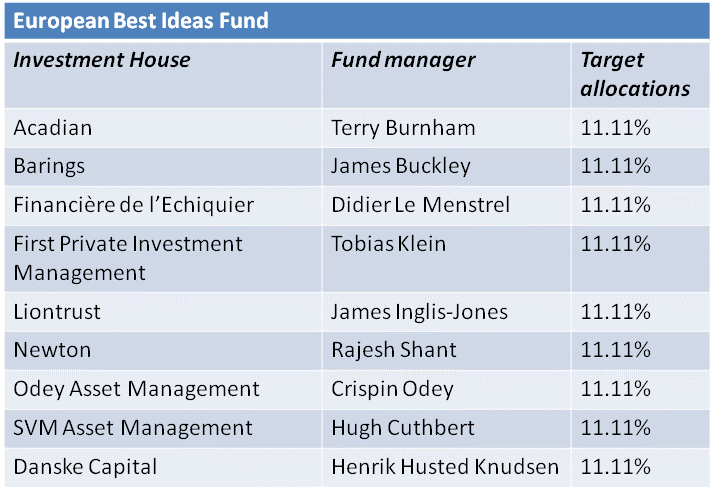
There are a number of hedge fund managers and managers of absolute return funds amongst the roster of managers employed by Skandia in the Best Ideas Funds. In fact I would go so far as to say that there is a disproportionate number of such managers amongst the portfolio managers used (see tables below). Would that be because hedge fund managers tend to apply the best portfolio management practices given by Skandia more than long-only managers?