Wednesday, 7 July 2010

Clarium Update - YTD -13.8%

Clarium's Peter Thiel (photo:Bloomberg)
In the month of June 2010, Clarium LP was down 7.7%, with 2010 year-to-date performance of -13.8% (as of June 30th; all figures are net estimates). As a fund, Clarium currently manages approximately $404m in assets, and, as a firm, total assets under management, including similarly managed accounts, are approximately $1,026m (as of July 1st, 2010).


Previous postings on Clarium:The Limits to Fundamental Conviction (25th Nov 2009)
Clarium Capital Managment's hedge fund is down 16.4 percent through November (7th Dec 2009)
Clarium Redux: Still Arguing with the Markets (11th April 2010)

China Investment Corporation…the next winner is…York Capital

China Investment Corporation (CIC), the Chinese sovereign wealth fund, currently manages $332bn andlast year invested $58bn. It  has been on accelerated path in learning about investing in hedge funds for the last three years. A source close to the CIC suggests that they are about to make their next commitment to a specific hedge fund.

The story of China Investment Corporation’s interest in alternatives can be traced back to the purchase of a USD 3 billion stake in alternative investment company Blackstone during its IPO in mid-2007. A predecessor entity to the then unformed CIC negotiated a non-voting stake with a four year lock-up. On day one of public trading this looked like a master stroke as Blackrock stock soared to $45 from the $31 (top-of-the-range) issue price. However that level has never been seen since and post-Credit Crunch the BX stock traded down to $4 and is now at just over $9.

The second leg of the advisory platform for CIC’s hedge fund program was the purchase of an interest in Morgan Stanley late in 2007. The Chinese SWF bought $5.6 billion of Morgan Stanley convertible securities with a conversion price of $48 to $57 in 2007. This was a 10% stake at the time. The CIC’s stake in MS was then diluted when, in October 2008, a major stake in the investment bank was bought by Mitsubishi UFJ. In the middle of last year CIC spent $1.2bn buying 44.7m shares of common stock in the bulge bracket investment firm to take its interest back to 9.86%.

So the CIC had two natural partners in looking to expand its investments beyond fixed interest and other additional assets. The intention from the off was to invest as much as $6bn within a year to hedge funds. The first step for CIC in investing in hedge funds was taken in July 2009 when allocations were made to the fund of hedge fund units of Blackrock and Morgan Stanley. Blackrock received an allocation of $500m to put into a portfolio of hedge funds, and Morgan Stanley some $200m.


Co-Opted Specialist Knowledge

At this point, at the start of the second half of 2009, the China Investment Corporation was utilising a knowledgeable special adviser to the chief investment officer of CIC. Felix Chee, the special advisor, had been responsible for an allocation of $1bn to hedge funds when he was working at the endowment of the University of Toronto. But this was several leagues different. The intention then and now is to build a core exposure to hedge funds for CIC with two elements – holdings in large, experienced single manager hedge funds and exposure to hedge funds via a small number of funds of hedge funds.

So having described the first funds of hedge funds exposures, what about the single manager exposures? Special advisor Chee has stated that CIC were to going to give capital to the best managers across a spectrum of investment strategies. The representatives of the Chinese SWF certainly started at the top: they invited Jim Simons of Renaissance Technologies to go to China to see if he was prepared to sell a chunk of his firm. He was not, and given his subsequent announcement that Simons will retire this year, it was only to be expected that the first single manager allocations went elsewhere. The first allocations came at the end of the 3Q last year and went to a natural extension of the fixed income investments already in place within the CIC, probably allowing some comfort that the strategies being used were ones that could be readily understood.

Unsurprisingly, the first two allocations of capital went to large, successful hedge fund management companies. The largest mandate to date has gone to a very large firm - Oaktree Capital Management is a Los Angeles based shop that manages US$76 billion in fixed-income strategies including distressed debt and high yield. The CIC has given Oaktree a $1bn mandate.

Oaktree espouses a clear investment philosophy based on six elements: the primacy of risk control (priority of preventing losses); an emphasis on consistent returns in the medium term to deliver a high batting average in the long term; Oaktree only invests in inefficient markets which may give a return to the manager’s skill and effort; specialisation of each investment portfolio is the surest route to the return targets; the investment process is entirely bottom up; the firm keep portfolios fully invested whenever attractively priced assets can be bought and do not time markets.

The second single manager hedge fund mandate granted by the China Investment Corporation was awarded at the end of last September to London’s Capula Investment Management. Reflecting the dynamism of the industry, Capula was set up only in 2005, and sold a chunk of the equity in the management company to the Petershill Fund (run by Goldman Sachs) in 2008. At the time of the capital allocation from CIC Capula ran between $3 ½ and 4 bn mostly in fixed income arbitrage. Capula presently advises on $4.6bn of assets. The returns of the main fund, Capula Global Relative Value Fund are very impressive – average annual returns of 13.3% with 88% of months positive. The volatility of the return series is only just under 3.5% and there has been no correlation to traded equity markets.


In-House Specialist Knowledge

After the first single manager hedge fund investments in the third quarter of 2009, the next significant development in the hedge fund activities of CIC came at the end of the year when there was an appointment to run the hedge fund investments on a permanent basis. Bill Lu, was born and educated in China, but received his post graduate education in the United States, and went on to manage the relationships in China of Paul Tudor Jones’ Tudor Investments. His background as a portfolio manager at Tudor, and experience at both end of the Sino-American axis make his credentials clear.

Lu is responsible for CIC’s investments in hedge funds and investments in securities which reflect hedge fund exposures in public markets. It is thought that after a couple of quarters bedding in, the first of Bill Lu’s major decisions is about to become publicly visible as the next single manager hedge fund mandate from CIC is made known.

The market scuttlebutt suggests that CIC will allocate capital to New York’s York Capital, an organisation running nearly $14bn in event driven strategies. James Dinan’s firm is known for using a catalyst-driven, fundamental value approach, which it applies to US, European and Asian developed market securities, including taking credit risk. Whilst the size of the allocation has not been confirmed, an allocation of $500bn would be proportionate to the other hedge fund investments of China Investment Corporation.


Two Additions from AR Magazine: 1) York Capital Ranked Number One Among Top 50 by Investors 
2)York explains May losses

RANKED Number 1 in 2010
AR Magazine carries out an annual poll in which investors score hedge funds by various criteria. In 2010 York Capital Management came top, moving up from 10th place last year. Here is what the citation says:

"York Capital, with $11.35 billion, edged $50.9 billion Bridgewater Associates out of the lead, scoring 52.63 points out of a possible 60 and jumping nine notches from its tenth-place ranking in last year's survey. "I think the world of York's founder [Jamie Dinan] in terms of his ability and his integrity, and needless to say, I am impressed with his performance," says Richard Galanti, chief financial officer of Costco, who has been an investor in York since its inception. Adds another institutional investor in the firm: "They were very bearish at the end of '08, but then they were very adaptable when they realized that things had changed in '09... when they realized equities weren't going to be as bad as they thought, they were able to make that adjustment and to make something off of it, which is very admirable."


Investors say their main concern now with hedge fund generally is performance, as evidenced by alpha generation jumping into second place of the six factors that investors took into consideration when scoring the top 50 firms in the AR Billion Dollar Club for the report card. York, which did not restrict redemptions during 2008—which investors appear to remember—also ranked high in transparency and liquidity, two of the other six factors. Investors rated firms on alignment of interests, alpha generation, independent oversight, infrastructure, transparency and liquidity terms, scoring firms in each of those categories on a scale from 1 to 10, for the possible total of 60.

MAY LOSSES
York Capital Management’s investments in General Motors, Alcon and Xerox contributed to the York Select Fund’s negative May performance, according to a recent investor letter. The $1.2 billion fund’s private equity position in Chrysler, meanwhile, produced positive returns. York Select, a concentrated event-driven strategy, dropped 5.70% in May, but remains up 1.23% for the year.


"In May, the equity and credit markets dramatically shifted their focus from corporate earnings growth to the unfolding European fiscal crisis and the potential impact on the global recovery,” read the letter. “These macro economic concerns triggered significant market selling and investor de-risking activities overshadowing positive company-specific developments.”

York manages $13.8 billion firmwide. Chief investment officer Daniel Schwartz and partner Michael Weinberger co-manage York Select in New York.

York Select is a more concentrated version of the firm’s flagship $4.3 billion multistrategy and diversified event-driven fund, York Capital Management, which fell 4.9% in May leaving it up 3 basis points for the year. In 2009, York Select gained 82.59%, following a loss of 44.91% in 2008. Most of the Select fund’s investors are wealthy individuals and family offices. The fund is not open to institutions given its concentrated positions and high volatility.

In May, the majority of the York Select fund was heavily invested in financials (37.5% of the portfolio), materials (28%), and healthcare (14.6%).

York Select’s position in General Motors contributed to a month in the red. “Our bonds in General Motors produced losses on concerns about the sustainability of the economic recovery following the events in Europe,” the letter read.

Another losing position was the fund’s investment in eye-care company Alcon. In January, Nestlé agreed to sell its remaining interest of 156,076,263 shares of Alcon to healthcare company Novartis. But the remaining shares of Alcon have declined recently due to Novartis’ shares trading poorly and the Swiss Franc’s fall against the U.S. dollar, the letter said. York believes that Novartis will need to increase its offer in order to encourage the minority Alcon shareholders to tender their shares, given that Novartis’ offer to Nestlé is higher than the stock consideration offered to Alcon shareholders.

York’s stake in European polyethylene-maker Lyondell Chemical Company also dipped due to the general market weakness in European equities. Prior gains in Xerox likewise evaporated in the May maelstrom.
Positive positions came from the Select fund’s private equity investment in Chrysler. “After the U.S. government stake was bought out, [it] resulted in increased investor interest."

York remains concerned about the European sovereign debt situation and its effect on the global economy. “We are focused on identifying the compelling opportunities that market dislocations often offer our strategies."

All of York's funds were negative in May; The $3.4 billion York Credit Opportunities Fund dropped 4.80%; the $260 million York Global Value Partners fund fell 6.20%; the $2.3 billion York European Opportunities Fund fell 2%; the $420 million York European Focus Fund was down 3.50%; the $210 million York Asian Opportunities Fund dropped 5.70% and the York Total Return fund, the firm’s fund of funds that invests across all of its funds, was down 4.60%.

Most of York’s funds remain positive for the year. The Credit fund was up 4.48%, Global Value was up 65 basis points, European was up 5.18%, European Focus was up 3.67%, and Total Return was up 2.39%. The only fund in the red for the year is the Asian fund, with a loss of 1.07%.

Wednesday, 30 June 2010

Hedge fund tax drain from UK - it was not just an empty threat

From today's "CityAM" newspaper:

"ALAN Howard, the hedge fund entrepreneur and Conservative Party donor, has quit the country to live and work in Switzerland. The co-founder of Brevan Howard Asset Management, one of Europe’s largest hedge funds, joins two other fund managers in the company’s Geneva office as part of a bigger exodus out of the City.

The firm acquired offices in Switzerland with capacity for 40 employees in February. It has said previously it has no plans to move its entire London operations elsewhere. The hedge fund’s listed company BH Macro said in a statement to the stock exchange that Howard “continues in his role as the principal risk taker” for company investments.

Howard has a personal fortune of £875m, according to The Sunday Times, and already owns a home in Switzerland.

BlueCrest, another hedge fund, expects as many as 70 of its 350 staff to be based in Geneva by next year. Chief executive Michael Platt said in April: "The establishment of the Geneva office...will enhance the group's ability to recruit and retain the best talent in our industry.”"


It will not necessarily be possible to generalise from this example and say that the exodus of hedge fund managers from London willl become a major trend for several reasons. Just take Alan Howard to begin with.

He may or may not be worth £875m, but whatever his net worth it runs into hundreds of millions of pounds.  Howard has the largest stake in Europe's largest hedge fund group. So changes to the capital gains tax regime in the UK may have a significant impact on his retaining his existing wealth.

The number of managers generating as much wealth through income each tax year is very limited. So Alan Howard is atypical for the sheer size of his annual earnings. The Brevan Howard main man is also an extreme example in part because he has made money each year. Many managers have not had to pay much tax at all on earnings in 2008, as they received only management fees and not performance fees. Although the majority of managers are through their high water marks by now, most of them have not moved their NAVs significantly on from that break-even level for profits. So they have limited incentive to move now.

A third element to point out is that Alan Howard has the distinct advantage of having a house in  Switzerland, indicating a degree of comfort and familiarity with living in the country. These advantages will not be available and be felt by many other hedge fund managers.


Addition of 2nd August
Alan Howard is to be joined in Switzerland by a former colleague. Jean-Philippe Blochet was a fellow founder of Brevan Howard and now works for Moore Capital Management. Blochet is to move to the new Zurich office of Moore Capital where he will work alongside Kornelius Klobuchar, who has also relocated from London. According to Bloomberg the firm is expected to hire further staff, and to move additional London-based personnel.

Griffin Capital Management, which moved its main investment office to Gibraltar from London, opened an office in Zurich in May this year. 

Wednesday, 16 June 2010

After An Unusual Month

Listening to Hugh Willis of BlueBay Asset Management on a conference call on Monday I was struck that twice he mentioned that May was a very unusual month in markets. Indeed it was; and in equity markets it resulted in losses of 8% (SPX) to 10% (MSCI Emerging Markets). Willis noted that such monthly losses had occurred only 5 or 6 times in his career.


So how infrequent are such losses? To find out I looked at the S&P over the last three decades. There were 34 months for which the monthly loss was 5% or greater. Below is table showing all these losing months.

Monthly Losses of 5% or More on the S&P500 Index from 1980 and Onwards


(Note that the great bull market started in August 1982)

A few observations:


• There is increased clustering through time and far more observations of big losses in the neutral decade of the Noughties compared to the bull decades of the ‘80s and ‘90s.


• The frequency of subsequent 1 month positive returns was lower post-2000 than in the great bull market.


• For longer holding periods after a fall of 5% or more in stocks in a single month the outcomes have been distinctly worse in the Noughties than in the bull market decades. Holding stocks for a month or up to a couple of quarters after a 5% fall in stocks would tend to make you money in the ‘80s and ‘90s and lose you money in the last ten years or so.


• As a mechanistic strategy, buying for a month after a 5% fall in markets would have cost you money in the Noughties.


• As a mechanistic strategy, buying stocks after a monthly 5% fall in markets and holding for a quarter or two quarters would have cost you money in the Noughties, and made a ton of money in the ‘80s and ‘90s.

Tuesday, 8 June 2010

April saw Outflows - Negative Data Revisions Caused by Funds of Funds?

A month ago when I reported on industry fund flows I wrote:

"The flows at the industry level are unlikely to pick up in the next few months given the gyrations in the markets for traditional assets. Collective memory of falling markets is still strong at this point, only just over a year on from the market lows. The level of traded equity volatility has doubled in the last few weeks, and price levels in FX, commodities, equities and bonds have shifted quickly enough that the perceptions are that the markets are trading more emotionally. This is not the background against which most institutional investors can devote senior management time to making active decisions about allocations to hedge fund strategies, and still less about allocations to individual hedge fund managers."

My expectations were met in April, as TrimTabs Investment Research and BarclayHedge reported that the hedge fund industry posted an estimated outflow of $3.5bn in that month.  


Industry Level Net Flows Per Month


Inflows in November 2009     $18.7bn
Inflows in December 2009      -$3.8bn
Inflows in January 2010           $7.1bn
Inflows in February 2010        $16.6bn
Inflows in March 2010             $7.6bn
Inflows in April 2010              -$3.5bn

Source: TrimTabs Investment Research and BarclayHedge

TrimTabs and Barclayhedge also reported that the April flows "were the third outflow in five months". This was not how the flows data were reported month by month - the table above gives the flows as originally reported in each month, and April was the first negative flow of the year for the industry. This suggests that  the early estimates of (positive) flows were not backed up by the subsequent data reported to databases.

All hedge fund databases get a similar experience - the early reporting funds are usually those with better numbers to report. Also funds of hedge funds report to databases with a lag to single managers. The negative flows could be concentrated in the multi-manager hedge funds, which would be consistent with barely a month of positive inflows to funds of funds (in aggregate) since the middle of 2008.

So positive flows, such as there have been, have been concentrated in single manager hedge funds, and funds of hedge funds as a whole continue to have difficulty attracting net new assets.

Monday, 7 June 2010

Hedge Fund Takeovers - Martin Currie and Schroders Acquire

One of the themes I have written about for 2010 is that of M&A in the hedge fund business. The latest example is that of Martin Currie, the Scotland-based manager, taking over the Sofaer Capital European long/short equity business. So this deal is not for the whole of Sofaer's hedge fund business, just the European equity part of it, and no price details have been disclosed.

Citywire report that Martin Currie Investment Management has agreed to acquire the $280 million (£190.6 million) Sofaer Capital European long/short equity business as of July 1.

The two principals in charge of the fund, Michael Browne and Steve Frost, will move to Martin Currie and continue to run the $140 million vehicle. The pair has worked together on European equities for more than 20 years and began to co-manage the Sofaer Capital European hedge fund, which has delivered an annualised return of 8% versus -0.6% by the MSCI European benchmark, in January 2001.

Addidtion:
Subsequent to this posting Schroders has acquired a 49% interest in RWC Partners, a London-based hedge fund management firm. At the date of completion of the transaction, RWC had gross business assets of approximately £10 million and its total assets under management are just over €2 billion.

There are a couple of points of interest in this. Schroders acquired a minority, and have no formal agreement in place to acquire the balance of RWC Partners. This suggests that the sellers were negociating from a strong position.

The other point of interest is that the two fund managers of Schroders Income Fund (the top performing income over 3 years) who recently resigned from Schroder Investment Management were to join RWC in August! The managers concerned, Nick Purves and Ian Lance, were given the opportunity to veto the deal between RWC and Schroders, but declined to do so.  

The momentum at RWC has been maintained by the addition of a team to run absolute return and currency funds - Peter Allwright and Stuart Frost will join from Threadneedle, where they ran the £2bn Threadneedle Absolute Return Fund. The pair have experience running global and European bond funds, so it is natural to expect more bond products to follow.

Wednesday, 2 June 2010

Rough May and YTD for Domestic Equity Hedge Funds

Equity markets have been a switchback this year – a series of rises and troughs like a sinewave. The markets had a normal interim correction after a good start to January. The correction took equity markets down nearly 10% at the low in early February, and then we had a rally of above-average strength – a gain of nearly 17% in two-and-a-half months.


The Euro and commodity inspired fall since the start of May has been very aggressive to the downside. As is typically seen, volatility has risen with falling prices from as low as 5% on 10 day basis to over 30% currently. Share prices fell 8.2% in the calendar month.


At the aggregate level, looking at hedge fund indices as a proxy, and for equity hedge funds as a whole, the equity market background has been perfect to trap equity hedge fund managers. Hedgies tend to manage their balance sheet (net and gross) on the feedback their P&L gives them about their current positioning. As the P&L gets more positive the net fund exposure bias tends to be reinforced the same way, and vice versa.


Of course, some managers are skilled market-timers and they will add value for their investors by raising and cutting the net exposure to markets around turning points, or adding aggressively to exposures in trending markets. But such market timers are a rarity, and as there are over four thousand equity hedge funds in the United States it is fair to say that the typical hedge fund manager there will not have enjoyed this year’s markets because of the directional changes.

Hedge Fund Research of Chicago tracks equity hedge fund returns of domestic (US based managers) via a daily-priced investible hedge fund index. The HFRX Index for Equity Hedge Funds was up 1.29% from the end of 2009 to the end of April, compared to the S&P500 up 6.4% (ex dividends). So far so dull.


But May was extremely difficult for equity hedge funds on the back of rising net exposures – created because of a trending market from mid-February to mid-April. The HFRX Index for Equity Hedge Funds lost 3.4% in May, putting the year-to-date return at the hedge fund index level at minus 2.1%.


This is the index level return, around which there will be a particularly wide dispersion of performance delivered from individual hedge funds. So expect May 2010 returns from equity hedge dedicated to US markets to be anything from +2% to -7%. Emerging market equity hedge funds and those in Asia will have done worse than -3.4% on average in May. Ouch..

Friday, 28 May 2010

Growth in Absolute Return Products Reflects Some Retail Interest in Hedge Fund Strategies

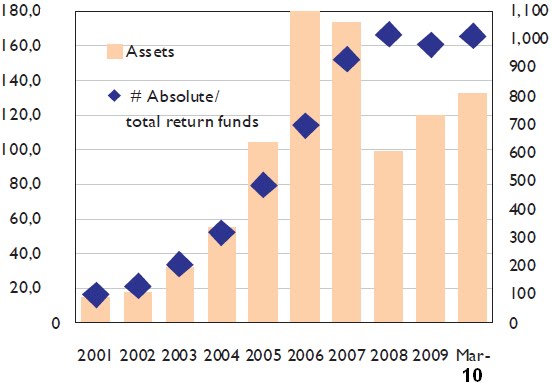
There is further evidence this week that absolute return funds are finding increasing acceptance. Lipper has written about sales of the products (in combination with total return funds) in the first quarter, and the trends suggest some good growth.  


Assets Under Management (in €bns. lhs) and Numbers of Absolute Return
and Total Return Funds (rhs)

In the first quarter, they attracted net inflows of €9.7bn compared to €11bn during the whole of last year. According to Lipper, for investors, the attraction of the funds has been boosted by a combination of low interest rates, economic uncertainty and stock market volatility. “Among product providers, hedge fund managers see absolute return funds as an opportunity to move into the mainstream mutual fund market, though figures show that the most successful funds are from fund managers with a foot in both camps,” states Lipper.

As a group absolute return funds aim to achieve positive returns in all market conditions, but they can have different types of exposure in order to achieve it. They invest through a variety of investment strategies in domestic equity or bond markets, or sectors such as commodities, while others have a global spread and hold a broad range of assets. It is particularly noteworthy that absolute return bond funds sold particularly well during the first quarter as investors sought out higher yields. Indeed seven of the best-selling absolute return funds in the first quarter were bond funds.


The popularity of bond absolute return funds suggests that these are retail and/or distributor/advisor products. The top selling products were from, in order, Standard Life, Julius Baer, UBI Pramerica, JPMorgan, Schroder, and in aggregate the largest asset managers in absolute return and total return funds are shown in the table below:

Top Five Groups by Assets in Absolute Return/ Total Return Products
as at End March 2010


The names that have cropped up each have strong branding, and excellent distribution capability, providing supporting evidence that these are retail products rather than products that are invested in by institutions. This point is reinforced by the fact that the UK and Italy together make up 40% of the sales by end market – territories with strong IFA and bank networks for distribution, respectively.

Some absolute return funds are described as Newcits, principally those launched by hedge fund managers. Lipper suggest that more than half of European hedge fund managers have launched, or are planning to launch a Newcits product. Given that the market is for retail products, the sales represent a new end-market for hedge fund groups and therefore represent incremental business. The power of branding in retail channels would itself reinforce the concentration in the hedge fund business – the bigger funds taking an increasing share of the industry through time.

Wednesday, 26 May 2010

One Step Beyond for Lipper on Hedge Funds

We are well used to output from Thomson Reuters reporting on factual stories on the hedge fund industry. Through the Lipper subsidiary they are going a step further. Up to this point Global Head of Hedge Fund Research Aureliano Gentilini has published research looking backwards. He has gone from exhaustive analysis on dispersions of hedge fund returns and returns by strategy to something altogether less certain – forecasting.

What he has produced is the kind of output you see from funds of funds managers as they describe the macro environment and how it may suit/hurt the returns from the various hedge fund strategies.

Here are some edited extracts from Lipper Hedge Funds Insight Report, “Hedge Funds Outlook”, May 2010

Selected hedge fund strategies are expected to successfully navigate current market turmoil as the risk/return profile of hedge fund managers remains intact

􀁠 The global macro-scenario, macro-information flow arrival, and volatility clustering are expected to continue dominating market sentiment in the short run.

􀁠 In the current trading environment macro and systematic traders are expected to benefit the most from trading across diverse asset classes.

􀁠 Looking at the recent past, historical patterns occurring in 2007 might materialize again. Several macro-driven "crowded trades" are about to appear again in hedge portfolios.

􀁠 Concerns about absorption of new government bond issuance of PIIGS countries and low bid-to-cover ratios at government debt auctions will affect the intermediate-to-long sector of the yield curve in those countries.

􀁠 The Dedicated Short-Bias strategy will be a bright spot as market fears resume. The ten-day exponential moving average of the CBOE Equity Put/Call Ratio—a gauge of the sentiment of speculative traders, which hit a multi-year record low of 0.472 on April 15—appears to be close to a reversal to the downside.

􀁠 FX strategies will continue offering attractive opportunities to lock in profits in the short term. Of interest is the change in positioning that large speculators executed in the euro foreign exchange futures markets in the week ending May 18.

􀁠 In the current market scenario gold and the U.S. dollar are expected to again trend higher in tandem, with the precious metal trending to record highs after a temporary pause.

Monday, 24 May 2010

Chart of The Week - Increasing Significance of Chinese Growth

I haven’t posted a chart of the week for some months. It has to be very telling; it has to be important.

This graphic qualifies on both counts:


Monthly change since January in real retail sales (in January 2007, US$ bn)


Source: Goldman Sachs Global ECS Research


What does it show? Over the period of the recent downturn in global economies, the loss of US real retail sales through recession was about the same in absolute Dollars as the gain in retail sales in absolute Dollars in China.


If ever there was a way of capturing the increased global significance of Chinese economic growth this is it. Chinese growth is so large that it rivals in absolute dollars the significance of the United States in changes in marginal contributions to real global growth, at least as far as the consumer is concerned.


Of course we already had on board that China’s growth in commodity consumption can overwhelm the significance of that of the rest of the world. But it is not just through industrialisation that China is making it’s impact.