Showing posts with label absolute return funds. Show all posts

Tuesday, 26 April 2011

Selecting the Best Managers – a natural bias to hedge fund managers?

I carried out manager research for an American fund of hedge funds for several years early last decade. Manager research and portfolio construction is a team effort so I had to find a way to put across to my colleagues the merits of the managers I followed. We use a lot of inputs to understand how managers manage capital, so in our heads each of us has a multi-faceted view of the portfolio manager and his process, but it is not feasible to put it all across to someone else. So we have to find ways to summarise and capture the essence of our take on the hedge fund manager.

In my case I used a numeric score of what I considered then, and still do now, the key drivers of performance. So I gave each manager a score between 1 and 10 for each of source of alpha and for risk management. Risk management included portfolio construction, position sizing, diversification, risk measurement, downside risk and use of stops. The source of alpha score took into consideration the added value of the specific person/people pulling the trigger, the breadth and depth of research, whether there was a unique or unusual information source being used, the sustainability of the manager's edge, how adaptable the approach was to change, and the richness of the opportunity set being addressed. A mid-ranking manager would score 6 for each, in the way I used the scales, but this was a closed marking system. No manager ever got 10 for either metric. I never gave any manager a score less than 4 for alpha or risk management in the time I carried out manager research. At the bottom end it is easy to understand why: managers setting up a hedge fund have nearly always has significant success previously in trading or investing. They are not neophytes; and though some learn on the job about managing capital in the hedge fund format, they have all managed capital before.

After a while meeting managers, and hearing how they do what they do, I realised that whilst the alpha score was important, risk management was a bigger differentiator. So getting into risk management issues early in the process saved a lot of time and effort: if a manager didn't have discipline and a consistent process in risk management it was time to move on to another hedge fund.

A legacy of this time is that I remain interested in how to assess managers – it is useful in my consultancy work, at the least. In the book I am reading at the moment – "Investing with the Grand Masters" by James Morton – I am engaged to see what criteria the author used for selection of the managers.

So I was interested to read about the Skandia Investment Group's Best Ideas fund range. Skandia has a fund platform and operates multi-manager funds, but the Best Ideas funds are not a standard fund of funds. Neither are they portfolios of pure hedge funds. These are portfolios of funds (mostly long-only funds) run by well-regarded portfolio managers who have been given the freedom to invest in their highest conviction investment ideas on a dedicated basis.


The lead manager on Skandia Investment Group's Best Ideas fund range, Lee Freeman-Shor, applies four key pieces of academic investment research to his selection process. These are:

1. High conviction investing: Research from Randy Cohen of the Harvard Business School, Christopher Polk and Bernhard Silli of the London School of Economics suggests that the bulk of fund manager's returns come from their highest conviction ideas. As a result the Best Ideas managers are limited to holding only ten stocks, their ten highest conviction ideas.

 2. Kelly Criterion: a formula first described in 1956 by John Larry Kelly to determine the optimal betting size to maximise wealth. Perhaps the most famous Kelly practitioner is Warren Buffet who once said: 'Why not invest your assets in the companies you really like? In 1972 Buffet had 42% of Berkshires assets in American Express. Freeman-Shor allows the managers to apply Kelly to the extent that they can invest up to 25% in a single stock.

3. High Active Share: this measures the proportion of a fund's assets that differ from the benchmark index. In their 2009 paper 'How Active is your fund manager? A new measure that predicts performance' Martijn Cremers and Anti Petajisto indicated that running a fund with a high 'active share' delivers the highest and most repeatable returns. The European Best Ideas Fund has a high active share, currently 83%.

4. Behavioural science: Research by Andrea Frazzini in 2006 showed that the best performing managers realise the highest proportion of losing trades. Freeman-Shor's job as overall portfolio manager is to be a coach and work with the Best Ideas managers to ensure they do not succumb to, amongst other things, sunken cost bias when they are losing and are thus executing their ideas appropriately.


In a good hedge fund there is a competition for capital between the investment ideas – that is, all full sized positions are conviction ideas. So the concept of high conviction investing is seen in the hedge fund world. The Kelly Criterion applies in several hedge fund strategies – event driven investing, activist investing, and to a lesser extent in global macro investing. The third piece of applied research might just say why hedge funds have inherent qualities relative to long only strategies, as 100% of many hedge fund portfolios are active bets. There are no index constraints in hedge fund portfolios, though the presence of positions held only to hedge impacts the percentage of the portfolio applied to seek alpha.

The fourth piece of academic research applied to the Skandia Best Ideas funds has a very strong resonance for me. The conclusion from Frazzini is that the best performing managers realise the highest proportion of losing trades. From my work with traders I know that this can be applied with minor tweaks in hedge funds: the best traders realise their losses either early, or in line with their stated stop-loss policies. This allows winners to run, and losers to be cut. This characteristic is also often seen in systematic approaches to markets, particularly by CTAs. With good money management it is feasible to run a successful CTA with a hit-rate (percentage of winning trades) of only 35%. The hit-rate in a discretionary money manager has to be a lot higher, and for a fundamentally driven manager with a long holding period the hit-rate can get into the high 80's as a percentage.

The fruit of the application of these concepts has been good – the Skandia European Best Ideas Fund has shown some strong out-perfromance. On the third anniversary since launch the fund was 17% ahead of the MSCI Europe index and 15% ahead of its peer group (Morningstar European Large Cap Blend), putting it in the top 5% of European funds since inception and 1st quartile over all time periods.

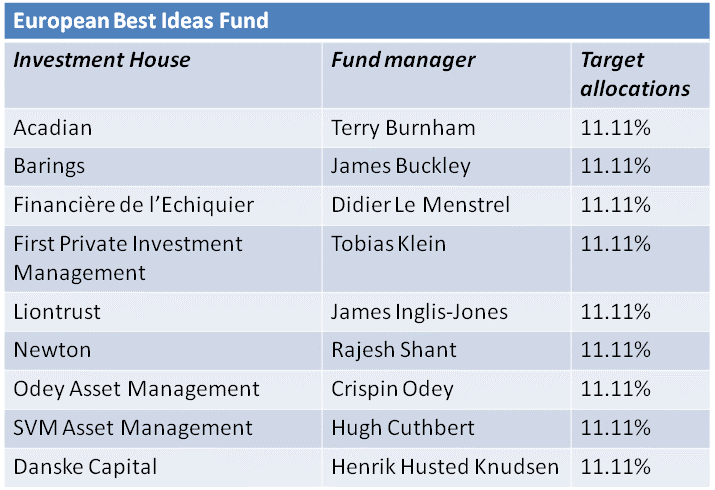
There are a number of hedge fund managers and managers of absolute return funds amongst the roster of managers employed by Skandia in the Best Ideas Funds. In fact I would go so far as to say that there is a disproportionate number of such managers amongst the portfolio managers used (see tables below). Would that be because hedge fund managers tend to apply the best portfolio management practices given by Skandia more than long-only managers?



Friday, 28 May 2010

Growth in Absolute Return Products Reflects Some Retail Interest in Hedge Fund Strategies

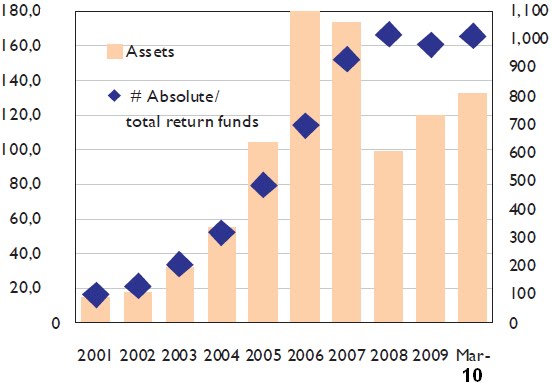
There is further evidence this week that absolute return funds are finding increasing acceptance. Lipper has written about sales of the products (in combination with total return funds) in the first quarter, and the trends suggest some good growth.  


Assets Under Management (in €bns. lhs) and Numbers of Absolute Return
and Total Return Funds (rhs)

In the first quarter, they attracted net inflows of €9.7bn compared to €11bn during the whole of last year. According to Lipper, for investors, the attraction of the funds has been boosted by a combination of low interest rates, economic uncertainty and stock market volatility. “Among product providers, hedge fund managers see absolute return funds as an opportunity to move into the mainstream mutual fund market, though figures show that the most successful funds are from fund managers with a foot in both camps,” states Lipper.

As a group absolute return funds aim to achieve positive returns in all market conditions, but they can have different types of exposure in order to achieve it. They invest through a variety of investment strategies in domestic equity or bond markets, or sectors such as commodities, while others have a global spread and hold a broad range of assets. It is particularly noteworthy that absolute return bond funds sold particularly well during the first quarter as investors sought out higher yields. Indeed seven of the best-selling absolute return funds in the first quarter were bond funds.


The popularity of bond absolute return funds suggests that these are retail and/or distributor/advisor products. The top selling products were from, in order, Standard Life, Julius Baer, UBI Pramerica, JPMorgan, Schroder, and in aggregate the largest asset managers in absolute return and total return funds are shown in the table below:

Top Five Groups by Assets in Absolute Return/ Total Return Products
as at End March 2010


The names that have cropped up each have strong branding, and excellent distribution capability, providing supporting evidence that these are retail products rather than products that are invested in by institutions. This point is reinforced by the fact that the UK and Italy together make up 40% of the sales by end market – territories with strong IFA and bank networks for distribution, respectively.

Some absolute return funds are described as Newcits, principally those launched by hedge fund managers. Lipper suggest that more than half of European hedge fund managers have launched, or are planning to launch a Newcits product. Given that the market is for retail products, the sales represent a new end-market for hedge fund groups and therefore represent incremental business. The power of branding in retail channels would itself reinforce the concentration in the hedge fund business – the bigger funds taking an increasing share of the industry through time.

Tuesday, 9 March 2010

Gartmore Results for 2009 - Absolute Return Products Attract Capital

Gartmore's hedge fund range is well known, and indeed well-regarded as a whole. The reasons for that are evident from the table below which shows performance :


Note:Data is based on published NAV returns. Returns denominated in currency of the primary share class.


(1) AUM is net of performance fees accrued


(2)Annualised returns net of fees and commissions with dividends re-invested to December 2009
 
What is also interesting in the Gartmore results for 2009 is the growth in Absolute Return Funds


From a corporate perspective that 11 out of 14 hedge funds produced positive returns in 2009 bodes well, and that the funds in negative teritory for the year are the smaller ones also helps. 
 
Gartmore categorises absolute return funds as part of their mutual fund range. In 2009 the absolute return funds drew in £903m net, and the positive flows continued into 2010. In the first two months of this year Gartmore's absolute return funds had net inflows of £195m, and the company has launched two new absolute return funds in 2010. From a recent beginning the absolute return funds are now 5% of the firm's AUM, and importantly for cash flow, the absolute retun funds crystalise their perfromance fees quarterly. Last year absolute return fund contributed 10% of the firm's performance fees. Quite useful those absolute return funds, eh?

Wednesday, 2 December 2009

Podcast 2- A Discussion with UK Equity Portfolio Manager Nick Shenton at Polar Capital

Click on the links to download or play the sound files (embedded player available).

Part 1 (7 minutes 51 seconds)

0.30 Joining Phil Hardy at Polar Capital

1.50 Idea generation

4.40 What Phil Hardy brings to the process of stock selection

5.15 Harder to find shorts now

6.30 Shorts can work faster than longs


Part 2 (10 minutes 50 seconds)

0.25 Websites look at daily

1.35 Websites useful for company insight

2.58 Segro as an example

4.50 Recent investment book reading- Niall Ferguson, "The Greatest Trade Ever"

8.37 Risk/Reward for UK equity trades

9.05 Two other influential books - "Soros on Soros" and "Inside the House of Money"


With thanks to Nick Shenton CFA who works on UK equity hedge fund and absolute return products with Polar Capital Director Philip Hardy


The Greatest Trade Ever

By Gregory Zuckerman
Reviewed by Alexandra Scaggs from www.smartmoney.com

Ever wonder how a single trade can create a legend? Gregory Zuckerman outlines how just such a thing happened with John Paulson and the rest of the characters who profited wildly from the collapse of the real estate bubble."

In The Greatest Trade Ever," Zuckerman, who writes The Wall Street Journal’s "Heard on the Street" column, focuses as much on the personalities and characters of the investors as on the bubble and collapse that increased their wealth exponentially.

Players here include Paulson, whom Zuckerman characterizes as a reformed playboy and true skeptic; Paolo Pellegrini, a Wall Street outsider who went to Paulson for his last shot at a career; Jeffrey Greene, the Hollywood version of a big-shot investor; and Andrew Lahde, the young West-Coast investor who cashed out and left finance for good.

The book addresses how deals are made and how personality counts just as much as the financial mechanics behind the trade, which may be why Paulson has come out with a statement saying he is “disappointed” with the book. But Zuckerman shows that in finance, office politics can matter as much as smarts.

Tuesday, 24 November 2009

Apologies to Polar Capital

In a recent post ("Lack of Transparency Traduced") I mentioned that on-shore products would do well to follow the example of hedge funds in regard to communications with investors. UCITS III funds are the new vehicles for fully regulated absolute return funds from asset management companies, and as an example of incomplete communication I mentioned an absolute return product from Polar Capital, having seen a monthly newsletter.

I had not appreciated that I was in receipt of an edited version of more full monthly letter. So my apologies to the managers of the Fund and Polar Capital's marketers that their efforts were mis-represented. It turns out that the same sort of information is provided by the firm for its hedge funds and its absolute return range.

I hope the information provision by Polar sets a good example for those that launch absolute return UCITS products in the future, following the high standard set in the hedge fund industry.

Monday, 16 November 2009

Lack of Transparency Traduced

One of the most commonly repeated fallacies about the hedge fund business is that it lacks transparency. I think the opposite: in many ways hedge funds provide much better information flows than long-only managers. Hedge funds cannot be easily sold, but are more often bought, and may only be bought by experienced and provenly-monied investors. So if someone is a qualified investor they can be in receipt of a plethora of information on a potential investment in a hedge fund.

The information flow is different at different stages, and is provided in several ways. In order to subscribe to a hedge fund investors are sent an offering memorandum or prospectus. They are usually sent a presentation document of some length, and most investors in hedge funds get to meet the manager of the Fund. He can answer their specific questions directly. When a potential investor decides that they are seriously interested in a hedge fund they will ask for a further set of information flows – portfolio snapshots and transaction lists to analyse, and the potential investor will ask for a completed due diligence questionnaire. The standardised due diligence questionnaires go into detail on the management company, business structure, ownership and resources of the investment advisor to the fund. The investment processes and risk management procedures are disclosed. The due diligence questionnaire can run to 40 pages once completed. Prior experiences and track records of the principals will be made available to a serious potential investor.

Once a potential investor subscribes and has capital in a hedge fund they receive other information to keep them abreast of developments in their fund. Typically hedge fund managers send out a monthly written communication (or "letter") to investors and potential investors. The letters - usually sent between 3 and 10 business days after month-end – contain a lot more analysis of activity and the portfolio than a long-only manager would provide. The letters from a hedge fund typically contain a breakdown of the portfolio by sector and geography and sometimes macro factor exposure. The largest sector and individual position exposures are disclosed. The use of cash and effect of current hedging is often given, and the liquidity of the portfolio is sometimes reflected in days-to-liquidate information. The portfolio risk is often described in exposure and VaR terms. Often the letters contain some P&L attribution and risk concentration information.

In addition to the letters, managers sometimes grant elective access to the portfolios they run via either the websites of their prime brokers and/or a third party risk measurement/attribution service like Measurerisk, or Riskmetrics. For investors that mimic a fund through a managed account, a further level of disclosure is available - the portfolio activity and exposures are then visible real-time. Portfolio managers of hedge funds now arrange conference calls for their investors, and podcasts and video links to keep their investors informed on a current basis and facilitate some interaction with the manager whilst not consuming too much of his or her time.

Contrast all the above with what an investor in an OEIC/UCITS receives for information flows – reports twice a year, months out of date, and with a low level of information and little analysis of either activity or the current investments/portfolio. The portfolio manager is extremely unlikely to be available to talk to a potential investor in an OEIC/UCITS, and the investor might find it difficult to get hold of a marketing person to quiz, nevermind the key decision-maker.

So qualified investors in hedge funds that display serious intention do not have issues of transparency with hedge funds. Only those who do not need access and legally cannot have access are excluded.

There are now dozens of funds that could be characterised as a half-way house between a hedge fund and a mutual fund or OEIC – absolute return funds. Major investment houses have started these funds to make available to retail investors some of the hedge fund investment strategies. The providers are hopeful they can offer products with the advantages of hedge funds in terms of scope of investment powers (wider than a long-only fund), but without some of the disadvantages of hedge funds (poorly regulated offshore domiciles, high fees and restrictive redemption terms).

I am disappointed that the onshore investment industry has not taken some lessons in communication from hedge funds: absolute return funds are producing manager letters, but they contain only pale shadows of the information shown in a hedge fund manager letter. Polar Capital is a quoted manager of long-only and hedge fund products, and has been running the UK Absolute Return Fund for 17 months. The monthly letter contains only monthly performance numbers and a graph of the same, plus six paragraphs of text – half looking backwards and half looking forwards. That I completely agree with the manager's outlook (given below) does not detract from the point that it exemplifies - investors in hedge funds get better transparency than investors in other forms of pooled investment.


Outlook

We remain cautious over the near term outlook for global equity markets. The recent reporting season on the whole was better than expected, largely the result of both cost cutting and strong cash generation. Revenue growth remains subdued but largely stable. However, as we said last month, it’s better to travel than to arrive; the internal dynamics of the market are not encouraging and whilst sentiment indicators are far from extreme, we expect the market to drift lower over the coming weeks, which should provide a better entry point into stocks with less market risk attached. As we near the end of the year, who would have thought that global equity markets would have performed so strongly? Many investors who are sitting on decent profits, (and with November the last liquid month for trading) will want to avoid risking these profits and are likely to be nervous holders of risk assets going into year end. On balance, we therefore expect a period of heightened volatility with risks skewed to the downside. As they said in one of the Godfather movies, it’s time to ‘go to the mattresses’, meaning time for war. A battle between the bears and the bulls is likely to persist for a while, with plenty of ammunition for both sides of the argument.

The Fund is currently modestly net short on both a dollar and delta adjusted basis and is exhibiting an inverse correlation with the market. When we feel the risks to the downside have either materialised or passed, we will be quick to take up our exposure levels in order to capture the value we believe is inherent within our long book.

Philip Hardy, Polar Capital, 5th November 2009