Showing posts with label branding. Show all posts

Friday, 21 January 2011

Chart of the Day – Funds of Hedge Funds Flat-line in Asset Flows in North America

My Chart of the Day comes from The Eurekahedge Report which looks at 2010 hedge asset flows and investment returns. The chart compares the monthly asset flows to North American hedge funds and funds of hedge funds since the start of 2008. The contrast in flows in the recovery phase is very striking: single manager hedge funds net redemptions stopped four months earlier than net redemptions to funds of funds; and there have been net subscriptions to single manager funds in most months since April 2009, and net subscriptions to funds of funds have flat-lined over the same period.

Monthly asset flows to North American hedge funds vs North American funds of hedge funds

The North American component of the hedge fund story is very constructive at the single manager level. Not only have NAVS recovered well since the Credit Crunch but in doing so last year the Eurekahedge North American Hedge Fund Index was ahead of the S&P 500 until the last month of the year. Over the last three years North American single manager hedge funds produced annualised returns of just over 7 1/2 %, versus 5 1/2 % for the Global Eurekahedge Index. Indeed American hedge funds produced better returns than funds managed from other developed regions in each of the last three years. So American single manager hedge funds have done better in performance terms than those in other regions.

The three year annualised returns of North American funds of funds are negative according to Eurekahedge, just as the MSCI North America had negative returns over the same period (to end November 2010). Further the 3-year annualised standard deviation of returns of funds of funds is the same as that for single manager hedge funds. So that on a three year basis funds of funds have not delivered absolute returns, and the volatility of returns over that period has not been lower than single manager funds (which historically had previously always been the case). So the return-for-risk argument is weak for funds of funds relative to single manager funds in North America.

As a source of capital for the whole hedge fund industry American investing institutions have become dominant. Survey evidence shows some recovery of appetite amongst institutional investors in hedge funds – questions on investment intentions produce a net positive balance from respondents on a consistent basis since the end of 2009, with US investors more positive than investors in other regions. But the "intentions" have turned into net positive flows only for single manager hedge funds in aggregate (though around 30% of funds of hedge funds report net inflows in the second half of last year). There several plausible explanations for the contrast in flows depicted in the chart.

The gap in performance between single manager hedge funds and funds of funds may have got too wide for investing institutions to bear. Historically there were a few years, over the course of decades, in which multi-manager hedge funds out-performed single manager hedge funds. So in those years there was a (relative) pay-off for strategy allocation and avoiding the under-performers and blow-ups – which is for what investors pay funds of funds. It was commercially crucial that funds of funds did that in the key year of 2008, and they didn't, as a whole. It is now many years since funds of funds in aggregate even got near single manager returns.

Given the return records for single manager and multi-manager hedge funds the additional layer of fees in the latter cannot be justified in the minds of institutional investors. Fund of funds' management fees have been falling for more than a decade, reflecting the balance of supply and demand over that time. In contrast single manager fees have held up much better, with the exception of the immediate post Credit Crunch period. Indeed Eurekahedge record that the average management fees for single manager start-ups in 2010 was higher than for 2009's start-ups.

A third plausible explanation for the difference in asset flows to the two hedge fund sectors in North America is the increased accumulated knowledge and experience of the investing institutions there. The model seems to have shifted. For most of the last decade funds of funds were the mechanism for investing institutions to allocate to hedge funds, but a knowledge transfer has taken place. The senior staff at institutions now have a familiarity with hedge fund concepts and can interpret hedge fund data readily. Whilst funds of funds companies can demonstrate advantages in due diligence process, depth of understanding of investment strategies, and risk management and portfolio construction of funds of funds compared to the dedicated resources available to most investing institutions, the latter can now comfortably find these capabilities on an out-sourced basis. External advisors for strategic decision making and tactical monitoring of hedge funds have usurped the role of the dedicated funds of funds. The same tasks are being carried out, but maybe by a combination of a very small dedicated in-house team with input from an external advisor on a fixed fee basis. A number of funds of funds companies may be retained by investing institutions to give a plurality of opinion and form of analysis, for benchmarking, but experienced investing institutions may not feel the need to pay the old fee scales. Plus the marginal increases in allocations to hedge funds by pension plans is increasingly going to direct investing in single manager funds.

In each of these regards the North American part of the industry is in the vanguard. Most of the assets of the hedge fund industry are managed by managers in the United States. For a U.S. investor to visit (and allocate to) an American hedge fund manager is a lot easier than for a Japanese investing institution – hence there will always be a place for funds of funds for Japanese investors in hedge funds. American investing institutions are the largest contributors of capital to the hedge fund industry at the moment, and will be for some time. Given all the above - relative performance, regional strengths, fee structures etcetera - plus the fact that large, branded hedge fund groups are highly likely to be American, is it any wonder that 85% of the global flows into hedge funds are going into American single manager hedge funds? 


To see more postings on multi-manager hedge funds click on "funds of hedge funds" in the LABELS gadget on the lhs of the page.
 

Monday, 7 June 2010

Hedge Fund Takeovers - Martin Currie and Schroders Acquire

One of the themes I have written about for 2010 is that of M&A in the hedge fund business. The latest example is that of Martin Currie, the Scotland-based manager, taking over the Sofaer Capital European long/short equity business. So this deal is not for the whole of Sofaer's hedge fund business, just the European equity part of it, and no price details have been disclosed.

Citywire report that Martin Currie Investment Management has agreed to acquire the $280 million (£190.6 million) Sofaer Capital European long/short equity business as of July 1.

The two principals in charge of the fund, Michael Browne and Steve Frost, will move to Martin Currie and continue to run the $140 million vehicle. The pair has worked together on European equities for more than 20 years and began to co-manage the Sofaer Capital European hedge fund, which has delivered an annualised return of 8% versus -0.6% by the MSCI European benchmark, in January 2001.

Addidtion:
Subsequent to this posting Schroders has acquired a 49% interest in RWC Partners, a London-based hedge fund management firm. At the date of completion of the transaction, RWC had gross business assets of approximately £10 million and its total assets under management are just over €2 billion.

There are a couple of points of interest in this. Schroders acquired a minority, and have no formal agreement in place to acquire the balance of RWC Partners. This suggests that the sellers were negociating from a strong position.

The other point of interest is that the two fund managers of Schroders Income Fund (the top performing income over 3 years) who recently resigned from Schroder Investment Management were to join RWC in August! The managers concerned, Nick Purves and Ian Lance, were given the opportunity to veto the deal between RWC and Schroders, but declined to do so.  

The momentum at RWC has been maintained by the addition of a team to run absolute return and currency funds - Peter Allwright and Stuart Frost will join from Threadneedle, where they ran the £2bn Threadneedle Absolute Return Fund. The pair have experience running global and European bond funds, so it is natural to expect more bond products to follow.

Friday, 28 May 2010

Growth in Absolute Return Products Reflects Some Retail Interest in Hedge Fund Strategies

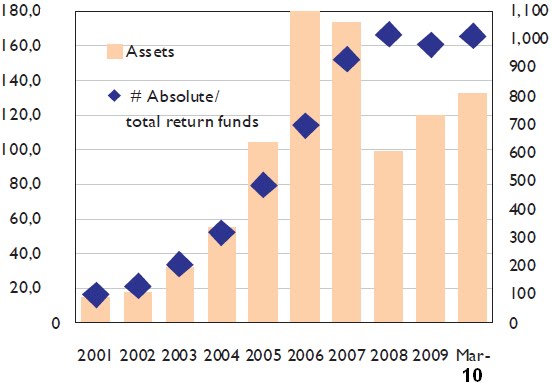
There is further evidence this week that absolute return funds are finding increasing acceptance. Lipper has written about sales of the products (in combination with total return funds) in the first quarter, and the trends suggest some good growth.  


Assets Under Management (in €bns. lhs) and Numbers of Absolute Return
and Total Return Funds (rhs)

In the first quarter, they attracted net inflows of €9.7bn compared to €11bn during the whole of last year. According to Lipper, for investors, the attraction of the funds has been boosted by a combination of low interest rates, economic uncertainty and stock market volatility. “Among product providers, hedge fund managers see absolute return funds as an opportunity to move into the mainstream mutual fund market, though figures show that the most successful funds are from fund managers with a foot in both camps,” states Lipper.

As a group absolute return funds aim to achieve positive returns in all market conditions, but they can have different types of exposure in order to achieve it. They invest through a variety of investment strategies in domestic equity or bond markets, or sectors such as commodities, while others have a global spread and hold a broad range of assets. It is particularly noteworthy that absolute return bond funds sold particularly well during the first quarter as investors sought out higher yields. Indeed seven of the best-selling absolute return funds in the first quarter were bond funds.


The popularity of bond absolute return funds suggests that these are retail and/or distributor/advisor products. The top selling products were from, in order, Standard Life, Julius Baer, UBI Pramerica, JPMorgan, Schroder, and in aggregate the largest asset managers in absolute return and total return funds are shown in the table below:

Top Five Groups by Assets in Absolute Return/ Total Return Products
as at End March 2010


The names that have cropped up each have strong branding, and excellent distribution capability, providing supporting evidence that these are retail products rather than products that are invested in by institutions. This point is reinforced by the fact that the UK and Italy together make up 40% of the sales by end market – territories with strong IFA and bank networks for distribution, respectively.

Some absolute return funds are described as Newcits, principally those launched by hedge fund managers. Lipper suggest that more than half of European hedge fund managers have launched, or are planning to launch a Newcits product. Given that the market is for retail products, the sales represent a new end-market for hedge fund groups and therefore represent incremental business. The power of branding in retail channels would itself reinforce the concentration in the hedge fund business – the bigger funds taking an increasing share of the industry through time.

Friday, 9 April 2010

Fund of Hedge Funds Consolidation: The gun has been fired

For just about all of the last decade it has been consistently suggested that the fund of hedge funds sector was just about to consolidate.


Industry watchers suggested that the three different size categories had very different profiles - as potential acquirers and takeover targets. The medium-sized players were going to snap-up their smaller brethren. The larger players were going to add to their assets under management by picking up medium-sized funds, and small funds of funds looked out-moded and should merge or fade away, so it was said and written.

The rationale for consolidation had several arguments:-

  1. The industry was mature, as shown by the declining average fees charged.

  2. Assets under management in funds of hedge funds as a percentage of the whole hedge fund industry peaked as long ago as the middle of 2008.

Graphic 1. Global Fund of Funds Industry


Source:IFSL estimates

   
3. In 2009 the attrition rate amongst funds of funds was twice the rate of single manager funds at times.
  
4. The costs of being in the business were on the rise as staff remuneration and the costs of compliance were only going up.
  
5. Institutional investors were increasingly dominating flows into the industry, and only large scale fund of funds organisations looked of institutional quality.
  
6. Brand names and critical mass were important to institutional investors and furthermore this client base required high-end (and therefore expensive) risk management systems and risk management professionals.
 
7. Assets are still leaving funds of hedge funds - according to TrimTabs they lost $17.4 billion in the three months to February 2010. 

In short, for five years it has been widely held that the margins of funds of hedge funds could only contract, and that the prevailing business models couldn’t be sustained.

In such an environment it became logical for founders of businesses, particularly of the boutique “family-office-plus”, to sell out and capitalise on the growth of their funds of funds businesses. But somehow it never quite happened to the extent expected.

However, a coincidence of recent events suggests that maybe, at last, we are about to see some M&A activity amongst funds of hedge funds. Here is a sample of some of the recent deals done.

In the last year

In January 2010 the Swiss based quoted multi-strategy firm Gottex bought the three Constellar funds of funds run by Ted Wong. The assets under management, at $150m, were not significant relative to the rest of Gottex, which manages over $8bn, mostly in market-neutral products. But they diversify the product mix into directional multi-strategy funds of funds offerings and, maybe more significantly, increase the firm’s knowledge of the US onshore and offshore markets.

Serial acquirer Aberdeen Asset Management has added to its string of acquisitions of long-only businesses by acquiring some alternative asset management contracts. In November of last year Aberdeen picked up the management contract for Bramdean Alternatives, giving it an opportunity to look at the fund of hedge funds business at close hand. It must have liked what it saw because in February 2010 Aberdeen paid £84.7 million to RBS for assets under management of £13.5 billion (as at 30 September 2009), comprising an established, award-winning fund of hedge funds business (that of Coutts), a long-only multi-manager business and certain private equity and real estate funds of funds. Aberdeen has built good distribution, and plugging-in alternative investment strategies should further diversify the revenue streams, and the fund of funds product can be pushed into existing channels when appropriately packaged.

It is true that the long tail of fund of hedge funds businesses has shrunk somewhat in the last 18 months. Ansbacher left the business, as did Commerzbank via its COMAS subsidiary, and tiddlers like Collingham Capital Management undertook an organised retreat from the business.

Several hedge fund firms ran in-house funds of funds that they hoped to commercialise, following the template of Renaissance Technologies’ Meritage Fund, the West Coast fund of funds that was founded to invest partners’ capital in single manager hedge funds. But these “natural extensions” of the business can find it as hard as unconnected funds of funds to get traction. For example, London based money manager Millennium Global closed down its small fund of funds run by Hamlin Lovell in the middle of last year, and Brevan Howard had a good-hard-look at entering the fund of funds business before deciding against it in 2009.


In the last month

That hesitation shown by Brevan Howard has been overcome by a couple of buyers of fund of funds businesses in the last month. First, Collins Stewart, the stockbroking and wealth management firm, has bought discretionary investment management firm Corazon Capital which has £382 million in assets under management with offices in Guernsey and Geneva. Corazon Capital was itself a management buy-out from Dawnay Day in 2008. Curiously the deal with Collins Stewart has been done for only £1m cash paid. As much as a further £6m worth of shares could be paid as the balance of the consideration over three years, dependent on performance in the next 12 months. In January 2009 Corazon had $1.2bn AUM, so the shape of the deal may be explained by the drop in assets alone. As for strategic rationale, Collins Stewart has long had a Guernsey presence and a small Geneva office itself, so there is a clear scope to reduce costs – as long as they hold onto the assets.

Second, and maybe the larger surprise of the two deals announced for funds of funds last month, was the purchase of a 75.1% stake in Aida Capital by Standard Life Investments. Aida Capital is a London based, FSA registered, fund of hedge funds manager. Aida currently manages the Aida Open-Ended Fund, a Guernsey listed investment vehicle and the Aida Closed-Ended Fund, an investment fund listed on the London Stock Exchange. In total AUM at Aida are around $50m, whilst Standard Life manages around $207bn. A “modest upfront fee” will be paid for the stake. At that scale it is all upside for Standard Life – it will have access to a wider range of alternative investments than before, and new fund of hedge fund products will be created specifically for Standard Life, which may be distributed through recognised life company channels. It is also open for the life company assets to be invested in funds of hedge funds, particularly when the issues of legal structure are resolved in the UCITS III format.

Neither of the two deals done last month, nor the deals done over the last year in the fund of hedge fund sector are large or involve major firms in the business. So how can there be an idea that the starting gun has been fired for acquisitions of fund of hedge fund businesses? It is partly the passage of time from the financial disaster of the 2H of 2008, and the condition of the financial markets now, and the turnaround in flows to hedge funds. Unlike during previous rallies from bear market lows in the early Noughties there are now hedge fund businesses with listings. The value of their shares as takeover currency has been rising, and a number of them have existing fund of hedge fund businesses. Merger and acquisition activity was muted last year but has risen this year in other sectors: as market levels have risen so entrepreneurial spirits have been able to get funded. The same should apply to quoted alternative asset management and hedge fund businesses.

The flows into single manager hedge fund businesses re-started in the middle of last year. The sales cycle for funds of funds is longer than ever, but the commitment of institutional investors to their hedge fund investment programmes should mean that funds of funds will see positive flows on a net basis by the middle of this year. And so top line growth is an additional consolidation driver. There is also scope to do deals to leverage a fund of funds infrastructure that has a lot of capacity for capital growth and margin expansion, like Aida Capital.

So there are a number of motivations and corporate strategies at play in the new environment for takeovers of funds of funds businesses. The gun has been fired.


The bulk of this article first appeared on The Hedge Fund Journal website

Friday, 29 January 2010

Podcast 3 - A Q&A with Two Third Party Marketers of Hedge Funds

Click on the emboldened header (e.g Part One) to link to the sound file. Clicking on the link will open a page containing the sound file - download or play in your browser

Part One
(8 minutes)
Clicking on the link above will open a new window with two choices available: download the podcast or play the podcast.

1.50 What are Third Party Marketers?

2.23 How was 2009 for Third Party Marketers?

4.05 Databases over Third Party Marketers?

6.00 Transactions versus Relationships

7.01 Repeat Visits to Targets

7.58 Decisions by Committees

(13 minutes)
0.00 Branding in the Hedge Fund Business

2.48 Marketing Materials

4.16 Clarity of Materials over Logo Design

5.10 Boiled-Down Presentations

6.37 The Last Two Minutes of the Presentation

7.13 Matching Material to Territory and Investor type

8.22 Establishing Trust

8.55 Initial Assessment of Manager

9.40 Friends & Family Money First

10.47 More Established Manager for Institutional Investors

11.19 The Sourcing of Managers

(6 minutes)
0.00 Next Stage after Identifying the Managers to Work With

1.50 Marketing Due Diligence

3.04 The Sweet Spot Now

5.18 Strategies to Appeal in 2010


My Thanks go to James Palmer of Red Sky Capital Solutions (redskycapsol.com)

And Barry Rogers of Alternative Investment Management (AIM) Partners (research@aimpartners.co.uk)

for their contributions to the discussion podcast above.

Thursday, 24 December 2009

A Creative Way to Build a Hedge Fund Brand Name – Broadwalk Asset Management

I was listening to trader trainer Michael Martin interview Jim Rogers on his excellent website (http://martinkronicle.com/), and I heard Jimmy Rogers say that investors should stay with what they know and are interested in. In working with portfolio managers I often ask them which sectors or types of stock they are good at investing in, and which they can't seem to get right. It may be they can't read retailers, or always seem to mis-time growth stocks, but it is very important to eliminate what you are not good at as a trader or investor. I think of it as playing defence to some extent – by eliminating a repeated error, and focussing on what you are provenly good at your returns have to improve.

There may be an element of ego involved – it may seem a sign of weakness on the part of a money manager to leave out a sector or type of stock from their universe. But investors, and ultimately the manager, will only be interested in the scale of returns achieved. So my conviction is to put the ego to one side, check the data, and eliminate areas of weakness. For example I worked with a manager who occasionally dabbled in the financial sector, but whose major strength was in consumer-related sectors. Analysis showed that the hit rate (percentage winning trades) was a lot lower in financial stocks than in other sectors, and I advised leaving the financials alone. Losses in the financial positions were slightly larger than those typically tolerated. If anything the stop-losses should have been tighter and positions sized smaller initially.

The ultimate specialism is sector funds, a strategy area I hope to return to shortly in more detail. In Europe we have begun to be used to hedge funds specialising in sectors, though they are a well established and successful phenomenon of the US hedge fund industry. Investor interest in sector hedge funds should be strong – the return data suggests they can offer enhanced return and lower correlation with markets if the funds have an appropriate framework for portfolio structure. The evidence for this contention is stronger at the manager level than at the index level - there is scope to add a lot of value to a portfolio hedge funds through manager selection in sector funds.

I came across an unusual sector fund this month. The Broadwalk Select Services Fund, run by Charlie Cottam, is Europe's first "Services" sector focused fund. The Fund has been going since June last year, and it has been going rather well. Most hedge funds made money in the first half of 2008 and lost more than their first half gains in the second half of the year. The Broadwalk Select Services Fund was up 1.3% over the last seven months of 2008 through putting in four down months and three up months. Obviously the average up-month in 2008 was bigger than the average down-month!

Charlie Cottam preserved capital well in the first few months of this year, and did better thereafter: through the end of November the Fund is up 44% for the year. The relevant market index for the fund is the FT-All Share Index (the Fund concentrates on UK companies), and that benchmark was down in four months of 2009, and the Fund managed by Broadwalk Asset Management was down in only one of those months. Over the whole life of the Fund the FT-All share has been down 14.6%. According to the manager he didn't get properly invested until February/March of this year, but once he did he made excellent returns through stock selection – the net is now about 80%, and the fund is concentrated (large position size).

The manager of the Fund claims two forms of competitive edge: better information and original analysis. The original analysis comes from Cottam's experience on the sell-side. As a chartered accountant himself he sees accounting issues not well understood by those analysing the service sector specifically. He may have a point as there are few sell-side analysts in the sector with similar tenure as an analyst. The manager himself sees an advantage in his ability to use his been-through-the-cycle experience to turn around his conception on a company and stock quickly – he can grab an emerging opportunity at the time when other analysts are getting out their apocryphal pen to write a research note.

Cottam is an experienced sell-side analyst, and in that may be a true edge as he was company broker to 33 UK corporates. This unique arrangement for UK quoted companies – a corporate brokership for each quoted company – gives the appointed broker a privileged position in terms of access to management. Cottam has kept his company network intact as he has moved to the buy side. His management contacts and experience of individual management teams based on their historic behavior helps Cottam to spot the early warning signs of change in outlook for companies and sectors. His sell side experience enables him to understand the flow information on stocks and their relative positioning in the market.

So Charlie Cottam uses his deep experience in service companies to extract alpha – staying with what he knows and is interested in. He has also taken steps to reinforce his edge by keeping senior management engaged with Broadwalk – last year he initiated the Broadwalk Business Services Awards. This is the second year of the Broadwalk Business Services awards to recognise outstanding achievements by quoted companies in the business services sectors. The UK often leads the world in business services -it is one of the less well-known success stories of the economy, and these awards are a step towards raising its profile. The categories and 2009 winners are: Company of the year (Aggreko), CEO of the year (Nick Buckles, G4S), Chairman of the year (John Peace, Experian), Deal of the year (Balfour Beatty - Parsons Brinkerhoff), Small company of the year (Hargreaves Services), and Entrepreneur of the year (Michael O'Leary, Ryanair).

I think this is a terrific example of creative thinking by a hedge fund manager, and Charlie Cottam's entrepreneurialism and unusual means of brand building are to be commended.