Showing posts with label global macro. Show all posts

Friday, 14 September 2012

Top Quotations From Battle Of The Quants

Latest four stories on Hedge Fund Insight:

Top Quotations From Battle Of The Quants London
"An edge in analysis of social media is much more feasible than in analysis of news - there are only six traders globally who are successful trading off news analysis, " Rob Passarella, DataSift.

"There is a huge leap to move from getting  interesting signals to a viable investment strategy," Leigh Drogen, Estimize. Read more >>


SEB Bias Towards RV and Macro In Outlook For Hedge Funds
The market is being driven mainly by investor risk appetite and sentiment, which in turn are driven by unpredictable political decisions. Central bank actions are also driving hedge fund returns to a growing extent, as are hopes for a new round of quantitative easing from the US Federal Reserve (the Fed) or the European Central Bank (ECB)’s potential purchases of government securities from peripheral euro zone countries. Read more >>


SVM Positioned For US Recovery To Beat Expectations
SVM portfolios are currently fully invested, recognising attractive valuations in the UK and Europe and a more encouraging outlook for global growth.  In the US, news in construction, housing and retail suggests that the worst is past. US construction and housing sectors, representing in total one-sixth of the US economy, are steadily recovering.  We believe that US recovery will beat expectations.  US banks are also much better capitalised than UK and European ones, and have largely gone through their write-offs.
Read more >>


Hedge Funds’ Performance? Volenti Non Fit Injuria
The rules on investor eligibility mean hedge fund investing “is not by any enterprised nor taken in hand unadvisedly or lightly; but reverently, discreetly, advisedly, soberly and in the fear of God, duly considering the causes for which alternatives are ordained”. The hedge fund industry has no case to answer against the recurring charges of non-performance and self-enrichment at the expense of clients. Those who invest in hedge funds willingly undertake the investment and operational risks implicit in the niche money-making schemes of the stinking rich. All of the usual criticisms, e.g. the fees, the hidden beta, the lock-ups, the illiquid holdings and the spraying of chic joints’ walls with Tattinger, are all disclosed in the offering documents and/or are writ large in the industry’s track record, which is getting on for thirty years as an investment style.
Read more >>

Tuesday, 24 April 2012

Hedge Fund Industry Assets Recover to Last Summer’s High


Highlights from HFR Global Hedge Fund Industry Report 1Q 2012

  • Total capital invested in the global hedge fund industry increased to $2.13 trillion, surpassing the previous record of $2.04 trillion set at mid-year 2011.

  • Investor preferences for fixed income-based Relative Value and less correlated Macro strategies, which have been favoured for over two years, accelerated in 1Q12, with these two strategies receiving an overwhelming majority of the new investor capital for the quarter. Investors allocated $12.4 billion in net new capital to Relative Value and $7.8 billion to Macro, while redeeming $2.9 billion from Equity Hedge and $940 million from Event Driven strategies.

  • Investor preference for the industry’s most established managers continued to be pronounced in 1Q12, with $18.3 billion in new capital allocated to firms with greater than $5 billion in AUM, while firms managing less than $5 billion experienced a combined net outflow of nearly $2 billion for the quarter. 

  • Investors continued to reduce exposure to hedge funds via Funds of Hedge Funds, with FOFs experiencing a net outflow of $5 billion in 1Q, representing the 4th consecutive quarter in which FOFs experienced a net outflow. While only 13 percent of FOFs experienced net asset inflows during the quarter, as a result of performance gains, assets invested in FOFs increased by $14 billion to end 1Q12 at $644 billion.

Friday, 20 April 2012

Quotation Of The Day - What Is A Macro Manager?


Mike Novogratz, Co-Chief Investment Officer of Fortress Investment Group, and manager of one of the world's largest global macro funds:

“A famous macro manager said that the reason you join macro management, rather than a really hard business like equities, is that all you need to do is look at a bunch of charts and read “The Wall Street Journal”. 

“What we do in reality is look at news from a whole variety of sources, we meet with government officials and we travel a great deal. We try to catch the big waves of market sentiment and the business cycle. A lot of it is trying to catch the bottom of the valley of prices.”

Thursday, 5 April 2012

Managing An Existing Macro Position - Aussie Dollar Example from Bridgewater As Would Be Managed by Caxton Associates

Having been asked what would a trader or macro manager do now on the Aussie Dollar position mentioned in a couple of articles (here and here) here is a response. Below in graphic one is the original set-up graphic annotated to show the current A$/US$ rate.
Graphic One - A$ v US$ over the six months to 9th March 2012
 
Sources: www.fxstreet.com, Hedge Fund Insight

Clearly the risk/reward has worked out well to date, but how much is enough?

There are two forms of feedback loop – the fundamental and the technical. If the fundamentals are still in gear with the original trade idea, and the outcomes are being driven for the reasons looked for then the trader will concentrate on the technical position.

As mentioned in the article on macro position taking of early last year the trader will have a series of measures or indicators he tracks once in a position – momentum measures, volatility measures, and flows to reflect the dynamics of market positioning. Although the fundamental rationale may still be in place with as much or more force than previously, any of these indicators alone or in combination may cause a macro trader to change his position size. The mindset is to win the war by winning the battles though not all the skirmishes.    

In the case of the short Australian Dollar position (versus the US$) the battle plan is going fine (a positive P&L) but there may be a skirmish due to test the resolve of the bears on the A$.  Markets don’t go up or down every day, and there are always intermediate reversals and consolidations, even in strong up or down trends or moves.

Just as there were significant market levels on the set-up, the A$ rate may have reached a zone of parity with the US$ which represents a test area for the technical side of the investment case. The zone is predicated on a combination of technical measures – previous highs or lows and natural reversals levels based on Fibonacci analysis.  It is very common to look for zones of significance in price charts based on combinations of technical factors – Elliot wave analysis plus significant moving average levels, ichimoku levels plus medium term RSI, or Bollinger band support level and a medium term trend line.  One measure in isolation is worth something, a combination of measures from different approaches is worth a lot more to the professional market watcher.

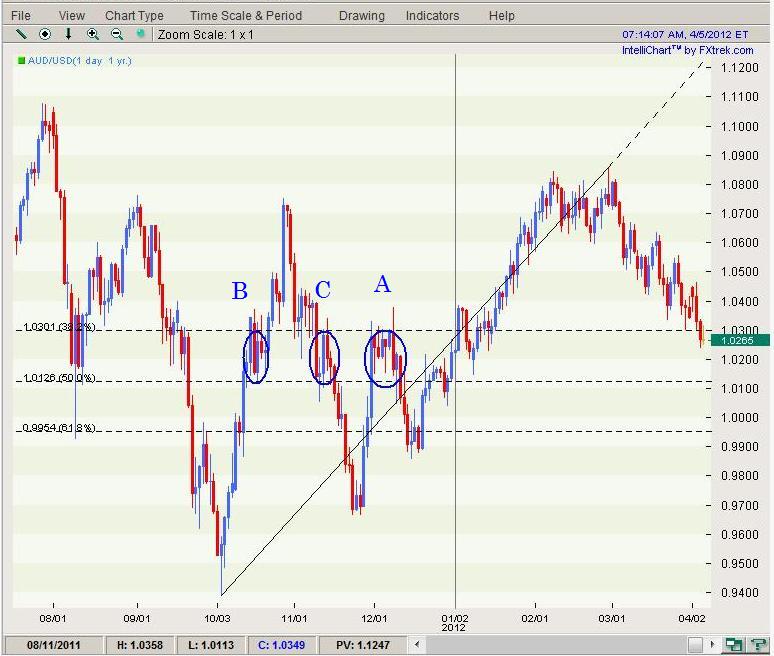
In the case of the A$ there are two nested Fibonacci levels and a previous interim top in the picture versus the US$. In the graphics below the Fibonacci levels are shown separately and then together. 

Graphic Two - A$ v US$ over the last year showing set 1 of Fibonacci levels
 
Sources: www.fxstreet.com, Hedge Fund Insight

Graphic Three - A$ v US$ over the last year showing set 2 of Fibonacci levels and historically relevant price action
Sources: www.fxstreet.com, Hedge Fund Insight

In graphic three the price action circled and labelled A is much more significant than the zones circled and labelled B and C. The interim top at A in December 2011 might act as a support level for a declining A$. The circled areas B and C show that the A$/US$ rate spent slightly more time in this price band that at other levels nearby in recent market history. 

Graphic Four - A$ v US$ over the last year showing sets 1 & 2 of Fibonacci levels
Sources: www.fxstreet.com, Hedge Fund Insight

In graphic four the 38.2% retracement level of one Fibonacci measurement is close to the 50% retracement level of the other Fibonacci measure.  

The graphics illustrate that there is a chance that the A$ might try to find support around the current level. That is, if you like, a short term trading hypothesis. The medium term fundamental case is still in place, whether based on China’s impact on commodity prices or domestic Australian property prices.

A macro trader will now be in a twitchy mode of observing the market action where he has a position. There is as yet no market action in pure price terms (though there may be in RSI or flow information terms) to tell a (macro) trader to trim his position, but he will be watching intently for a trigger to cut his short A$ position by a third or a half. A trigger in the actual instrument traded could be any number of short-term patterns. A reversal day with good volume, a close near the high of the day or the markets acting to bad news for the A$ with stoicism (not going down) would all make a macro trader change his position. 

It is very important for macro traders to observe consistency across markets and asset classes. The senior trader from Caxton illustrated that point in the article here last year. In that case how the S&P acted in concert with €/$ was watched closely. For the case in question, other commodity-related currencies and markets will be watched to see if they are reversing, even if the A$ does not do so on a given day. So the trigger to scale back the A$ position might come from another market (or more likely cluster of markets) that is expected to exhibit co-movements to the changes in A$/US$.

If the A$ does not show signs of reversal, some newly emergent strength, then the macro trader, whether at Bridegewater or Caxton Associates, will keep hold of the short position, until the pre-set take profit level comes in to view, or it becomes clear that the trade is getting crowded.