Showing posts with label event driven. Show all posts

Friday, 14 September 2012

Top Quotations From Battle Of The Quants

Latest four stories on Hedge Fund Insight:

Top Quotations From Battle Of The Quants London
"An edge in analysis of social media is much more feasible than in analysis of news - there are only six traders globally who are successful trading off news analysis, " Rob Passarella, DataSift.

"There is a huge leap to move from getting  interesting signals to a viable investment strategy," Leigh Drogen, Estimize. Read more >>


SEB Bias Towards RV and Macro In Outlook For Hedge Funds
The market is being driven mainly by investor risk appetite and sentiment, which in turn are driven by unpredictable political decisions. Central bank actions are also driving hedge fund returns to a growing extent, as are hopes for a new round of quantitative easing from the US Federal Reserve (the Fed) or the European Central Bank (ECB)’s potential purchases of government securities from peripheral euro zone countries. Read more >>


SVM Positioned For US Recovery To Beat Expectations
SVM portfolios are currently fully invested, recognising attractive valuations in the UK and Europe and a more encouraging outlook for global growth.  In the US, news in construction, housing and retail suggests that the worst is past. US construction and housing sectors, representing in total one-sixth of the US economy, are steadily recovering.  We believe that US recovery will beat expectations.  US banks are also much better capitalised than UK and European ones, and have largely gone through their write-offs.
Read more >>


Hedge Funds’ Performance? Volenti Non Fit Injuria
The rules on investor eligibility mean hedge fund investing “is not by any enterprised nor taken in hand unadvisedly or lightly; but reverently, discreetly, advisedly, soberly and in the fear of God, duly considering the causes for which alternatives are ordained”. The hedge fund industry has no case to answer against the recurring charges of non-performance and self-enrichment at the expense of clients. Those who invest in hedge funds willingly undertake the investment and operational risks implicit in the niche money-making schemes of the stinking rich. All of the usual criticisms, e.g. the fees, the hidden beta, the lock-ups, the illiquid holdings and the spraying of chic joints’ walls with Tattinger, are all disclosed in the offering documents and/or are writ large in the industry’s track record, which is getting on for thirty years as an investment style.
Read more >>

Friday, 3 August 2012

Update of 3rd August

These stories have been posted on www.hedgefundinsight.org:

http://www.hedgefundinsight.org/gross-staff-turnover-is-not-the-issue-at-citadel/
Citadel LLC, the $11bn AUM Chicago-based hedge fund group, has produced some great returns for investors over the long term. In the last calendar year, the two main multi-strategy funds, Kensington Global Strategies and Wellington Fund, both racked up gains of more than 20%. But Citadel has another reputation, aside from very good returns...

http://www.hedgefundinsight.org/opinion-some-reasons-swfs-will-not-buy-hf-management-companies/
A recent article suggested that SWFs are exploring the possibility of buying asset management companies. Could hedge fund management companies be on their radar? The reasons given for buying asset managers are two-fold: to reduce fees and to ramp up investment expertise.

http://www.hedgefundinsight.org/avenue-capital-backs-punch-taverns-and-travelodge-debt-to-recover/
A recent article in the “New York Times” made a a big play about Avenue Capital’s strategic allocation of capital to Europe, which meets  the opportunistic and value-driven approach of founder Marc Lasry. The $3bn of capital is expected to be committed for 3 to 5 years, but is being drip-fed in at roughly $150m  a month .

http://www.hedgefundinsight.org/gradually-and-then-suddenly/
Markets are funny places, and the things that happen there stranger still. Economic data has been getting steadily soggier from around the world and the eurozone crisis rumbles on, yet global bonds, equities and commodities have turned in sprightly returns for July.

http://www.hedgefundinsight.org/event-driven-is-a-strategy-for-todays-erratic-markets/
In these treacherous times the degree of macro risk in markets is substantial and it is tempting to try to capture these opportunities. The confident macro trader will certainly argue for the opportunity while the fundamental investor may be confounded by factors beyond their considerations. One of the more controlled ways of investing in the current environment is event driven strategies.

http://www.hedgefundinsight.org/short-selling-spuriousness/
On Monday, July 23rd 2012 2 Euro Zone nations acted in a manner that revealed panic and questionable judgement. In an attempt to prevent “speculative” trades depressing asset values Italy and Spain reintroduced a ban on short selling. This was a response to the tumble in the equity and bond markets.

Tuesday, 24 April 2012

Hedge Fund Industry Assets Recover to Last Summer’s High


Highlights from HFR Global Hedge Fund Industry Report 1Q 2012

  • Total capital invested in the global hedge fund industry increased to $2.13 trillion, surpassing the previous record of $2.04 trillion set at mid-year 2011.

  • Investor preferences for fixed income-based Relative Value and less correlated Macro strategies, which have been favoured for over two years, accelerated in 1Q12, with these two strategies receiving an overwhelming majority of the new investor capital for the quarter. Investors allocated $12.4 billion in net new capital to Relative Value and $7.8 billion to Macro, while redeeming $2.9 billion from Equity Hedge and $940 million from Event Driven strategies.

  • Investor preference for the industry’s most established managers continued to be pronounced in 1Q12, with $18.3 billion in new capital allocated to firms with greater than $5 billion in AUM, while firms managing less than $5 billion experienced a combined net outflow of nearly $2 billion for the quarter. 

  • Investors continued to reduce exposure to hedge funds via Funds of Hedge Funds, with FOFs experiencing a net outflow of $5 billion in 1Q, representing the 4th consecutive quarter in which FOFs experienced a net outflow. While only 13 percent of FOFs experienced net asset inflows during the quarter, as a result of performance gains, assets invested in FOFs increased by $14 billion to end 1Q12 at $644 billion.

Friday, 29 April 2011

Syz’s Altin Zigs When Others Zag

ALTIN AG (LSE:AIA) (SWX:ALTN), the Swiss alternative investment company listed on the London and Swiss stock exchanges, discloses quarterly its entire hedge fund portfolio holdings as part of its policy of full transparency to investors initiated in 2009. Looking at the strategy allocation shifts of the fund of funds managed by Banque Syz makes an interesting contrast with the expressed biases of investors in hedge funds given in the Deutsche Bank Alternative Investment Survey.


Graphic 1. Net Allocation Plans by Strategy of Hedge Fund Investors


Source: 2011 Deutsche Bank Alternative Investment Survey

Asked in January this year, the respondents to the survey ranked as the top three strategies for receiving allocations of capital in 2011 as equity long/short, event driven and global macro. So it was striking that the Alternative Asset Advisors SA, the subsidiary of Syz that manages ALTIN AG, had acted in exactly the opposite way over the first three months of the year. As the fourth column in graphic 2 shows the largest reductions in strategy allocations made by 3A were in equity long/short, event driven and global macro.

Sometimes reductions in allocations in portfolios of hedge funds are effected through a passive route. That is as flows come in, net new subscriptions are allocated to preferred strategies, and the strategies or managers with sufficient allocations at that point are diluted. But ALTIN is a closed-ended investment company, so the capital available to invest changes with new capital raisings on the stock exchange and with leverage. There have been no capital raising (in fact shares in ALTIN AG have been bought back), and leverage at the portfolio level is broadly the same over the first three months of the year. So in this case the reductions in allocations to strategy are active decisions based on a number of possible factors. The factors are views on prospective returns at the strategy or individual hedge fund level, and (fund of funds) portfolio composition issues. That is reductions may be driven by bottom-up factors (marginally high allocations to a single fund that needs to be trimmed after very strong performance or changes at the firm), or driven at the highest level of management (portfolio level leverage as a function of hedge fund returns across all strategies), as well as at the intermediate level of strategy allocation. In this case the changes seem to have been made at the intermediate level because two funds have been added that invest using investment strategies that were not represented in the portfolio at year end.


Graphic 2. Breakdown of Capital by Investment Strategy of ALTIN AG


Source: Regulatory News Service of the London Stock Exchange

The two new funds are ZLP Offshore Utility Fund Ltd (an equity market-neutral fund) and Providence MBS Offshore Fund Ltd (a fund investing in mortgage backed securities (MBS), under Fixed Interest Strategy in table above). The first of the new funds is a sector specialist fund that adds value by the application of deep knowledge of one industry. The market-neutral fund, managed by Zimmer Lucas Capital of New York, should produce a return stream with a low correlation with traded markets. The managers of ALTIN know the managers of the fund very well – 3A were early backers of Zimmer Lucas Capital as far back as the year 2000.

The Providence MBS Offshore Fund Ltd is managed by Russell Jeffrey, founder of Providence Investment Management LLC of Providence RI. The $895m fund takes a relative value approach to residential MBS, and capitalizes on price dislocations in the agency MBS and related fixed income markets. The fund has a CAGR of 23.44 % since inception in 2004, and over the last 3 years it is ranked in the top 0.1% of all hedge funds for absolute returns.

The Deutsche Bank survey of investors in hedge funds showed no net interest in investing in either equity market-neutral or dedicated fixed income strategies in 2011. So it is not just in reductions in allocation to strategies that the managers of ALTIN zig when others zag, but also in new subscriptions to hedge fund investment strategies.

Tuesday, 26 April 2011

Selecting the Best Managers – a natural bias to hedge fund managers?

I carried out manager research for an American fund of hedge funds for several years early last decade. Manager research and portfolio construction is a team effort so I had to find a way to put across to my colleagues the merits of the managers I followed. We use a lot of inputs to understand how managers manage capital, so in our heads each of us has a multi-faceted view of the portfolio manager and his process, but it is not feasible to put it all across to someone else. So we have to find ways to summarise and capture the essence of our take on the hedge fund manager.

In my case I used a numeric score of what I considered then, and still do now, the key drivers of performance. So I gave each manager a score between 1 and 10 for each of source of alpha and for risk management. Risk management included portfolio construction, position sizing, diversification, risk measurement, downside risk and use of stops. The source of alpha score took into consideration the added value of the specific person/people pulling the trigger, the breadth and depth of research, whether there was a unique or unusual information source being used, the sustainability of the manager's edge, how adaptable the approach was to change, and the richness of the opportunity set being addressed. A mid-ranking manager would score 6 for each, in the way I used the scales, but this was a closed marking system. No manager ever got 10 for either metric. I never gave any manager a score less than 4 for alpha or risk management in the time I carried out manager research. At the bottom end it is easy to understand why: managers setting up a hedge fund have nearly always has significant success previously in trading or investing. They are not neophytes; and though some learn on the job about managing capital in the hedge fund format, they have all managed capital before.

After a while meeting managers, and hearing how they do what they do, I realised that whilst the alpha score was important, risk management was a bigger differentiator. So getting into risk management issues early in the process saved a lot of time and effort: if a manager didn't have discipline and a consistent process in risk management it was time to move on to another hedge fund.

A legacy of this time is that I remain interested in how to assess managers – it is useful in my consultancy work, at the least. In the book I am reading at the moment – "Investing with the Grand Masters" by James Morton – I am engaged to see what criteria the author used for selection of the managers.

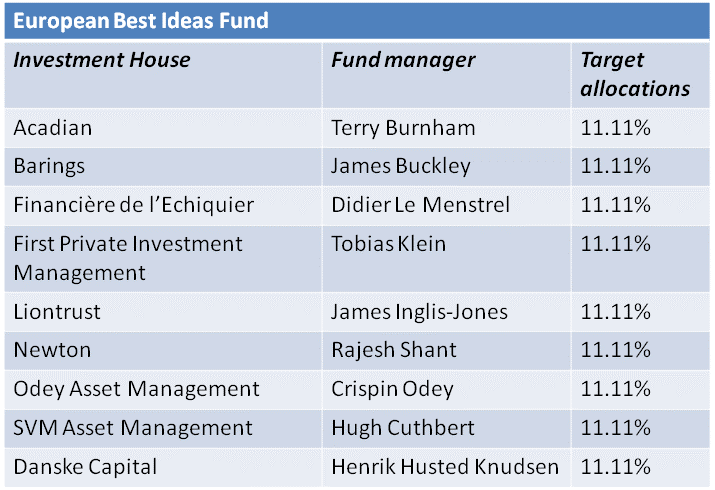
So I was interested to read about the Skandia Investment Group's Best Ideas fund range. Skandia has a fund platform and operates multi-manager funds, but the Best Ideas funds are not a standard fund of funds. Neither are they portfolios of pure hedge funds. These are portfolios of funds (mostly long-only funds) run by well-regarded portfolio managers who have been given the freedom to invest in their highest conviction investment ideas on a dedicated basis.


The lead manager on Skandia Investment Group's Best Ideas fund range, Lee Freeman-Shor, applies four key pieces of academic investment research to his selection process. These are:

1. High conviction investing: Research from Randy Cohen of the Harvard Business School, Christopher Polk and Bernhard Silli of the London School of Economics suggests that the bulk of fund manager's returns come from their highest conviction ideas. As a result the Best Ideas managers are limited to holding only ten stocks, their ten highest conviction ideas.

 2. Kelly Criterion: a formula first described in 1956 by John Larry Kelly to determine the optimal betting size to maximise wealth. Perhaps the most famous Kelly practitioner is Warren Buffet who once said: 'Why not invest your assets in the companies you really like? In 1972 Buffet had 42% of Berkshires assets in American Express. Freeman-Shor allows the managers to apply Kelly to the extent that they can invest up to 25% in a single stock.

3. High Active Share: this measures the proportion of a fund's assets that differ from the benchmark index. In their 2009 paper 'How Active is your fund manager? A new measure that predicts performance' Martijn Cremers and Anti Petajisto indicated that running a fund with a high 'active share' delivers the highest and most repeatable returns. The European Best Ideas Fund has a high active share, currently 83%.

4. Behavioural science: Research by Andrea Frazzini in 2006 showed that the best performing managers realise the highest proportion of losing trades. Freeman-Shor's job as overall portfolio manager is to be a coach and work with the Best Ideas managers to ensure they do not succumb to, amongst other things, sunken cost bias when they are losing and are thus executing their ideas appropriately.


In a good hedge fund there is a competition for capital between the investment ideas – that is, all full sized positions are conviction ideas. So the concept of high conviction investing is seen in the hedge fund world. The Kelly Criterion applies in several hedge fund strategies – event driven investing, activist investing, and to a lesser extent in global macro investing. The third piece of applied research might just say why hedge funds have inherent qualities relative to long only strategies, as 100% of many hedge fund portfolios are active bets. There are no index constraints in hedge fund portfolios, though the presence of positions held only to hedge impacts the percentage of the portfolio applied to seek alpha.

The fourth piece of academic research applied to the Skandia Best Ideas funds has a very strong resonance for me. The conclusion from Frazzini is that the best performing managers realise the highest proportion of losing trades. From my work with traders I know that this can be applied with minor tweaks in hedge funds: the best traders realise their losses either early, or in line with their stated stop-loss policies. This allows winners to run, and losers to be cut. This characteristic is also often seen in systematic approaches to markets, particularly by CTAs. With good money management it is feasible to run a successful CTA with a hit-rate (percentage of winning trades) of only 35%. The hit-rate in a discretionary money manager has to be a lot higher, and for a fundamentally driven manager with a long holding period the hit-rate can get into the high 80's as a percentage.

The fruit of the application of these concepts has been good – the Skandia European Best Ideas Fund has shown some strong out-perfromance. On the third anniversary since launch the fund was 17% ahead of the MSCI Europe index and 15% ahead of its peer group (Morningstar European Large Cap Blend), putting it in the top 5% of European funds since inception and 1st quartile over all time periods.

There are a number of hedge fund managers and managers of absolute return funds amongst the roster of managers employed by Skandia in the Best Ideas Funds. In fact I would go so far as to say that there is a disproportionate number of such managers amongst the portfolio managers used (see tables below). Would that be because hedge fund managers tend to apply the best portfolio management practices given by Skandia more than long-only managers?


Friday, 17 December 2010

John Paulson on the Benefits of Activism

John  Paulson
John Paulson may have made been the subject of the book "The Greatest Trade Ever" about his shorting of (residential) mortgage-backed securities, but that trade was as typical for him as Michael Steinhardt going long U.S. Treasuries in 1981. Steinhardt was an analytical equity investor betting his reputation on an unfamiliar asset class in government bonds. Paulson's deep experience was in something else too*.

John Paulson's professional background is in mergers and acquisitions, and so it was natural that the investment strategy in which he came to specialise was risk arbitrage, first with Bear Stearns and then Gruss Partners, before he opened his eponymous firm. As with many practitioners who go on to play other stages of the event cycle, risk arbitrage led to exposure to distressed bonds, and eventually to the full panoply of event investing of divestitures, recapitalizations and other company reorganizations and financings.

So it is the associated specialism of activist investing that is covered here with John Paulson. This is a written form of a presentation
he made a few years ago on the topic . Whilst the principles of what John Paulson describes are still valid, the aftermath of the Credit Crunch makes comments on real estate and banking anachronistic in today's market conditions.

Simon Kerr, December 2010


Paulson & Company is an event arbitrage firm, and we have been in business 15 years and activist investing is not our only activity but is in an important part of our investment strategies. I'm going to talk today about the benefits of activism.

Activism is good for the stock market. It is good for investors and is also good for business and is good for corporate governance.


The Benefits of Activism

One: The first benefit, and primary benefit, of activism is to increase shareholder value. We get involved when a stock is trading at a discount to its true value. Through activist strategies we seek to realise that value.

Two: The second goal, and as important as realising shareholder value, is to improve corporate governance. Unfortunately there are situations where corporate Boards or managements don't always act in the best interests of the stockholders. Activists make sure that all shareholders are treated fairly and properly.

Three: Another benefit is that activist investing carries out a role on behalf of other investors. We might have to act alone, and we might own only 5 or 10% of a company, but when he share price goes up all investors in the company benefit. That helps individual investors who don't have the time or resources to act in this way. It also benefits pension funds and other institutional investors that can't get involved for political reasons or because it is outside their mandate. But I would say that in many if not most of the situations in which we get involved we are clearly getting the support of institutional investors. Even if they are somewhat constrained in coming out and saying so publicly, they are supportive of the goals we are trying to achieve.

Four: Activism keeps management and boards focussed on shareholders' interests. Prior to activist investing Boards acted in their own interests. It used to be that the only thing shareholders could do when they didn't agree with what was going was to sell the stock. Activism gives shareholders a voice, and makes management listen.

I believe it also creates companies stronger. Many times what leads to an activist situation is where a company management is pursuing a strategy that that they are reluctant to let go of. Shedding loss-making operations and merging with other companies to get to global scale, in the end, does result in stronger, more competitive and more profitable companies.

Five: Activist investing also removes inertia. You can't just accept the status quo. If management have been doing something for a long time and are happy with it, that is not good enough. Management have to be accountable and activist investors showing up forces management to be accountable.


Why is There a Need for Activism?

The primary reason for activism is that in public companies there can be divergent interests between owners of the business and management. In many public companies, particularly in cases of very old, established companies, the board members and management frequently own de minimis amounts of stock. So their decision-making criteria for running the company are other than those which are best for company shareholders. Frequently they are focussed on the perks of running a large public corporation. Many times they like their cushy jobs, they like all their perks and the prestige that go along with the positions they hold. Ideally the Boards want to be left to run the company - they view shareholders as bothersome.

In some of the old companies the Boards can become very insular. Many times the Boards don't have any stock at all. They are reluctant to incorporate change. Then there is a need for an activist to get involved.


The Criteria We Look for in an Activist Situation

  1. The company is trading at a deep discount to fair value
    If the company is doing the right thing, the shares are trading at a full value and the shares are trading at a high P/E, then there is no need for an activist to get involved. However if it is trading at 50% discount to fair value, if it is pursuing strategies that have failed, if it is under-performing and the sum-of-the-parts is at premium to current traded values then that attracts the activist investor.


  2. Strategic Initiatives Available
    There have to be readily implementable strategic alternatives to unlock that value (some examples will follow). So we look for a discount and a situation where if management took action that discount could be quickly eliminated. Typically the management has been reluctant to act, simply because they don't want to change things. The activist investor comes in and acts as a positive catalyst for positive change.


Why Would the Company be Under-valued?

Why would a company be undervalued to the extent that an activist could get involved? The most common reason is that the company is in disparate businesses. Some of the businesses are weaker than the others. The sum of parts is greater than the value of the whole, and the remedial strategies are not always seen as readily implementable.

Examples:

The sum of the parts was greater than the whole. Take as an example Cadbury Schweppes. In the U.S. beverage business it was an also-ran in market share, but it had an attractive confectionary business. Combined as a public company they traded at a discount to the fair value.

Sainsbury's had very valuable real estate and the management was reluctant to separate that real estate element from the retail operations. It traded at a big discount to the asset value of the business. (Property investor) Robert Tchenguiz showed up on the share register and highlighted that differential, and the stock appreciated significantly.

In (Dutch company) Stork – another situation where they were in many disparate businesses - people that wanted the individual businesses didn't want the whole rag-bag of businesses, and as a consequence the shares traded at a very significant discount.

Then there are situations where the track-record of the management is poor. Though there are pieces of the company that are valuable, investors lose confidence in the management, and as a result don't attach a high multiple to the stock. Two situations come to mind – Ahold from Holland and ABN AMRO, the Dutch bank. Both companies, for different reasons, had underperformed in stock market. There were actions that could be taken to highlight the value, but the managements needed some pressure from shareholders to do something about it.

We also see situations where managements are not focussed on shareholder value. It could be through no fault of management, but that the private market value is very different from the public market value. A ready example is the real estate sector. Real estate can be capitalised at very high multiples of cash-flow, but generally the public market looks at multiples of earnings. You can't get full value for real estate assets in the public market.

So for example, Ahold had a fair amount of real estate and the shares traded at approximately 7 ½ x EBITDA. Yet real estate transactions are being done at over 20x EBITDA. So put the real estate in a public company and the market gives it 7 ½; separate the real estate, sell it to someone privately, and you can get 20x. Some deals were done recently at approaching 24x EBITDA. The latter deals had cap rates as low as three and a half percent. That is the incentive - the difference between public and private valuations. For the retailers it is not necessarily a problem of management, but a difference in value can be realised through re-structuring, tax treatments and other considerations.


Activism Need Not be Confrontational

Many people see that activism has to be confrontational. That is not the case - some of our best investments have been where we have been working together with management, outside of the public eye, to enhance value. For example, a fund was written up in the newspaper yesterday: Blue Harbour is an activist investor that only does friendly transactions. They buy a stake in situations which are under-valued, and where they believe strategic re-structuring will add value, and then they work with management collaboratively to achieve that goal.

We have worked with managements at Ahold and The Mirant Corporation constructively. Actions the management have taken have added value in both cases.

In Cadbury and Laidlaw we have worked in a non-confrontational manner. Generally it is important for management to listen to shareholder concerns: when investors make a point that is valid, it is up to management to respond to those concerns and help to realise that value.


But Management Can Defend Aggressively

In the ideal situation, you take a stake and management greet you with open arms, and you agree to enhance shareholder value, but sometimes management is very confrontational. Sometimes the Board and management don't like being told what to do, and the management take action which harms shareholder value. I will refer to two recent examples.

After ABN AMRO granted exclusive negotiating rights with Barclays, RBS indicated an interest to pursue an acquisition. ABN AMRO management said they couldn't negotiate with RBS because of the exclusivity agreement with Barclays. That exclusivity period expired, and even knowing the RBS interest, ABN AMRO management then extended that exclusivity period. They used that second period to negotiate what was effectively a poison pill: they arrange to sell the prize asset which RBS was after (LaSalle Bank) to Bank of America. This made it almost impossible for RBS to pursue the deal they wanted with ABN AMRO.

ABN AMRO was refusing a deal at a higher price so they could choose the buyer that they wanted to sell to. This was done though many shareholders in ABN AMRO did not want this to happen. This is thankfully rare, where management use scorched-earth tactics to destroy value in order to serve their own interests.

Thankfully ABN AMRO were taken to court by Dutch shareholder group, VEB, and the shareholder group won. In order to sell even some of the the assets ABN AMRO management needed shareholder approval. Without that activism on the part of the Dutch shareholders association the incremental value in the asset sale would not have been realized.


Another hostile situation where were involved was Stork – this was a deeply undervalued businesses on a sum-of-the-parts basis. It traded at a 50% discount to fair value of the component parts on a peer group public company basis. It was in chicken processing, aerospace, oil services, and believe it or not scores of other businesses at well. So there could no corporate buyers of the whole company, because buyers of oil services did not want a chicken business. We believed the best and most promising business in the group was aerospace. We suggested either splitting into three businesses or building the group around the core aerospace business.

The Board refused to listen to us, even though we owned up to 35% of the shares, and the Board owned no stock. We said that that was unfair, and let's put it to a shareholder vote. At the shareholder meeting 89% of the votes at that meeting were for the change in strategy. The Board refused to listen to the voice of the meeting and said the Board make strategy not shareholders. So we called another meeting to replace the Board. To deny our rights the Board then initiated a poison pill – issuing super voting preferred stock to themselves. The preferred would represent the majority of votes if the issue was allowed. We had to take the company court. We argued that the poison pill was originally put in place to stop an unwarranted takeover, not to prevent shareholders from voting. The court agreed with us and threw out the pill. We are now in the process of trying to negotiate something with Stork. Our preference is always to do something collaboratively rather than confrontationally, but unfortunately it doesn't always work out that way. And we have to act to protect our interests on those occasions.


Examples of Activist Positions of Paulson & Company

Cadbury – a great company. In two businesses: it is a world leader in confectionary, but also had a substantial but sub-scale drinks business. Everyone knew that it was in the interests of shareholders that the businesses split – the best strategy was thought to be to sell the drinks businesses and concentrate on confectionary. Once Nelson Peltz declared his stake management realized the logic and immediately announced they would consider separation of the businesses. The stock jumped almost 40% in a few months of the announcement of the split of the businesses. Incidentally Nelson Peltz had good knowledge of the situation as he had sold Snapple Beverages to Cadbury five years previously.

ABN AMRO – over the five years prior to the involvement of the The Childrens' Investment Fund the stock had moved sideways whilst the banking sector was up substantially. ABN AMRO share appreciated 40% in a few months after the TCI stake became public knowledge. This shows the benefit of an activist stirring the pot. Shareholders had been disgruntled with ABN AMRO management for some time. It was a big bank, but it had pursued a strategy of being a small player in a lot of different markets. It was one of the largest banks in the world, but it had a tiny operation in the U.S., it had small operations in Italy, in Brazil, and the Middle East. That situation does not create operational strength, or allow for synergies, or allow for expanded margins. Contrast that with those banks that had large shares of deposits in its markets. Large shares of deposits in a banking market leads to profitability, so although ABN AMRO had grown it had not created value.

Ahold – the re-structuring activity in Ahold took the shares up 50% at the same time that the retail index was up 5%. The company does well operationally in Holland and Sweden but poorly in the US. As a consequence the shares traded at a discount to the sum of the parts. We proposed selling off or spinning-out the under-performing US operations, to focus on the successful European operations. We believed that that would create shareholder value. They were responsive. They sold off the US food service operations, and received much more than anyone expected – some $7bn. They bought back stock with the proceeds. The story doesn't end there because management are considering other initiatives which came from the activist shareholders. We have met with management and they have listened.

The Mirant Corporation - a very successful situation as the shares are up over 100% in a year, and Paulson & Company was the largest shareholder. Mirant, an Atlanta-based power company, itself had come out of bankruptcy and had a new CEO. They announced that they wanted to buy another utility with stock, but their own shares were trading at a discount to the sum-of the-parts, and they were proposing to acquire the target company at a premium. It was a very dilutive acquisition proposal.

The proposal drew very sharp criticism from nearly all the existing Mirant shareholders. Ed Muller, the CEO, was surprised, but he listened to shareholders, and dropped the proposal within a week. He then reached out to shareholders, and met with us and other large shareholders individually. We explained that we thought they should do is sell off their non-core assets and concentrate on the Mid-Atlantic utility business. Rather like ABN AMRO they had bits of businesses all over the place. It had utilities in the Philippines, Jamaica, Trinidad and Tobago, and the Bahamas and in the U.S. in Texas, in California and in other states.

After meeting with us he realized that the best thing to do was to hire bankers and sell off the widespread operations, and concentrate on the core utility business. He sold the Philippines assets to Tokyo Electric; he sold the Caribbean assets to Marubeni; he sold the non-core US assets to a private equity group. It was our most successful activist position, and it was done with a collaborative approach to management.


Summary: Benefits of Activism

  • Activism Improves Valuation for Everyone
  • It Frequently Results in Better Governance
  • Activism Creates More Efficient Companies
  • It Removes Inertia
  • Activist Investing Holds Management Accountable


*Before he began his investment career, John Paulson accumulated academic distinctions. He was Valedictorian of his class at New York University's College of Business and Public Administration and received his MBA from Harvard Business School as a Baker Scholar, the school's distinction for the class' top students. After a stint as a management consultant with the Boston Consulting Group, he joined Odyssey Partners as an Associate and moved on to Bear Stearns in 1984 where he became a Managing Director in mergers and acquisitions. In 1988, he became a general partner of Gruss Partners. In 1994, he started Paulson Partners L.P., and in 1996, Paulson International Ltd., a companion offshore fund. In 2001, the firm launched a leveraged version of its funds. Based in New York, Paulson & Co. currently manages $33.6bn, up from $700 million in July 2003.


For a European take on activism read about Cevian Capital on this blog or at The Hedge Fund Journal

Tuesday, 23 November 2010

Strategy Allocation in Funds of Hedge Funds - IAM as an example

International Asset Management Limited is Investment Manager for Alternative Investment Strategies Limited, a Channel Islands Listed diversified portfolio of hedge funds. Through the Channel Islands Stock Exchange some top level information is made available.

For example, the strategy allocation as at 30 September 2010 was

Long/Short Equity
30.7
Macro
18.4
Credit
11.4
Fixed Income Rel Val
10.9
Event Driven
10.3
Multi-Strategy
9.4
Trend Followers / CTAs
5.3
Cash & Receivables
3.5
Fund of Funds
0.1
Source: International Asset Management Limited

Strategy allocation at a fund of hedge funds at any one time is a function of a range of factors covering the practical and the structural:
forecast returns per strategy, fund, and underlying market;
macro factor forecasts;
correlation and variance forecasts (or at least assumptions of stability);
fund historic performance compared to peer groups and strategy index returns;
benchmark weightings, normal allocation range per strategy;
strategic biases, and tactical shifts; 
cash flows, and liquidity of the underlying funds (notice period for redemption); 
frictional costs (spread on fund dealing, forward pricing, spread on underlying securities, redemption fees, premium or discount on traded funds, commissions);
and illiquid security constraints (side pockets and side cars).

In addition managers have the subjective influences to cope with - there will be anchoring to the selections made previously, both by strategy and by manager. There are relationships with managers to maintain, and not a single hedge fund manager likes receiving redemption notices, even if they are described to the fund manager by the investor as "rebalancing" or "just trimming an overweight". One investor I know told me that when he tried to diversify away from his very large holding in Soros' Quantum Fund by recycling just some of his gains in the fund, Soros told him it was all or none. He could take it all out or leave it all in but could not limit his exposure at the margin.This is where rationality meets a business man overseeing a business, and it is not seen as constructive in any way by the latter.

Still and all, the fund of funds managers have to manage. In former times, when positive fund flows extended to funds of funds as well as single manager hedge funds, the job of strategy/fund allocation was a lot more simple. The new inflows could be directed to the currently preferred funds and those that were being de-emphasised could be diluted down without any need for redemption notices.  That all stopped in mid 2008. Since then strategy allocation in funds of funds has required (for most funds of funds for most of the time) a redemption for every subscription. Given that there was a persistence of net redemptions as a businesss background for funds of funds well into this year it has been very challenging to activelly allocate to strategies and individual hedge funds since.

One of the advantages of the Listed (funds of) hedge funds is that they are closed-ended vehicles: the capital, if not permanent capital, is there for a finite medium-to-long-term period. This does not get over the need to redeem from one fund to subscribe to another, but at least for the Listed funds of hedge funds there has not been a wall of redemptions to cope with. And if market demand allows there may be tranches of new capital raised for quoted vehicles, to mimic the positive allocation/dilution tactic of open ended funds of funds that have positive flows.

The way that International Asset Management (IAM) has used this capacity to allocate to strategies is shown in the following table.


Strategy Allocation at Quarter End through 2010

3Q
2Q
1Q
4Q’09
Long/Short Equity
30.7
27.4
38.2
35.4
Macro
18.4
17.7
16.9
17.2
Credit
11.4
9.5
9.2
8.3
Fixed Income Rel Val
10.9
11.4
8.9
8.2
Event Driven
10.3
11.9
9.5
12.1
Multi-Strategy
9.4
10.3
6.9
6.9
Trend Followers / CTAs
5.3
7.6
10.5
9.5
Cash & Receivables
3.5
4.1
-0.2
2.1
Fund of Funds
0.1
0.1
0.1
0.3


Source: International Asset Management Limited


A couple of strategy shifts are clear from this time series. In early 2010 capital was taken from Event Driven funds and allocated to Long/Short Equity. After the first quarter CTAs and Equity managers were used as sources of capital for additions to weightings in Multi-Strategy, Credit and to raise cash.


Rather like the approach to hedge fund investing taken by the Common Fund in the U.S., it seems that IAM used a core/satellite approach to portfolio construction, as the Top 10 holdings in Alternative Investment Strategies Limited has been very stable over the last year. The funds listed at the latest data point are shown below.

The Top 10 Holdings as at 30 September
Cobalt Offshore
5.82%
IAM Trading Fund
5.25
Claren Road Credit
4.87
SCP Ocean
4.86
Capula Global Relative Value
4.72
Arrowgrass International
4.71
WCG Offshore
4.66
York European Opportunities
4.64
Prologue
4.41
Diamondback
4.40
Source: International Asset Management Limited

The funds are the same as at the start of the year with only one exception (highlighted). The Top 10 funds accounted for 48.34% of the capital at the three-quarter stage.

The Top 10 Holdings of Alternative Investment Strategies Limited as at 31st December 2009
Cobalt Offshore
5.5%
SCP Ocean
4.75
IAM Trading Fund
4.74
Plainfield
4.62
York European Opportunities
4.20
Capula Global Relative Value
4.15
WCG Offshore
4.13
Claren Road Credit
4.11
Diamondback
4.06
Prologue
4.01
Source: International Asset Management Limited

There is a continual battle in reality and in marketing pitches about the relative contribution of the top-down (strategy allocation) and bottom-up (manager selection) in funds of hedge funds. The long list of practical difficulties given here shows that specifically since mid-2008 funds of funds have had less degrees of freedom in both of those regards than they had previously enjoyed, and that though there may be disappointment over the returns from funds of hedge funds over that period, there are also generic reasons why they have been as limited as they have been. There are other reasons for the under-performance relative to hedge fund indices and hedge fund averages, but they can be explored at another time.


Footnote: The net asset value performance of Alternative Investment Strategies since inception in December 1996 to 30 September 2010 is 146.84%, equivalent to an annualised rate of 6.75%.

ADDITIONAL: UBP ON STRATEGY ALLOCATION  (from their Outlook for 2011)
Larry Morgenthal, CIO of Alternative Investments at UBP Asset Management, believes that reports of the demise of hedge funds are premature. He is quite positive about the industry and believes hedge funds remain an attractive proposition: they provide diversification benefits and they have strong alpha generation potential.

With respect to the various hedge fund strategies, Larry Morgenthal goes on to say, "Allocating between hedge fund strategies is in some respects like dating - we have had a great relationship with credit, are having an affair with long-short equity and think that emerging markets could be marriage material, while macro is like an old flame - not large in the picture now but one we expect to get back together with in the future."

ADDITIONAL TWO: Send me some examples of funds of hedge funds strategy allocations (letters) and I will post a range of them here.