Showing posts with label consultancy. Show all posts

Tuesday, 26 April 2011

Selecting the Best Managers – a natural bias to hedge fund managers?

I carried out manager research for an American fund of hedge funds for several years early last decade. Manager research and portfolio construction is a team effort so I had to find a way to put across to my colleagues the merits of the managers I followed. We use a lot of inputs to understand how managers manage capital, so in our heads each of us has a multi-faceted view of the portfolio manager and his process, but it is not feasible to put it all across to someone else. So we have to find ways to summarise and capture the essence of our take on the hedge fund manager.

In my case I used a numeric score of what I considered then, and still do now, the key drivers of performance. So I gave each manager a score between 1 and 10 for each of source of alpha and for risk management. Risk management included portfolio construction, position sizing, diversification, risk measurement, downside risk and use of stops. The source of alpha score took into consideration the added value of the specific person/people pulling the trigger, the breadth and depth of research, whether there was a unique or unusual information source being used, the sustainability of the manager's edge, how adaptable the approach was to change, and the richness of the opportunity set being addressed. A mid-ranking manager would score 6 for each, in the way I used the scales, but this was a closed marking system. No manager ever got 10 for either metric. I never gave any manager a score less than 4 for alpha or risk management in the time I carried out manager research. At the bottom end it is easy to understand why: managers setting up a hedge fund have nearly always has significant success previously in trading or investing. They are not neophytes; and though some learn on the job about managing capital in the hedge fund format, they have all managed capital before.

After a while meeting managers, and hearing how they do what they do, I realised that whilst the alpha score was important, risk management was a bigger differentiator. So getting into risk management issues early in the process saved a lot of time and effort: if a manager didn't have discipline and a consistent process in risk management it was time to move on to another hedge fund.

A legacy of this time is that I remain interested in how to assess managers – it is useful in my consultancy work, at the least. In the book I am reading at the moment – "Investing with the Grand Masters" by James Morton – I am engaged to see what criteria the author used for selection of the managers.

So I was interested to read about the Skandia Investment Group's Best Ideas fund range. Skandia has a fund platform and operates multi-manager funds, but the Best Ideas funds are not a standard fund of funds. Neither are they portfolios of pure hedge funds. These are portfolios of funds (mostly long-only funds) run by well-regarded portfolio managers who have been given the freedom to invest in their highest conviction investment ideas on a dedicated basis.


The lead manager on Skandia Investment Group's Best Ideas fund range, Lee Freeman-Shor, applies four key pieces of academic investment research to his selection process. These are:

1. High conviction investing: Research from Randy Cohen of the Harvard Business School, Christopher Polk and Bernhard Silli of the London School of Economics suggests that the bulk of fund manager's returns come from their highest conviction ideas. As a result the Best Ideas managers are limited to holding only ten stocks, their ten highest conviction ideas.

 2. Kelly Criterion: a formula first described in 1956 by John Larry Kelly to determine the optimal betting size to maximise wealth. Perhaps the most famous Kelly practitioner is Warren Buffet who once said: 'Why not invest your assets in the companies you really like? In 1972 Buffet had 42% of Berkshires assets in American Express. Freeman-Shor allows the managers to apply Kelly to the extent that they can invest up to 25% in a single stock.

3. High Active Share: this measures the proportion of a fund's assets that differ from the benchmark index. In their 2009 paper 'How Active is your fund manager? A new measure that predicts performance' Martijn Cremers and Anti Petajisto indicated that running a fund with a high 'active share' delivers the highest and most repeatable returns. The European Best Ideas Fund has a high active share, currently 83%.

4. Behavioural science: Research by Andrea Frazzini in 2006 showed that the best performing managers realise the highest proportion of losing trades. Freeman-Shor's job as overall portfolio manager is to be a coach and work with the Best Ideas managers to ensure they do not succumb to, amongst other things, sunken cost bias when they are losing and are thus executing their ideas appropriately.


In a good hedge fund there is a competition for capital between the investment ideas – that is, all full sized positions are conviction ideas. So the concept of high conviction investing is seen in the hedge fund world. The Kelly Criterion applies in several hedge fund strategies – event driven investing, activist investing, and to a lesser extent in global macro investing. The third piece of applied research might just say why hedge funds have inherent qualities relative to long only strategies, as 100% of many hedge fund portfolios are active bets. There are no index constraints in hedge fund portfolios, though the presence of positions held only to hedge impacts the percentage of the portfolio applied to seek alpha.

The fourth piece of academic research applied to the Skandia Best Ideas funds has a very strong resonance for me. The conclusion from Frazzini is that the best performing managers realise the highest proportion of losing trades. From my work with traders I know that this can be applied with minor tweaks in hedge funds: the best traders realise their losses either early, or in line with their stated stop-loss policies. This allows winners to run, and losers to be cut. This characteristic is also often seen in systematic approaches to markets, particularly by CTAs. With good money management it is feasible to run a successful CTA with a hit-rate (percentage of winning trades) of only 35%. The hit-rate in a discretionary money manager has to be a lot higher, and for a fundamentally driven manager with a long holding period the hit-rate can get into the high 80's as a percentage.

The fruit of the application of these concepts has been good – the Skandia European Best Ideas Fund has shown some strong out-perfromance. On the third anniversary since launch the fund was 17% ahead of the MSCI Europe index and 15% ahead of its peer group (Morningstar European Large Cap Blend), putting it in the top 5% of European funds since inception and 1st quartile over all time periods.

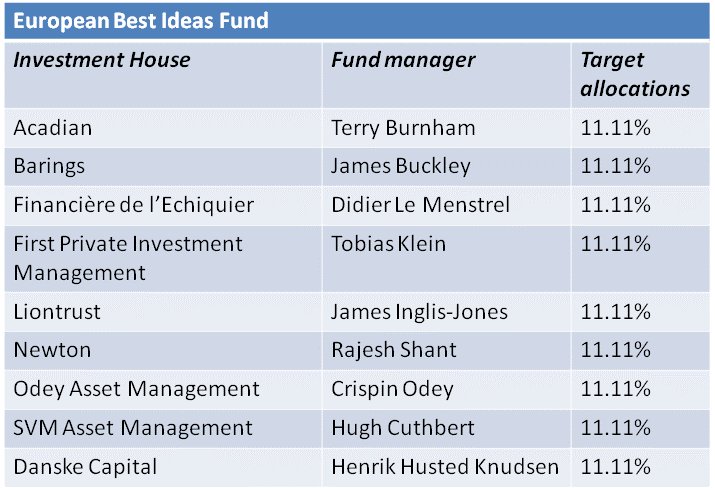
There are a number of hedge fund managers and managers of absolute return funds amongst the roster of managers employed by Skandia in the Best Ideas Funds. In fact I would go so far as to say that there is a disproportionate number of such managers amongst the portfolio managers used (see tables below). Would that be because hedge fund managers tend to apply the best portfolio management practices given by Skandia more than long-only managers?



Thursday, 7 April 2011

Consulting Two - No Explicit Cost v Negative Carry Option Strategies

In my consultancy work I have been surprised by the frequency with which I have come across zero-cost strategies in options. Traders and portfolio managers find them more alluring than they should. It is as if these strategies intrinsically have more merit and deserve more attention. They don't.

To take on an options strategy, in say an equity index, the trader or PM must have a view on the underlying. To have an informed view the trader must follow the instrument closely – this allows them to attach probabilities to the possible broad scenarios behind taking a view via options. So the thinking may be that the index has had a good run and is beginning to act tired; that is there is limited upside from the current level. Or it could be that a particular share has formed a double bottom, there is good value in them and selling might begin to dry up. The first scenario is one that might suit an over-writing of call options. The second might fit an underwriting near current levels by selling put options.

To simplify market activity there are three broad outcomes possible – a trading range, a further significant rise, or a significant fall. Lesser directional movements are captured in the trading range scenario. The money manager or trader will have views on the likelihood of each of these, or to put it another way, if pressed most money managers could attach probabilities to the three broad outcomes. The money manager might have a view that the odds of a significant decline are small, say 10%, but having had a good run the odds of a trading range to consolidate the rise is quite high, say 60%. And the chances of further significant upside are greater than the chances of a significant fall, given the evidence of new buyers – so the odds of a significant rise are 30%. Whatever the exact percentages, the trader will have his own take on what the probabilities are of the three possible outcomes. It is his own probabilities which need to be fed into the construction of an option strategy to make it a fit of his view.

Of course the further significant rise might follow an intermediate pause for refreshment in the price of the shares or index. The extent of time taken to consolidate or pause is a key point. This is the time frame factor, and all managers have a time frame in which they add most value. This is the period over which they generate alpha. If they are a scalper, they shouldn't be taking a view over the next quarter, and a fundamentally-driven stock selector should not be looking to implement a view over the next couple of days. If a manager has a variant perception on earnings, for example, that would normally emerge over several quarters rather than over a week. All option strategies have a time frame, fixed around the months of the option maturities. To be a good fit for the trader the option strategy has to take place over the right forecasting horizon for them.

In a commodity market traders will know the price level at which industrial users will be highly likely to come in to buy. They may know the price zone when commercial hedgers have historically increased their open interest. In the world of equities a manager will have a clear idea of where value is emerging in a particular stock, and where companies buy-in their own stock. In fixed income traders will know at what interest rate funding becomes attractive to a particular category of market participant. So the portfolio manager or trader will have his own mental map of the significant levels of the markets they follow as they see them. In contrast, traded options are bought and sold for strike prices set at intervals by the rules of the exchange on which they trade.

The currency of option trading is volatility. So it might be said that the vol on a class of options is at least a couple of points rich compared to its recent history. Or that the smile of the volatility curve is particularly skewed because of a recent freefall in prices, meaning that out-the-money puts are expensive relative to those with strike prices near-the-money. The 3-D volatility surface is what the options market maker takes his view on.

The users of options may or may not have a view on volatility per se. The users may have opinions on levels and how long it might take for moves to develop and mature, and what probabilities they attach to scenarios for their markets. Professional traders will have a view on vol. Portfolio managers who read a lot of fundamental research and meet company managements are unlikely to have a strong or well-informed view on option volatility by class, never mind by strike. So having done option training, PMs will know what implied and realised volatility are, but it is not the element on which they are typically able to take a well informed view. It is not their currency.

So it is that option strategies are often expressed in the language of levels – strike prices plus or minus net premium. For simplicity pay-off graphs tend to illustrate possible outcomes at maturity. This makes the marketing of strategies more straight forward, and expresses strategies in terms closer to those most readily understood by the widest number of portfolio managers. It does little for suitability or fitting with a manager's market view. And so we come to "zero cost" option strategies.

Zero-Cost Strategies
 
Zero-cost strategies would not matter much were it not for the frequency with which they are implemented. After all the PMs are all grown-ups and they can always say no to an options strategy proposal. But the allure of the cachet of no explicit cost seems to be very strong with the buy side. So a disproportionate number of strategies are created, sold and implemented based on the appeal of no up-front premium outlay.

The typical circumstances are that, for a give maturity, the premium attached to a near-the-money strike option happens to be twice the premium for an out-the-money strike option. This means that, taking account of one side being on the bid and the other on the offer, an investor can receive as much premium for selling two lots of options O-T-M as they pay for buying one lot of A-T-M options. The payoff profile is rising profit through to the OTM strike, and from that level out a declining profit.

Sometimes the ratio between the strikes dealt in is not 2:1, but say 5:2, but overwhelmingly in reality the zero cost collar or put protection is sold and implemented using a ratio of 2:1. The outcomes are then much more intuitive to comprehend (and pitch).

In the process of putting the strategy together the strike levels and maturity of options are selected to fit the template that the purchased premium outlay should be offset by the premium received from the options sold. Occasionally, when the term sheet is put together by a less experienced sell-sider, the O-T-M option is struck further out in time than the near the money option. This diagonal call spread/put spread is less elegant to sell and understand, and utilises two time horizons.

Now going back to the portfolio manager's use of options, he or she should use traded options when they efficiently implement their views on markets, and within their style of investing/trading. Their views come in several aspects: their own take on what the probabilities are of the (three) possible outcomes in the specific market; their own mental map of the significant levels of the markets;  and they should take views via option positions over a time-frame that has a resonance with their own horizon for adding value.

Explicitly stating the elements going into the views on markets makes plain how specific they are to the trader or portfolio manager. It may well be possible to express the market view of a portfolio manager using options – so the time frame, probabilities and significant levels match what can be achieved and structured in the options market. That can be guaranteed to happen using over the counter options; that is, using bespoke instruments. To a degree using pre-existing strikes, dates and a given volatility surface of traded options will always be a compromise versus that ideal fit.

Lay on top of that that zero-cost strategies are put together when there is a conjunction of option maturities, skewness and strikes that just happens to give a ratio of 2:1 in premiums, and the impartial observe can see that zero cost strategies are a very artificial construct. Further it is plain that in order to put them on portfolio managers or traders are quite conceivably having to compromise their own market view in some dimension to accommodate the implied view of the zero-cost option strategy. So the real cost of the zero-cost strategy is not the premium expended, which by definition is nil, but the potential for a significant compromise with the actual market view of the risk taker. This mis-match is too often the cost of the zero-cost option strategy.

Using Negative Carry Strategies
 
Parenthetically, the inverse of the driver of the zero-cost options strategy, has produced great returns in some hedge funds. Rather than be a net seller of gamma (through being short one unit of O-T-M delta) some of the most successful trades of all time have been long long-dated optionality. Being net long of option premium comes at a cost – there is time-value erosion to cope with. But for some patient investors there is a big attraction in having a negative carry trade which gives well defined upside/downside parameters.

The "greatest trade of all time" is the definitive example of the successful negative carry trade. Mortgage backed securities have embedded optionality in pre-payment risk, but through derivatives on MBS specific tranches and indices it was possible to construct trades that would benefit from no payment risk – when mortgagees hand back the keys on their houses. So it is that the likes of John Paulson and Kyle Bass made billions on the subprime meltdown. There was an explicit cost to the trade, but the downside was known from the outset, and at least in the mind of the originator of the trade the real risks were in rolling over the positions – the collapse was going to happen at some point, though its exact timing was not foreseeable.

A similar set up was seen by Mark Hart of Corriente Capital of Fort Worth Texas. Like Paulson he created a dedicated vehicle to run a long long-dated option strategy to play one specific investment idea for the medium term. In the case of Hart, the fund he created in 2007 with the founders of GavKal, the European Divergence Fund LP, owned credit default swaps on European sovereign risk. Hugh Hendry of Eclectica is hoping for a similar payoff (7:1 and better) from using CDSs for taking negative views on China-related plays.

Another successful manager that uses negative carry options is Jerry Haworth of 36 South Investment Managers of London. 36 South has a diversified fund, the Kohinoor Fund, that only uses long-dated options and which has a 10 year track record. Haworth has also set up funds to benefit from specific tail risk events that use the same approach – for example the Black Sawn Fund that made 234% in 2008.

For each of these managers the use of negative carry option strategies gives a very useful attribute - the left side of the distribution of returns is truncated. That is the range of possible outcomes is limited on one side, which is the classic desirable skewed distribution of hedge funds.

Finally, some successful managers will not engage in negative carry trades with optionality on a structural basis in their fund. Rather for some long established and successful managers they see themselves as earning the right to start to use these strategies once they have passed a return threshold for the year. So once they have earned 8 or 10% (and therefore have every chance of producing a double digit year as a minimum) they will invest some of their profits to give a shot at making a banner year.

When I was Head of Derivatives at Clerical Medical I used to tell the investment professionals there that derivatives should be used to implement their views on markets when the instruments allowed that to be done economically. So in specific circumstances, for a particular money manager, a zero-cost collar may exactly fit their market/stock view. But the investment concept invested in, and the fit of the option tactic with the view is more important than the explicit cost, as the successful examples of the use of negative carry option strategies show. 


The first article in this series on consulting in the hedge fund business can be found at Consulting One

Friday, 7 January 2011

Consulting One - Team Working in Hedge Funds

There is no such thing as a perfect hedge fund – we are all trying. So in my role as a consultant to hedge fund portfolio managers (PMs), I am usually carrying out remedial work in some dimension. Sometimes it can be about the positioning of hedge funds commercially, but usually it is about what the portfolio managers are doing. I'm going to write a series of articles about my consulting work – this is the first.

One of the key elements I have to investigate in my consulting work is the relationship between team members. I'm going to discuss one project I did with two joint-portfolio managers of an equity long/short hedge fund. This discussion is to raise issues and to describe ways of working. The team in this case comprised two members, PM "A" and PM "B", and they ran reasonably successful long-only products. There are three topics in this snapshot – the ground rules were not well established in this example, there were some important differences in style (personal and investment style) that got in the way of successful team working, and one of the portfolio managers had an unusual trait which had a bearing on his money management style. Finally I have included some of the solutions I gave to the portfolio managers and their boss.


Ground Rules

It is not unusual for a team to move from running long-only money together to managing a hedge fund. In doing so there will, of necessity, have to be new rules of engagement. Clarity of the decision making process is very important, for internal purposes (for accountability and reward), and for external parties like potential investors. It is important that there is agreement about the specific roles to be taken, and that there is a buy-in from the off of the structure adopted. A successful agreement or understanding will have a level of detail in it that may surprise some.

One of the most basic areas not made explicit in this case was the fund's objectives and the consequences that follow from that. The two portfolio managers did not have a common, agreed understanding of what returns would make the fund they both ran commercially attractive. Therefore they did not feel the need to measure their portfolio level risk and monitor it - where they taking too much or too little risk? They just didn't know.

Another consequence of this lack of commerciality in terms of return profile is that they had no notion of what was a the worst monthly loss they could sustain without putting themselves out of active consideration by investors. The worst monthly loss is a key metric both internally and externally. Internally the metric gives an implication of where portfolio level stops should kick in. Externally it is one of a number of measures that give investors an idea of what the whole risk profile should be like – number of winning-to-losing months, drawdown, recovery period, and what is a good and bad month for the style of investment.

One of the issues which provoked some tension in the relationship between the managers was how they split between them the sectors of the equity market they worked on. It was fine, and indeed seen commonly elsewhere, that the market was split into two – one half invested in by one portfolio manager. The tension, such as it was, arose because PM B did not want to be excluded from investing in some of the sectors covered by PM A. It was never satisfactorily covered in discussion at inception in the mind of manager B, and that oversight hung over discussions in the ensuing two or three years.

It is quite usual for a PM in a team of portfolio managers to be able to initiate positions without reference to their partners. But how the team will react to change for the positions (in size or price) does need to be covered in the ground rules. Is there any right of veto, is there a different scale of decision made when the partners don't agree? Once a position is owned is it subject to hard or soft stops – do both partners have to adhere to review and exit levels? For the fund and team under discussion one of the partners was much more engaged in challenging the positions initiated by the other partner. Whilst the partners whose positions were under discussion saw this as a personal style point (one partner was just more vocal/forthright than the other), the other partner saw such challenging discussions as part of the investment process. This difference in perception and therefore activity could easily undermine a relationship under pressure because of returns.


Differences Between the Portfolio Managers

Having had some preliminary discussions for an overview, and discussed at some length how the two portfolio managers spent their time and what structure they had in place in their investment process, some clear points of difference came through. To explore these further I conducted separate structured interviews – asking the same questions to each portfolio manager gave a chance to compare attitudes, preferences, and perceptions of the two team members. To put the following list of differences into context I quote from my written report on the managers: "The managers have fantastically complementary philosophies on the market. They get on very well on a personal basis. In fact they have worked incredibly well together with some quite significant differences in tactical approaches (strategy being broadly agreed)."


Differences in Time-Frame

PM B is more comfortable with the shorter term time-frame that running a L/S hedge fund usually requires. Specifically B is much more willing to incorporate the current implications of market action into his market view by stock than PM A.


Differences in seeing Companies and Stocks

They have a similar level of respect for each other's views on companies (specifically differentiating between stocks and companies). However, when looking at equities of companies (shares) portfolio manager B can be as dispassionate about shares as he can about companies. This is in contrast to PM A – who is still prepared to argue with markets when he likes the company, even when the share price action is saying that the market does not agree with the positive (or negative) view of the company in the short term. So the feedback loop from owning the shares – the P&L – is negative for the position and getting worse (e.g. if it is a short the shares are going up) and that message from the markets, even if it is just about short term timing of the position, is being ignored.


The Fall-back Input - is it Technical or Fundamental?

(or to put it another way "short-term or long-term" or even "stock market or real world")?

Through the structured interviews of the portfolio managers it is possible to tease out where there are differences between the team members on research time. For example, in this case PM A suggested that they needed to have 300 company meetings a year, PM B thought that 100 meetings a year with company management was enough. The different perceptions of what was needed fed through to the weighting given to the fundamentals. Or, as likely, reflected the biases the managers brought into the discussion. Under pressure PM A will rely on the fundamentals to win out, whilst PM B will listen to the message of the markets and will be prepared to cut losing positions.


Conviction or Confidence?

Operators in markets, particularly traders, but to a significant degree portfolio managers as well, bring with them the baggage from their previous life experience to their decision making. So sometimes in analysing a team it is not that there are subtle style differences so much as one of the team is coming from somewhere else attitudinally (or characteristically). There can be a one-sided difference, if you like. Portfolio manager X brings with them epsilon, whilst portfolio manager Y has acquired a trait of zeta.

Through the structured interview it came through very strongly that PM A (or the Alpha member!) had a strong conviction that the most important characteristic of a successful portfolio manager was confidence. It is true that someone operating in markets has to have the belief in themselves sufficient to take on the markets, but the very strong emphasis on confidence manifested itself in the investment process in this case. This happened in two ways.

The first expression of individual confidence, if you like an assertion of confidence of an investment view, was in position sizing. Having done the analytical work PM A would take what I would consider a large position for his initial holding in a stock. Almost by definition the stock was bound to be perceived as under-valued by the market at the point of taking the initial position. If the market further under-valued that (long) position by marking the shares down (causing a loss) this would create a "better" (cheaper) buying opportunity, so PM A would have some bias to expressing confidence in his initial view of the shares by buying more. But the more important point is the size of the initial holding – he may or may not add to the position. Portfolio manager B would take an initial position of less than half the size of that taken by PM A, and look to add to it.

The second expression of confidence was the maintenance of positions of large size. PM A would always look for a further up leg in longs he owned for fundamental medium-term reasons. PM B would have a bias to trim successful positions as the positive momentum waned (to top and tail the positions). There was clear anchoring by PM A in sticking to previously successful positions, and to cut them would, in his mind, be an expression of a lessening confidence in the initial research.


Recommendations and Suggestions to Address the Issues Raised

In this particular case I wrote a 30-odd page report to the CIO of the firm as well as presented my conclusions to the portfolio managers that ran the equity long/short hedge. In the report I made a series of tiered written proposals – key recommendations, other recommendations, and finally at a more elective level, some suggestions. In response to the issues raised above here are some of the Recommendations and Suggestions forwarded:


  • You should select what you consider to be "high potential" company meetings for both PMs to attend. This will enable higher conviction positions to be established at an earlier stage with a common background on the company.
  • Be very clear and explicit (shared between you) on the reasons for having a position in a stock. Indeed there may be five potential drivers for a stock to go up (or down), but you must be clear why you own it (are short of it). The stock position should be in a portfolio for reason of how it will contribute to the portfolio characteristics (factor bets) as much as any stock specific reason (factor). This allows you to control portfolio shape in an informed way. Drift in any one position may not matter, but when aggregated across a portfolio, factors like capitalisation effects will turn you into heroes or zeroes promptly in the hedge fund format. Own positions for a reason and stick to it.
  • You both have to have the capacity to invest in all sectors of the market.
  • You need a few mechanistic rules that you can apply to take even more of the emotion out of decision making:
  1. Automatic locking in profit/reducing exposure after a stated return. So a trading position that gives a 15% plus return in two weeks is completely sold, an investment position that gives 25%-plus return in a couple of months is halved automatically. The trading position can be bought again if it is equally attractive at some point. If the fundamentals still justify a larger position (they have improved since original position taken) then the investment position can be made larger.
  2. You need a review level and hard-stop level per position. I suggest a 10% loss on book should be a review level, and 15% is a hard stop level (sell whole position, no exceptions). As a reminder the ABC Large Cap Fund has a hard stop at 8% for non-core positions and a hard stop of 10% for core positions, and the ABC Europe Fund has 5 and 10% respectively.
  • Either can initiate a position, as at present. However there must be a vote before ADDING to a position – both PMs must agree.
  • Just as you need to know yourself to be an investor, you need to know your partner if you have joint and several decision-making, rather than having a presiding genius. Because you demonstrate some differences in personal style, there are times when you don't understand where your partner is coming from. I suggest that you complete a Myers-Briggs Model™ (Extravert, Introvert, Intuitive, Sensor, Thinker, Feeler, Judger, Perciever) questionnaire. This is particularly relevant for times of stress – we each revert to a fall-back way of operating and this is the kernel of what you need to know of each other for managing money as a team. If you understand more about where each other is coming from (not intellectually but in personal style) then you will be able to tolerate the differences more easily.

Monday, 20 December 2010

Two Sides of a Short Position - A High Quality Argument on Netflix

During my time as an analyst of hedge funds in 2000-2002, and later as a consultant working on portfolio management and risk management issues with hedge fund portfolio managers, I have been granted the privilege to hear the fundamental cases for positions taken by very good managers. Hearing about a single position in detail gives a potential investor or investment advisor some insight into how managers think about their positions. When consulting I would always ask how typical the sort of position is, as there is no structural insight given in hearing about something that is outside the usual style for the manager.

I look for several key points during discussion – how did the idea arise; what made the manager devote the scarce resource of research time to the company/industry; did the manager procure or carry out primary research on the company; at what level of the company has the hedge fund manager met management and how often; what sort of catalysts does the PM like to see, and has the hedge fund manager identified a catalyst for a change in fundamentals or for a change in (stock) market perceptions? All of these points will enable an outsider to gauge whether there is an edge in research. Consideration of the edge (if there is one), along with the breadth and depth of human resources in analysis, and a view on the creativity/fertility of the manager's mind, will feed into an assessment of the quality of the manager's alpha source and the potential for consistency in the alpha stream.

So it is I read with interest the published debate about Netflix between Whitney Tilson, the value-oriented founder and Managing Partner of T2 Partners LLC (www.T2PartnersLLC.com), and Reed Hastings, CEO of Netflix Inc. You can find Tilson's full rationale for his short position in Netflix at http://seekingalpha.com/article/242320-whitney-tilson-why-we-re-short-netflix, and the response by the Netflix CEO at http://seekingalpha.com/article/242653-netflix-ceo-reed-hastings-responds-to-whitney-tilson-cover-your-short-position-now. Most unusually for such a dialogue, it is a very high quality argument.

In this case the Netflix short is smaller than any of the top ten longs in the T2 portfolio. The fund manager does not have to be right on any one position, but how he (or she) deals with being right/or wrong in money management terms is important.

Saturday, 16 January 2010

Tosca Fund and Abaco Financials - Return Outcomes versus Portfolio Construction and Alpha Type

    Preface
The following discussion and analysis looks at two equity hedge funds that specialise in the financial sector. Naturally the sector was stressed as the nexus of the Credit Crunch, and the dislocations within the sector have created gross opportunities which have been taken advantage of by both the funds covered here. The longer-established Tosca Fund has undergone a successful reorganisation in order to align the portfolio processes with investors' requirements. So, to be clear, the portfolio construction elements discussed here relate to the Tosca Fund after the reorganisation of the final quarter of 2008.


One of the tenets of my consultancy business is that the portfolio construction and risk management used by a hedge fund should be consistent with the desired outcomes. The target returns are usually given as a range of absolute return per year, and sometimes come with a volatility of monthly return co-target or secondary target. The ranking of return versus risk assumption, whether it is volatility of return, downside risk, semi-variance, drawdown or worst monthly loss forecast is a primary element in understanding a particular hedge fund. Not just ex-post external measurement of risk versus actual monthly returns, but ex-ante from the perspective of the portfolio manager(s). What are they trying to achieve in terms of secondary risk characteristics other than absolute return, and how important are the higher moments in how they impinge on the investment process?

I have been looking at two hedge funds operating in the same speciality, and looking through their portfolio construction techniques. Both funds are financial sector specialists. Naturally, both the funds have had different portfolio shapes in the last 18 months than in the previous period.


Directional versus Market-Neutral
The Tosca Fund set up by Martin Hughes and now managed by Johnny de la Hay is a long/short global equity fund which is run with fund shape drawn from Hughes' experience at Tiger Management. Tiger cubs tend to have a net long bias, but to always have a significant short book. The shorts are there to make money more than hedge. The net varies between +30 to +50%. The gross used to be typically above a hundred and fifty percent of equity; the gross of Tosca Fund has been closer to 100% of equity this year. Tosca is a net-long bias, directional, and fundamentally-driven hedge fund.

ABACO Financials Fund is self-described by the managers as a market-neutral equity fund. It is of critical importance that that label market-neutral is at the first level of description along with the dedication to financials. For Inigo Lecubarri, Louis Rivera-Camino, and Martin Deurell who run the fund the beta-based market-neutrality encompasses a net between 20% net long and 20% net short. Striving to achieve relative performance within the portfolio, shorts are in place to hedge much more than for profit. A typical gross exposure (not average) has been, say, 190 percent of equity. A year ago the gross was less than 100% of equity, and is now back to the typical levels.

So the ABACO Financials Fund has had a structurally constrained and smaller net exposure to markets than Toscafund, and a slightly larger gross through its life. The gross exposure of the ABACO product is thought to be nearly twice that of Tosca Fund at the moment. The ABACO Financials Fund is a structurally market-neutral, very slightly directional equity hedge fund in which returns come from both fundamental investing and trading. Not that Tosca doesn't trade around positions at all, rather trading has not historically been a major contributor to overall returns.


Mandate Scope and Thematic Similarity
Tosca is not a pure financials fund. The top-down parts of the process includes a macro-economic analysis and micro-level analysis (firm and sector level) which gives an understanding of the growth prospects of various product categories. Whilst the core of this work is about the financial sector, inevitably the prospects of the financial sector as a buyer or seller of products and services becomes evident. So Toscafund invests in service sector stocks which the fundamental research process on the financial sector suggests will have a tailwind (longs) or headwind (shorts). For example, moves to a cashless, lower cheque utilisation banking sector drives demand for other forms of payment processing and transaction methods. The beneficiaries may be software or hardware providers.

ABACO is a pure financials hedge fund, with only a few positions being from outside Europe. The top-down elements of the ABACO investment process, the medium-term idea generation component, are very similar in outcome to those at Tosca. The knowledge base of the ABACO managers allows them to isolate the fundamental drivers for each sector and stock in their universe of more than 250 names. Drivers are of three classifications –a) Operational, b) Sector / Industry, and c) Macro-Economic. Companies financial performance is modelled based on the relevant drivers on the understanding that there is a trade-off between explanatory power and complexity. So for each company followed at Abaco the managers calculate an earnings sensitivity per factor. Earnings under various economic/sector scenarios can then be extrapolated, and then probabilities attached to the scenarios.

So for the top-down (longer time-frame) element both Tosca and ABACO are using a thematic approach. This means that in effect stock positions in the respective portfolios are knowingly related to a degree.

Time-Frames, Stops and Liquidity
The ABACO Financials Fund is managed with multiple time-frames as ABACO always has trading positions as well as core investments. The Tosca Fund is managed with a much greater bias to the medium term, and in hedge fund terms one could even suggest a long-term time frame. The Tosca process derives a target price based on internal analysis extending out two years or more. In the short term the stock market resembles a beauty pageant, and in the long term a weighing machine. The Tosca approach assesses the companies' worth on a rational multi-year basis (weighing machine basis) and looks through the fashionable or commonly held subjective biases.

This can be very powerful in allowing the manager of Tosca to argue with the short term perceptions in the market, and hold onto positions. Historically Tosca would tend not to use stops on positions or the whole portfolio, having taken a fundamental position on a stock.

The Abaco Financials Fund is run by three Portfolio Managers with different type of backgrounds:
from research (Inigo Lecubarri),portfolio management (Rivera-Camino) and from a trading background (Martin Deurell). Capital is allocated as a function of expected risk/return and catalysts, the latter acting as triggers for timing. So the core of the process is a creating an orderly ranking of long/short candidates. Candidates for inclusion are assessed for their marginal contribution to portfolio diversification before they are added. Both Tosca and ABACO use a correlation matrix of names in their universe to understand the relationships between their holdings (and potential holdings) on a historic basis.

Both Funds pay attention to the liquidity of positions – for Tosca Fund it must be feasible to liquidate 90% of the portfolio within three months of normal trading. In practise all but 10% of the current Tosca portfolio could be liquidated in 5 days on 20% of the market volume. For the ABACO fund at least 80% of the portfolio can be liquidated in less than a day's trading, and the balance of the portfolio can be liquidated in 2 to 3 days' trading. There are two factors at play here – size and style.

The Tosca Fund is more than $2.5bn in AUM, up to 20 times the size of the ABACO Financials Fund. As important is that the medium to long term holding period of the Tosca Fund is matched by fund liquidity terms of quarterly redemptions with 3 months notice. The ABACO Financials Fund has monthly dealing and it has a trading component as well as investment time-frame positions. So the liquidity demanded of the underlying positions of the ABACO fund is consistent with the style, just as it is for Tosca Fund.

Martin Deurell of ABACO has commented: "We are much more liquid (than Tosca) which can help us to execute the risk management efficiently. The drawback of this, of course, is that we can't capture certain alpha that Tosca can: they can take bigger positions in less liquid companies."


Some Diversification by Book for ABACO
As mentioned, a differentiator of ABACO versus Tosca is that the former explicitly run trading (short term) positions. Allocations of capital to trading positions vary through time, as does the P&L versus the medium term holdings. So there is an element of diversification by book for the ABACO Fund.

One further difference to emphasise between the two financial specialists is that, consistent with a market-neutral mandate, the ABACO Fund is described by the managers as a relative value fund. The long book is conceptually held versus the short book as it is at Tosca, but at ABACO the long and short books will be more similar. When a long position is put on by ABACO it is likely that a couple of short positions will be put on to minimise country and sector factors for the long. So for the same return target the ABACO fund structure would require a bigger gross.

Having written that however, the Tosca Fund (a global financials fund) is much more diversified by country exposure than the ABACO Financials Fund. Maybe it is appropriate as European financial specialists that ABACO has more concentrated country risk. It is clear too that both fund managers spend a lot of time analysing and ranking country growth and credit worthiness, so the thematic top-down element is at least partly about expressing country biases. It is worth pointing too that Tosca Fund takes an active view on emerging market exposures – over a market cycle this should contribute to both risk and return relative to a fund that only invests in developed markets.

In terms of the activity levels, from all of the above one could infer that the holding period of Tosca Fund is a lot longer than that of the ABACO Financials Fund, and that names turnover a lot quicker at ABACO. It doesn't mean that the research effort is more or less intense at either; it is just applied differently.

So on balance the manager of Tosca Fund is trying to extract alpha over a longer time-frame than the managers of the ABACO Financials Fund, and given the larger bias to fundamentals has been more prepared to argue with the markets. Tosca Fund is net-long biased; ABACO Financials Fund is a market-neutral relative value fund. The target return of Tosca Fund is 15-20% net to investors over a full cycle - something it has achieved historically for most of its existence. I believe it will be achieved in future. The target return for ABACO Financials Fund is 10%, and just about as important to the managers is the lack of correlation to markets.

Outcomes from the Two Styles

Tosca C (since re-organisation) versus a Peer Group of European-Based Equity Hedge Funds


The Tosca Fund was up 43% in 2009, the fifth time it has posted annual returns in excess of 20% since its inception in late 2000.


Data Source: Eurohedge

The ABACO Financials Fund has had an annualized return since inception in June 2003 of 8.69% ($ version) achieved with a monthly volatility (annualised) of 5.99%, and is having its best year yet in 2009. However, given the mandate, it is just as significant that the returns of the ABACO Fund have an r2 of 0.01 with the S&P500, according to a hedge fund database. Further the return series for ABACO has a negative correlation with other hedge fund equity market neutral funds, at least at the hedge fund index level. The Fund also shows nearly no correlation with the European financial sector time series.

Monthly and Annual Return of ABACO Financials Fund (EUR)

2003
2004
2005
2006
2007
2008
2009
Jan
--
0.71%
1.92%
1.32%
-1.06%
3.67%
2.89%
Feb
--
2.20%
0.85%
3.64%
1.61%
-0.46%
3.07%
Mar
--
0.84%
0.22%
-0.87%
0.44%
-3.13%
-2.58%
Apr
--
-1.54%
-1.02%
-0.50%
2.49%
4.01%
0.56%
May
--
0.69%
-0.34%
0.20%
2.70%
0.14%
2.75%
Jun
0.49%
2.06%
-0.15%
1.29%
1.19%
1.53%
-0.33%
Jul
0.59%
-2.31%
1.14%
0.18%
-2.63%
0.58%
1.37%
Aug
0.50%
0.45%
-1.07%
2.45%
2.65%
1.58%
4.98%
Sep
0.55%
1.26%
1.58%
1.40%
-0.83%
-5.33%
2.22%
Oct
1.34%
-0.18%
0.93%
0.61%
-0.36%
1.14%
-1.90%
Nov
0.51%
-0.42%
1.51%
2.37%
-1.61%
1.35%
2.29%
Dec
2.58%
0.76%
-0.27%
-0.66%
2.28%
0.36%
0.64%
YTD
6.73%
4.51%
5.37%
11.93%
6.89%
5.19%
16.88%
Source: Hedge fund database
The top down processes and risk measurements used by the managers of the two financial equity hedge funds are similar. The risk management and portfolio construction of the two hedge funds are different, but each consistent with their respective sources of alpha and targets for return, and explicit (ABACO)and implicit (Tosca) higher moments of their return series. Investors in hedge funds should always evaluate the extent that the portfolio construction and particularly the money management element of running a hedge fund is consistent with the form and time-frame of insight into markets utilised by a manager. In these two cases they are.

Thursday, 24 December 2009

A Creative Way to Build a Hedge Fund Brand Name – Broadwalk Asset Management

I was listening to trader trainer Michael Martin interview Jim Rogers on his excellent website (http://martinkronicle.com/), and I heard Jimmy Rogers say that investors should stay with what they know and are interested in. In working with portfolio managers I often ask them which sectors or types of stock they are good at investing in, and which they can't seem to get right. It may be they can't read retailers, or always seem to mis-time growth stocks, but it is very important to eliminate what you are not good at as a trader or investor. I think of it as playing defence to some extent – by eliminating a repeated error, and focussing on what you are provenly good at your returns have to improve.

There may be an element of ego involved – it may seem a sign of weakness on the part of a money manager to leave out a sector or type of stock from their universe. But investors, and ultimately the manager, will only be interested in the scale of returns achieved. So my conviction is to put the ego to one side, check the data, and eliminate areas of weakness. For example I worked with a manager who occasionally dabbled in the financial sector, but whose major strength was in consumer-related sectors. Analysis showed that the hit rate (percentage winning trades) was a lot lower in financial stocks than in other sectors, and I advised leaving the financials alone. Losses in the financial positions were slightly larger than those typically tolerated. If anything the stop-losses should have been tighter and positions sized smaller initially.

The ultimate specialism is sector funds, a strategy area I hope to return to shortly in more detail. In Europe we have begun to be used to hedge funds specialising in sectors, though they are a well established and successful phenomenon of the US hedge fund industry. Investor interest in sector hedge funds should be strong – the return data suggests they can offer enhanced return and lower correlation with markets if the funds have an appropriate framework for portfolio structure. The evidence for this contention is stronger at the manager level than at the index level - there is scope to add a lot of value to a portfolio hedge funds through manager selection in sector funds.

I came across an unusual sector fund this month. The Broadwalk Select Services Fund, run by Charlie Cottam, is Europe's first "Services" sector focused fund. The Fund has been going since June last year, and it has been going rather well. Most hedge funds made money in the first half of 2008 and lost more than their first half gains in the second half of the year. The Broadwalk Select Services Fund was up 1.3% over the last seven months of 2008 through putting in four down months and three up months. Obviously the average up-month in 2008 was bigger than the average down-month!

Charlie Cottam preserved capital well in the first few months of this year, and did better thereafter: through the end of November the Fund is up 44% for the year. The relevant market index for the fund is the FT-All Share Index (the Fund concentrates on UK companies), and that benchmark was down in four months of 2009, and the Fund managed by Broadwalk Asset Management was down in only one of those months. Over the whole life of the Fund the FT-All share has been down 14.6%. According to the manager he didn't get properly invested until February/March of this year, but once he did he made excellent returns through stock selection – the net is now about 80%, and the fund is concentrated (large position size).

The manager of the Fund claims two forms of competitive edge: better information and original analysis. The original analysis comes from Cottam's experience on the sell-side. As a chartered accountant himself he sees accounting issues not well understood by those analysing the service sector specifically. He may have a point as there are few sell-side analysts in the sector with similar tenure as an analyst. The manager himself sees an advantage in his ability to use his been-through-the-cycle experience to turn around his conception on a company and stock quickly – he can grab an emerging opportunity at the time when other analysts are getting out their apocryphal pen to write a research note.

Cottam is an experienced sell-side analyst, and in that may be a true edge as he was company broker to 33 UK corporates. This unique arrangement for UK quoted companies – a corporate brokership for each quoted company – gives the appointed broker a privileged position in terms of access to management. Cottam has kept his company network intact as he has moved to the buy side. His management contacts and experience of individual management teams based on their historic behavior helps Cottam to spot the early warning signs of change in outlook for companies and sectors. His sell side experience enables him to understand the flow information on stocks and their relative positioning in the market.

So Charlie Cottam uses his deep experience in service companies to extract alpha – staying with what he knows and is interested in. He has also taken steps to reinforce his edge by keeping senior management engaged with Broadwalk – last year he initiated the Broadwalk Business Services Awards. This is the second year of the Broadwalk Business Services awards to recognise outstanding achievements by quoted companies in the business services sectors. The UK often leads the world in business services -it is one of the less well-known success stories of the economy, and these awards are a step towards raising its profile. The categories and 2009 winners are: Company of the year (Aggreko), CEO of the year (Nick Buckles, G4S), Chairman of the year (John Peace, Experian), Deal of the year (Balfour Beatty - Parsons Brinkerhoff), Small company of the year (Hargreaves Services), and Entrepreneur of the year (Michael O'Leary, Ryanair).

I think this is a terrific example of creative thinking by a hedge fund manager, and Charlie Cottam's entrepreneurialism and unusual means of brand building are to be commended.