This year I have experienced two rounds of the Battle of the Quants. The first was the edition of the radio show "The Naked Short Club" broadcast on Monday of this week.
Host Dr.Stu bursts into the studio with his posse, and sets about arranging the guests
The show featured a line up of speakers that were going to feature at the conference later in the week:
Dr. Marco Fasoli- Managing Partner, Titian Global;
Robert Passarella- MD, Dow Jones;
Con Keating*- European Federation of Financial Analysts;
Simon Kerr- Enhance Consulting/Hedge Fund Journal;
Bartt Kellermann- Organiser, Battle of the Quants
There was some great too-ing and fro-ing between guests as topics were debated - both sides seemingly with conviction. It was the best edition of the show I have been on myself.
Bartt Kellerman, Rob Passarella, and guest announcer
and "Dazed & Confused" Editor Rod Stanley squeeze into the studio.
Rod Stanley reads his script, while Dr. Marco Fasoli
and Con Keating prepare to respond to a tough question.
If you would like to listen to this show you can hear it via this download link.
My second round of Battle of the Quants was the full conference held on Thursday the 16th June, at which the Keynote Speaker was Dr.Paul Wilmott, Ph.D, publisher of the eponymous quant magazine and website. His professional background includes trading volatility at a hedge fund, so he has seen and applied quantitative methods as used in finance in practice as well as in theory. He addressed his audience of quants and investors in quant funds on some of the problems of doing this. He cited calibration and market completeness as particular problems.
An example of calibration is the the estimation of volatility for the pricing of derivatives. Models have to be fit for purpose and reflect the world as is. According to Paul Wilmott re-calibration of a model by changing parameters is a form of model risk. He was aghast to inform his audience that regulators of financial activity like to see re-calibration of banks' models used to price products and estimate risk, sometimes to the point of enforcing re-calibration.
Dr.Wilmott sees the concept of market completeness as somewhat dangerous. Markets are incomplete in reality - even fast moving markets with very large volumes have gaps in price, as fx markets show over and over, and the flash crash in the S&P showed last year. The quant maven asked rhetorically "Why then is the idea of market completeness popular?" It is because it enables market participants to use ideas of risk neutrality and a certain type of mathematics. The danger is in the fact that risk neutrality in a state of market completeness is a special circumstance, and not the governing mode of markets.
The Keynote Speaker had a theory about quantitative techniques as used in finance - that most people who use them don't much go beyond the tools of second year undergraduate mathematics. In particular, Paul Wilmott claimed that knowledge of fluid dynamics and the maths of mechanics would replicate how most people in the market address some very complex real world topics in finance. He gave an example of coming across a group in a financial institution attempting to model hurricane activity who assumed a log-normal distribution.
My own take on this is that the application of quantitative techniques to markets is no different than, say, a fundamentally driven approach: there are a range of abilities and resources being applied within the broad category. So for those that analyse industries and companies there will be some who rely only on street research; there will be those who carry out there own research, and those that employ expert networks. The depth of knowledge and understanding of a company or industry will vary a lot, and (relative) bet size should vary with the size of the edge (and risk/reward).
A good example of how different market participants cope with the shortcomings of modelling is in the pricing of traded options. All market participants (apart from the retail punters) are aware that the distribution of market returns is not log-normal. If you like, if you have a Bloomberg screen you will know that there is a smile in option pricing in OTM puts. If you are running money at a long only institution and use options you will be aware that those OTM puts are not necessarily expensive, but reflect a higher probability of a large fall in the underlying asset than is reflected in a log-normal distribution of returns. For the long only investor, who would hedge or take risk using options over a period of weeks-to-months, the assumption of the distribution of returns is flawed but sufficient for the purpose. For a market maker, who is modelling a three dimensional volatility surface and managing risk through constructing a risk book with a positive gamma, and has a time frame of intra-day and over-night risk, the assumption of log-normal returns is not adequate. No market maker uses pricing software that assumes that naive distribution of returns. So the different utility functions of the types of market participants will feed into the willingness to operate with a pricing model that is known to have shortcomings.
*Con Keating told a good story off-air about getting through US Immigration quite a few years ago. Although UK passport holders benefited from a visa waiver scheme when travelling to the US, Brits still had to fill in the customs form. Keating completed his and waited-in-line to be seen by the customs/immigration officer. Many will know that the US immigration procedures for an alien can be tough - they don't hesitate in sending visitors back on the next flight.
Finally Con Keating got over the yellow line and handed over his papers; the officer raised an eyebrow on reviewing them: "Mr. Keating you know we take immigration matters very seriously here. You don't appear to be doing the same: it says here under 'currency and valuable material' being brought into the United States that you are bringing in $223million. Is that correct?"
Keating confirmed that it was, and the officer went to have a consultation with his superior, eventually deciding that it was okay for the would-be visitor to enter the United States. Keating was much relieved as although he was there for a series of important business meetings he also had the job of delivering $223m of bearer bonds on behalf of his employers!
Friday, 17 June 2011
Wednesday, 8 June 2011
Out of the Box - Graphic of the Day – Why Hedge Funds Will Continue to Grow
One of the advantages of looking at the activities of institutional investors is that their behaviour follows decision-making which stands for years at a time. The Investment Committee of a pension plan changes the strategic asset allocation say every 5 or more years. There may be a decision made to have 25% of plan assets in domestic equities with a tactical band of 20-30%, which allows for variation on an annual basis away from the central tendency of 25%. But for most of the time over six or seven years the plan assets will be around 25% in domestic equities from that point onwards, after a period of implementation.
The implementation of the change in asset mix will often take place over a year or more as mandates are changed, contractual notice is given to the money managers with the mandates, and the underlying assets are bought and sold. Allocations to domestic equity have tended to shrink over recent years, so the process might involve a plan sponsor giving six month notice to a Trust Bank that their mandate will halve in size, and then, in six months time the bank will liquidate a portion of their large cap mutual fund and transfer the cash to the pension plan's administrators.
The reverse process is expected to happen for hedge fund allocations over the next few years if the survey of investment consultants by Casey Quirk and eVestment Alliance is to be believed. The survey*, conducted in Dec 2010 and January 2011, asked investment consultants to forecast investment preferences and buying behaviour among North American institutional investors during 2011. One of the key trends that Casey Quirk identified was "The increasing role of heretofore "alternative" investments—hedge funds, private equity and real estate—which are emerging as the centerpiece of active asset management moving forward."
Graphic of the Day - Hedge Funds Break out of The Box
The Emerging Institutional Investment Framework
Source: Casey Quirk (Note Not to Scale)
The key point in this is that the way institutional investors see how they can use hedge funds is changing. It was hedge funds as part of an alternatives category - in a segmented ghetto by risk/return. This is changing towards hedge funds as sources of alpha within broader asset categories. Hedge funds are breaking out of the box!
Putting this framework, and the consequent asset shifts, into practise over coming years will not benefit all asset management businesses. Amongst the attributes of the winning asset management firms, according to Casey Quirk and eVestment Alliance, will be
- Managers offering non-correlated investments.
- Firms offering both "traditional" and "alternative" investments will stand the best chance of providing institutional clients with a total portfolio solution.
- Product development and innovation will remain critical competitive differentiators.
2011 Product Opportunity Map
Source: Casey Quirk, eVestment Alliance
It is important to understand that the product opportunity map compares expected search activity for the upcoming year relative to forecast from the previous year. What is clear is that consultants continue to believe that longer-term trends in search activity favour hedge funds, funds of hedge funds, and non-U.S. equities. However, there is a perceived shift in the demand for funds of hedge funds:
"Consultants focused on larger investors, as well as those focused on non-profit funds, expect more searches for direct investments in hedge funds than they did in 2010. This reflects three realities.
- First, most North American institutional investors selected a core fund of hedge funds in recent years, and few are yet convinced they need a change.
- Second, and more importantly, larger investors now seek more specialized FOHF strategies in place of, or in addition to, a diversified FOHF mandate. This challenges many FOHF vendors who do not offer a focused product.
- Finally, larger institutional investors—particularly well-funded non-profit funds—still seek to avoid higher fees and pooled vehicles offered by FOHFs.
FOHFs remain core investment vehicles among smaller pension plans who lack resources to select or access direct hedge fund investments. Additionally, investors increasingly are using outsourcing firms to provide exposure to a portfolio of hedge funds."
The trends identified by the survey authors will likely persist for some years, as allocations in pension plans change slowly, and allocations to hedge funds are going up – doubling in some forecasts. So hedge fund capital flows should be positive at the industry level on a multi-year outlook. There is still a role for funds of hedge funds serving American institutions, and indeed there should be growth in assets this year and next for funds of hedge funds as a whole. But to benefit from those allocations funds of hedge fund businesses are going to have to be in the top quintile of performance ranking over 5 years, and in 2008 specifically, or have a very good specialised product (by geography or investment strategy) to offer.
*This year, 55 investment consultants, representing an aggregate $10.4 trillion of assets under advisement participated in the survey.
Thursday, 2 June 2011
Seth Klarman of the Baupost Group - his top investment books
When I put my top investment books on this webpage (see lh margin) the choices inevitably reflected the style of investment I use myself. The books which enhanced that style rise to the top of the list, as well as those that are well written or well structured.
Similarly, looking at Seth Klarman's recommended reading list (given at the CFA conference last year), the choices reflect his value based style of investment:
Benjamin Graham's "The Intelligent Investor"
Joel Greenblatt's "You Can Be A Stock Market Genius"
Martin Whitman's "The Aggressive Conservative Investor"
Michael Lewis' "Moneyball: The Art of Winning an Unfair Game"
Andrew Ross Sorkin’s "Too Big to Fail"
Klarman also recommends the work of a couple of authors: Jim Grant and Roger Lowenstein.
You will know Jim Grant from Grant’s Interest Rate Observer. So you probably know how well he writes. His book titles are: "Bernard M. Baruch: "The Adventures of a Wall Street Legend" (Simon & Schuster, 1983), "Money of the Mind" (Farrar, Straus & Giroux, 1992), "Minding Mr. Market" (Farrar, Straus & Giroux, 1993), "The Trouble with Prosperity" (Times Books, 1996) and "Mr. Market Miscalculates" (Axios Press, 2008).
Roger Lowenstein I know best from his book on LTCM. These are some of his titles: "Buffett: The Making of an American Capitalist" (Random House,1995), "When Genius Failed: The Rise and Fall of Long-Term Capital Management" (Random House 2000), "Origins of the Crash: The Great Bubble and Its Undoing" (Penguin Press, 2004), "The End of Wall Street" (Penguin Press, 2010).
Wednesday, 1 June 2011
Hedge Fund Radio on the 6th June
Make sure you listen out for the Monday, June 6th edition of the Sony Awards-nominated N@ked Short Club on Resonance FM [104.4FM within London/online worldwide on the internet here]: 1 hour of loose talk about hedge funds and the state of the world, plus sweet prose and heady music...No promotional agenda, no commercial intent...just Ponzi Bier and Pure Alpha both on tap.
Host, Dr. Stu will help callers to the Emergency Hedge Fund Helpline (1-800-DISTRESSED) to re-evaluate their Inner Mark to Market, with expert guests: David Miller, CIO- Cheviot; Mike Gasior- CEO, AFS (astrally projected from the US); Philippa Malmgren, President- Principalis; Simon Kerr- Enhance Consulting/Hedge Fund Journal; Stephen Pope, Managing Partner- Spotlight; plus City headhunteress/ writer, Sarah Dudney & the Galleon-smooth Anna Delaney.
The show is broadcast between 9-10pm/ 21.00-22.00 hrs., London time.
And you can listen to a podcast of the show at (for a period):
http://dl.dropbox.com/u/1442785/The_Naked_Short_Club_6th_June_2011%20.mp3
And you can listen to a podcast of the show at (for a period):
http://dl.dropbox.com/u/1442785/The_Naked_Short_Club_6th_June_2011%20.mp3
Wednesday, 25 May 2011
How Hedge Funds Can React to the Insider Trading Enforcement Initatives of the US Govt
According to law firm Baker & McKenzie, the recent conviction of Galleon Group's Raj Rajaratnam serves as a further alert to hedge funds of the heightened risks posed by the US government’s sweeping insider trading enforcement initiative and the need to mitigate those risks proactively. In a client alert partner Marc Litt gave six things you need to know about the government focus on insider trading, and proffered some suggestions as to how hedge fund management businesses should respond. As a significant part of the readership of this website is hedge fund managers based in the United States I thought I would share the most relevant parts of the client alert.
Six Things You Need To Know
Among the lessons to be drawn from the government’s ongoing focus on insider trading and the conviction of Rajaratnam are the following:
1. More to come. Although the Rajaratnam conviction marks the highwater mark, to date, of the government’s crackdown on insider trading, it does not mark the end of that effort; there is more to come.
2. Aggressive enforcement tactics. Prosecutors will continue to use aggressive enforcement tactics, including wiretaps, search warrants and recordings made by cooperators, to build criminal insider trading cases.
3. Not just criminal enforcement. Where there is insufficient evidence to bring criminal prosecutions, regulators may instead seek sanctions through civil and administrative proceedings.
4. Reputational damage. Mere association with insider trading allegations visits severe reputational damage on the institutions involved and, especially in the case of hedge funds, can result in dissolution.
5. Compliance counts. The best way to avoid being swept into the enforcement net is to develop a rigorous insider trading compliance program, including a zero tolerance tone from the top, routine training, clear policies on using, or serving as part of, so-called “expert networks,” and spot-checks on whether the compliance program is being followed.
6. Be prepared. Develop a plan and provide training on how to react should the Government knock on the door.
How A Hedge Fund Business Should Respond
1. Review your compliance program, particularly your policies and procedures designed to prevent insider trading. Assess whether sufficient resources have been devoted to compliance.
2. Make sure that the use of expert networks or consultants is carefully controlled. Although the use of such resources is not per se illegal, it is a practice that is under scrutiny. A hedge fund should take appropriate steps to ensure that any information it receives is not material nonpublic information, including conducting due diligence on the source of the information.
3. Provide regular training on insider training geared to the investment strategy followed by the fund(s). Make sure that traders understand the risk to the firms reputation and existence were it to be associated with insider trading or any other illegal activity.
4. Prepare for the unexpected. Develop protocols and train employees with respect to: (a) securing information (hard-copy and digital) in the event the fund receives a subpoena; (b) responding to a search warrant; and (c) responding to approaches by law enforcement.For further input go to the website of the law firm (www.bakermckenzie.com) or contact Marc Litt at +1 212 626 4454 ( or marc.litt@bakermckenzie.com)
Wednesday, 18 May 2011
A State Pension Plan Hedge Fund Mandate - It Takes a While
American investing institutions are the dominant source of capital for the hedge fund industry. It is important to understand how and why they act. The Wyoming Retirement System just announced who would be managing its assets for its first hedge fund allocations. The winners of the mandates are not surprising, but here the focus is on the process that resulted in those winners. A search of the internet for references to the Wyoming Retirement System and hedge funds allows you to put together a chronology from the headlines:
June 2001: "Wyoming Studies Alts"
…The Wyoming pension fund is planning to make a decision about whether to push into alternatives investments such as real estate, private equity and hedge funds. ..Plan officials are working with the fund's consultant Buck Consultants.
August 2004: "Wyoming Puts Hedge Funds on the Back Burner"
…Wyoming has been slowly continuing its hedge fund education ... and would likely consider a fund of funds to temper its risk…
November 2004: "Wyoming to Decide on Hedge Funds Next Year"
…The plan has been mulling an allocation to hedge funds for more than a year…Mellon Consultants is advising…
March 2005: "Wyoming Appoints PIMCO for Absolute Return Mandate"
March 2009: "Trent May Joins Wyoming as First CIO"
…Trent May joins from hedge fund Deer Creek Capital Partners…
August 2009: "Wyoming Taps NEPC as General Consultant"
November 2009: "Wyoming Considers Its First Hedge Fund Investment"
… The change of tack has much to do with the retention of New England Pension Consulting as an advisor by the retirement system in September…
April 2010: "Wyoming Board Gives Permission to Invest in Hedge Funds"
August 2010: "Wyoming Puts out Combined Search"
…Wyoming Retirement System, is searching for multiple managers to run up to $560 million combined in a global tactical asset allocation strategy and a global macro hedge fund strategy… The system plans to hire three to six managers for a global macro hedge fund mandate, which will make up 30% of the $560 million. Trent May said the number of managers hired for both investments is dependent on RFP responses. The two investments will make up about 10% of the entire portfolio.
The selection process uses the Due Diligence Questionnaire (DDQ) as the key screening document. The risk/ return data should reduce the list of all applicants down to long list. And the DDQ can be used to get to a short list that can be evaluated for full-blown due diligence. New England Pension Consultants have put together some great questions to ask in addition to those in the standard questionnaire. They are in the full document for which the link has been given. In this case NEPC have used the Greenwich Roundtable Global Macro DDQ as the starting point – and very good that is too, as are all the Roundtable Guides. The following are extracts from the request for proposals for the hedge fund mandate:
The result of the search is that Moore Capital Management, Graham Capital Management, Brevan Howard, Caxton Associates and BlueCrest Capital Management have each been given $30m of capital, and a further global macro manager is expected to be appointed. Although the RFP gives threshold criteria of at least $250m in AUM and a minimum of a 2 year track record, which give scope for dozens of firms to qualify, it is hard to argue against the selections made. Amongst the five named there is a good variety of style, bias by asset class, and differences in pattern of return. It has taken a while in this particular case, but it is easy to see, given the process, why the hedge fund industry continues to get more concentrated as it is driven by American institutional investor flows.
June 2001: "Wyoming Studies Alts"
…The Wyoming pension fund is planning to make a decision about whether to push into alternatives investments such as real estate, private equity and hedge funds. ..Plan officials are working with the fund's consultant Buck Consultants.
August 2004: "Wyoming Puts Hedge Funds on the Back Burner"
…Wyoming has been slowly continuing its hedge fund education ... and would likely consider a fund of funds to temper its risk…
November 2004: "Wyoming to Decide on Hedge Funds Next Year"
…The plan has been mulling an allocation to hedge funds for more than a year…Mellon Consultants is advising…
March 2005: "Wyoming Appoints PIMCO for Absolute Return Mandate"
March 2009: "Trent May Joins Wyoming as First CIO"
…Trent May joins from hedge fund Deer Creek Capital Partners…
August 2009: "Wyoming Taps NEPC as General Consultant"
November 2009: "Wyoming Considers Its First Hedge Fund Investment"
… The change of tack has much to do with the retention of New England Pension Consulting as an advisor by the retirement system in September…
April 2010: "Wyoming Board Gives Permission to Invest in Hedge Funds"
August 2010: "Wyoming Puts out Combined Search"
…Wyoming Retirement System, is searching for multiple managers to run up to $560 million combined in a global tactical asset allocation strategy and a global macro hedge fund strategy… The system plans to hire three to six managers for a global macro hedge fund mandate, which will make up 30% of the $560 million. Trent May said the number of managers hired for both investments is dependent on RFP responses. The two investments will make up about 10% of the entire portfolio.
~~~~~~~~~~~~~~~~~~~~~~~~~~~~~~~~~~~~~~~~~~~~~~~~~~~~~~~~~~~~~~~~~~~~~~~~~~~~~~~~~~~~~~~~~~~
As a responsible and accountable public body the Wyoming Retirement System has to make available documentation for its processes and meetings. The source document for the combined search is well put together, and can been seen here.The selection process uses the Due Diligence Questionnaire (DDQ) as the key screening document. The risk/ return data should reduce the list of all applicants down to long list. And the DDQ can be used to get to a short list that can be evaluated for full-blown due diligence. New England Pension Consultants have put together some great questions to ask in addition to those in the standard questionnaire. They are in the full document for which the link has been given. In this case NEPC have used the Greenwich Roundtable Global Macro DDQ as the starting point – and very good that is too, as are all the Roundtable Guides. The following are extracts from the request for proposals for the hedge fund mandate:
Global Macro Hedge Fund Managers
To be considered for appointment as a global macro hedge fund manager pursuant to this proposal, investment management firms shall have not less than:
- $250 million of verifiable total firm assets under management
- Two (2) years verifiable Global Macro investment experience
List of Requested Documents & Data
DDQ
Pitchbook
Historical Monthly Returns & Monthly AuM in Excel
Organizational Chart
PPM
Biographies of Principles and Investment Professionals
Latest Monthly/Quarterly/Annual Letter & Risk Reports
EVALUATION AND SELECTION
Proposals will be evaluated and subsequent judgments made taking into account the following criteria:
- Performance – Return and volatility expectations. While each manager will be evaluated on its relative investment merits the aggregate GTAA allocation will be measured against a 60% MSCI ACWI / 40% Barclays U.S. Aggregate benchmark.
- Expertise – (a) Similar work performed for other institutions, with references of such funds to be specified in the proposal; (b) Assets under management; and (c) Investment experience broadly defined and experience in global tactical investments specifically.
- Key Personnel – Personnel to be assigned to this account, including key professionals, applicable portfolio managers, back-up and other staff assistance, and education and experience of all such key personnel.
- Fees – Reasonableness and competitiveness of fees.
- RFP Proposal – Clarity and responsiveness to requirements as requested in the RFP.
- Philosophy and Style - the extent to which the proposed philosophy and style best complement existing philosophies and styles and meet the requirements and expectations as presented in this RFP.
Selection Process:
- All RFP's will be reviewed with respect to the evaluation of the proposal by the Wyoming Retirement System's staff and the Board's investment consulting firm, New England Pension Consultants (NEPC). WRS' Chief Investment Officer, with the approval of the Executive Director, and in consultation with NEPC will be the sole judge with respect to the final selection of the firm(s) hired.
- Finalists will be notified of the results of the RFP selection process as soon as possible following selection; due diligence visits may be arranged with firms who make the finalist list.
The result of the search is that Moore Capital Management, Graham Capital Management, Brevan Howard, Caxton Associates and BlueCrest Capital Management have each been given $30m of capital, and a further global macro manager is expected to be appointed. Although the RFP gives threshold criteria of at least $250m in AUM and a minimum of a 2 year track record, which give scope for dozens of firms to qualify, it is hard to argue against the selections made. Amongst the five named there is a good variety of style, bias by asset class, and differences in pattern of return. It has taken a while in this particular case, but it is easy to see, given the process, why the hedge fund industry continues to get more concentrated as it is driven by American institutional investor flows.
Thursday, 12 May 2011
PODCAST FIVE - Sources and Types of Investor Demand As Seen by Third Party Marketers
Two 3PMs (James Palmer and Jonathan Lee) discuss the state of the industry with Simon Kerr.
Clicking on the link will open a page containing the sound file - download (mp3 format) or play in your browser. The use of a graphic equaliser will probably help the listening experience.
PART ONE (19.25)
Introduction to speakers and firms they represent.
2.38 Offices in different locations
4.26 What does a researcher do at a 3PM?
6.08 Testing a potential manager – chemistry, can they pitch and explain their edge? People, pedigree, performance, protection, process and place
8.34 Environment for capital raising? More competitive than ever. Perception of career risk amongst investors. Getting a "no" is easier.
14.02 US leading the way as investors and as providers of appropriate products.
15.58 Monthly liquidity required in Europe, share classes with better redemption terms
18.35 Demand for reporting status amongst UK investors in hedge funds
PART TWO (14.2)
UCITS - only few American funds going that route
1.22 Funds of funds – Some of big US funds of funds doing very well, smaller ones merging
5.04 Marketing and the increasing prevalence of investment consultants
8.34 How do you approach an investing institution with many layers of decision makers?
12.32 Due diligence changed, sales process changed?
PART THREE (16.0)
Where the demand for hedge fund product is concentrated.
3.20 Bringing American managers to Europe
5.55 Marketability of hedge fund UCITS – new marketing opportunity
8.03 What strategies are in favour? EM managers are still of interest; Increasing interest in market neutral.
12.00 Market environment/cycle good for which strategies? Sector funds have attractions.
PART FOUR (20.43)
Testing prospective managers. The edge, trust, establishing an understanding of outcomes between the external marketer and investment advisor.
3.59 Sourcing managers
6.05 Reporting by managers is response to the greatest current issue of transparency, and helps with capital retention.
10.20 Taking an investor relations role – maintaining dialogue with client
13.22 Dealing with a drawdown – investors buying into a drawdown? Unrealistic expectations from managers. Helping manager manage their time.
16.55 Demand for early stage managers. Critical level of AUM is now $150m. Record in 2008 important.
CONTACT DETAILS
JAMES PALMER
http://redskycapsol.com +44 (0)203 178 2108
JONATHAN LEE
http://www.hydeparkinvestment.com +44 (0) 20 7004 0900
Previous podcasts: ONE, TWO, THREE, FOUR
Clicking on the link will open a page containing the sound file - download (mp3 format) or play in your browser. The use of a graphic equaliser will probably help the listening experience.
PART ONE (19.25)
Introduction to speakers and firms they represent.
2.38 Offices in different locations
4.26 What does a researcher do at a 3PM?
6.08 Testing a potential manager – chemistry, can they pitch and explain their edge? People, pedigree, performance, protection, process and place
8.34 Environment for capital raising? More competitive than ever. Perception of career risk amongst investors. Getting a "no" is easier.
14.02 US leading the way as investors and as providers of appropriate products.
15.58 Monthly liquidity required in Europe, share classes with better redemption terms
18.35 Demand for reporting status amongst UK investors in hedge funds
PART TWO (14.2)
UCITS - only few American funds going that route
1.22 Funds of funds – Some of big US funds of funds doing very well, smaller ones merging
5.04 Marketing and the increasing prevalence of investment consultants
8.34 How do you approach an investing institution with many layers of decision makers?
12.32 Due diligence changed, sales process changed?
PART THREE (16.0)
Where the demand for hedge fund product is concentrated.
3.20 Bringing American managers to Europe
5.55 Marketability of hedge fund UCITS – new marketing opportunity
8.03 What strategies are in favour? EM managers are still of interest; Increasing interest in market neutral.
12.00 Market environment/cycle good for which strategies? Sector funds have attractions.
PART FOUR (20.43)
Testing prospective managers. The edge, trust, establishing an understanding of outcomes between the external marketer and investment advisor.
3.59 Sourcing managers
6.05 Reporting by managers is response to the greatest current issue of transparency, and helps with capital retention.
10.20 Taking an investor relations role – maintaining dialogue with client
13.22 Dealing with a drawdown – investors buying into a drawdown? Unrealistic expectations from managers. Helping manager manage their time.
16.55 Demand for early stage managers. Critical level of AUM is now $150m. Record in 2008 important.
CONTACT DETAILS
JAMES PALMER
http://redskycapsol.com +44 (0)203 178 2108
JONATHAN LEE
http://www.hydeparkinvestment.com +44 (0) 20 7004 0900
Previous podcasts: ONE, TWO, THREE, FOUR
Friday, 6 May 2011
Mark Anson’s Top Ten Hedge Fund Quotes
Mark Anson is unusual in having held the top job in a major institutional investor on both sides of the Atlantic. He was Chief Executive Officer of Hermes Pensions Management Ltd., where he was also the Chief Executive Officer of the British Telecom Pension Scheme, the largest pension fund in the United Kingdom. Prior to joining Hermes, He served as the Chief Investment Officer of the California Public Employees' Retirement System, the largest pension fund in the United States. More recently he joined Oak Hill Investment Management, the firm which grew out of Robert Bass's family office, as a Managing Partner and Chair of the Investment Committee.
10. "If we don't charge 2 and 20, no one will take us seriously."
9. "We are 75% cash because we cannot find sufficient investments."
8. "We charge 3 and 30 because that is the only way we can keep our assets under several billion."
7. "We don't invest in crowded shorts."
6. "I haven't shorted before, but I do have my CFA."
5. "Managed Futures are a better investment than Hedge Funds because Hedge Funds are a zero sum game."
4. "What's a Master Trust?"
3. "Your Head of Equity doesn't understand our Hedge Fund strategy."
2. "Basically, I look at the trading screens all day and go with my gut."
1. "He will be with you in a minute sir, he's still meeting with his architect."
*Top Hedge Fund Investors: Stories, Strategies, and Advice (Wiley Finance)
Friday, 29 April 2011
Syz’s Altin Zigs When Others Zag
ALTIN AG (LSE:AIA) (SWX:ALTN), the Swiss alternative investment company listed on the London and Swiss stock exchanges, discloses quarterly its entire hedge fund portfolio holdings as part of its policy of full transparency to investors initiated in 2009. Looking at the strategy allocation shifts of the fund of funds managed by Banque Syz makes an interesting contrast with the expressed biases of investors in hedge funds given in the Deutsche Bank Alternative Investment Survey.
Graphic 1. Net Allocation Plans by Strategy of Hedge Fund Investors
Source: 2011 Deutsche Bank Alternative Investment Survey
Sometimes reductions in allocations in portfolios of hedge funds are effected through a passive route. That is as flows come in, net new subscriptions are allocated to preferred strategies, and the strategies or managers with sufficient allocations at that point are diluted. But ALTIN is a closed-ended investment company, so the capital available to invest changes with new capital raisings on the stock exchange and with leverage. There have been no capital raising (in fact shares in ALTIN AG have been bought back), and leverage at the portfolio level is broadly the same over the first three months of the year. So in this case the reductions in allocations to strategy are active decisions based on a number of possible factors. The factors are views on prospective returns at the strategy or individual hedge fund level, and (fund of funds) portfolio composition issues. That is reductions may be driven by bottom-up factors (marginally high allocations to a single fund that needs to be trimmed after very strong performance or changes at the firm), or driven at the highest level of management (portfolio level leverage as a function of hedge fund returns across all strategies), as well as at the intermediate level of strategy allocation. In this case the changes seem to have been made at the intermediate level because two funds have been added that invest using investment strategies that were not represented in the portfolio at year end.
Graphic 2. Breakdown of Capital by Investment Strategy of ALTIN AG
Source: Regulatory News Service of the London Stock Exchange
Graphic 1. Net Allocation Plans by Strategy of Hedge Fund Investors
Source: 2011 Deutsche Bank Alternative Investment Survey
Asked in January this year, the respondents to the survey ranked as the top three strategies for receiving allocations of capital in 2011 as equity long/short, event driven and global macro. So it was striking that the Alternative Asset Advisors SA, the subsidiary of Syz that manages ALTIN AG, had acted in exactly the opposite way over the first three months of the year. As the fourth column in graphic 2 shows the largest reductions in strategy allocations made by 3A were in equity long/short, event driven and global macro.
Sometimes reductions in allocations in portfolios of hedge funds are effected through a passive route. That is as flows come in, net new subscriptions are allocated to preferred strategies, and the strategies or managers with sufficient allocations at that point are diluted. But ALTIN is a closed-ended investment company, so the capital available to invest changes with new capital raisings on the stock exchange and with leverage. There have been no capital raising (in fact shares in ALTIN AG have been bought back), and leverage at the portfolio level is broadly the same over the first three months of the year. So in this case the reductions in allocations to strategy are active decisions based on a number of possible factors. The factors are views on prospective returns at the strategy or individual hedge fund level, and (fund of funds) portfolio composition issues. That is reductions may be driven by bottom-up factors (marginally high allocations to a single fund that needs to be trimmed after very strong performance or changes at the firm), or driven at the highest level of management (portfolio level leverage as a function of hedge fund returns across all strategies), as well as at the intermediate level of strategy allocation. In this case the changes seem to have been made at the intermediate level because two funds have been added that invest using investment strategies that were not represented in the portfolio at year end.
Graphic 2. Breakdown of Capital by Investment Strategy of ALTIN AG
Source: Regulatory News Service of the London Stock Exchange
The two new funds are ZLP Offshore Utility Fund Ltd (an equity market-neutral fund) and Providence MBS Offshore Fund Ltd (a fund investing in mortgage backed securities (MBS), under Fixed Interest Strategy in table above). The first of the new funds is a sector specialist fund that adds value by the application of deep knowledge of one industry. The market-neutral fund, managed by Zimmer Lucas Capital of New York, should produce a return stream with a low correlation with traded markets. The managers of ALTIN know the managers of the fund very well – 3A were early backers of Zimmer Lucas Capital as far back as the year 2000.
The Providence MBS Offshore Fund Ltd is managed by Russell Jeffrey, founder of Providence Investment Management LLC of Providence RI. The $895m fund takes a relative value approach to residential MBS, and capitalizes on price dislocations in the agency MBS and related fixed income markets. The fund has a CAGR of 23.44 % since inception in 2004, and over the last 3 years it is ranked in the top 0.1% of all hedge funds for absolute returns.
The Deutsche Bank survey of investors in hedge funds showed no net interest in investing in either equity market-neutral or dedicated fixed income strategies in 2011. So it is not just in reductions in allocation to strategies that the managers of ALTIN zig when others zag, but also in new subscriptions to hedge fund investment strategies.
Tuesday, 26 April 2011
Selecting the Best Managers – a natural bias to hedge fund managers?
I carried out manager research for an American fund of hedge funds for several years early last decade. Manager research and portfolio construction is a team effort so I had to find a way to put across to my colleagues the merits of the managers I followed. We use a lot of inputs to understand how managers manage capital, so in our heads each of us has a multi-faceted view of the portfolio manager and his process, but it is not feasible to put it all across to someone else. So we have to find ways to summarise and capture the essence of our take on the hedge fund manager.
In my case I used a numeric score of what I considered then, and still do now, the key drivers of performance. So I gave each manager a score between 1 and 10 for each of source of alpha and for risk management. Risk management included portfolio construction, position sizing, diversification, risk measurement, downside risk and use of stops. The source of alpha score took into consideration the added value of the specific person/people pulling the trigger, the breadth and depth of research, whether there was a unique or unusual information source being used, the sustainability of the manager's edge, how adaptable the approach was to change, and the richness of the opportunity set being addressed. A mid-ranking manager would score 6 for each, in the way I used the scales, but this was a closed marking system. No manager ever got 10 for either metric. I never gave any manager a score less than 4 for alpha or risk management in the time I carried out manager research. At the bottom end it is easy to understand why: managers setting up a hedge fund have nearly always has significant success previously in trading or investing. They are not neophytes; and though some learn on the job about managing capital in the hedge fund format, they have all managed capital before.
After a while meeting managers, and hearing how they do what they do, I realised that whilst the alpha score was important, risk management was a bigger differentiator. So getting into risk management issues early in the process saved a lot of time and effort: if a manager didn't have discipline and a consistent process in risk management it was time to move on to another hedge fund.
A legacy of this time is that I remain interested in how to assess managers – it is useful in my consultancy work, at the least. In the book I am reading at the moment – "Investing with the Grand Masters" by James Morton – I am engaged to see what criteria the author used for selection of the managers.
So I was interested to read about the Skandia Investment Group's Best Ideas fund range. Skandia has a fund platform and operates multi-manager funds, but the Best Ideas funds are not a standard fund of funds. Neither are they portfolios of pure hedge funds. These are portfolios of funds (mostly long-only funds) run by well-regarded portfolio managers who have been given the freedom to invest in their highest conviction investment ideas on a dedicated basis.
The lead manager on Skandia Investment Group's Best Ideas fund range, Lee Freeman-Shor, applies four key pieces of academic investment research to his selection process. These are:
1. High conviction investing: Research from Randy Cohen of the Harvard Business School, Christopher Polk and Bernhard Silli of the London School of Economics suggests that the bulk of fund manager's returns come from their highest conviction ideas. As a result the Best Ideas managers are limited to holding only ten stocks, their ten highest conviction ideas.
2. Kelly Criterion: a formula first described in 1956 by John Larry Kelly to determine the optimal betting size to maximise wealth. Perhaps the most famous Kelly practitioner is Warren Buffet who once said: 'Why not invest your assets in the companies you really like? In 1972 Buffet had 42% of Berkshires assets in American Express. Freeman-Shor allows the managers to apply Kelly to the extent that they can invest up to 25% in a single stock.
3. High Active Share: this measures the proportion of a fund's assets that differ from the benchmark index. In their 2009 paper 'How Active is your fund manager? A new measure that predicts performance' Martijn Cremers and Anti Petajisto indicated that running a fund with a high 'active share' delivers the highest and most repeatable returns. The European Best Ideas Fund has a high active share, currently 83%.
4. Behavioural science: Research by Andrea Frazzini in 2006 showed that the best performing managers realise the highest proportion of losing trades. Freeman-Shor's job as overall portfolio manager is to be a coach and work with the Best Ideas managers to ensure they do not succumb to, amongst other things, sunken cost bias when they are losing and are thus executing their ideas appropriately.
In a good hedge fund there is a competition for capital between the investment ideas – that is, all full sized positions are conviction ideas. So the concept of high conviction investing is seen in the hedge fund world. The Kelly Criterion applies in several hedge fund strategies – event driven investing, activist investing, and to a lesser extent in global macro investing. The third piece of applied research might just say why hedge funds have inherent qualities relative to long only strategies, as 100% of many hedge fund portfolios are active bets. There are no index constraints in hedge fund portfolios, though the presence of positions held only to hedge impacts the percentage of the portfolio applied to seek alpha.
The fourth piece of academic research applied to the Skandia Best Ideas funds has a very strong resonance for me. The conclusion from Frazzini is that the best performing managers realise the highest proportion of losing trades. From my work with traders I know that this can be applied with minor tweaks in hedge funds: the best traders realise their losses either early, or in line with their stated stop-loss policies. This allows winners to run, and losers to be cut. This characteristic is also often seen in systematic approaches to markets, particularly by CTAs. With good money management it is feasible to run a successful CTA with a hit-rate (percentage of winning trades) of only 35%. The hit-rate in a discretionary money manager has to be a lot higher, and for a fundamentally driven manager with a long holding period the hit-rate can get into the high 80's as a percentage.
The fruit of the application of these concepts has been good – the Skandia European Best Ideas Fund has shown some strong out-perfromance. On the third anniversary since launch the fund was 17% ahead of the MSCI Europe index and 15% ahead of its peer group (Morningstar European Large Cap Blend), putting it in the top 5% of European funds since inception and 1st quartile over all time periods.
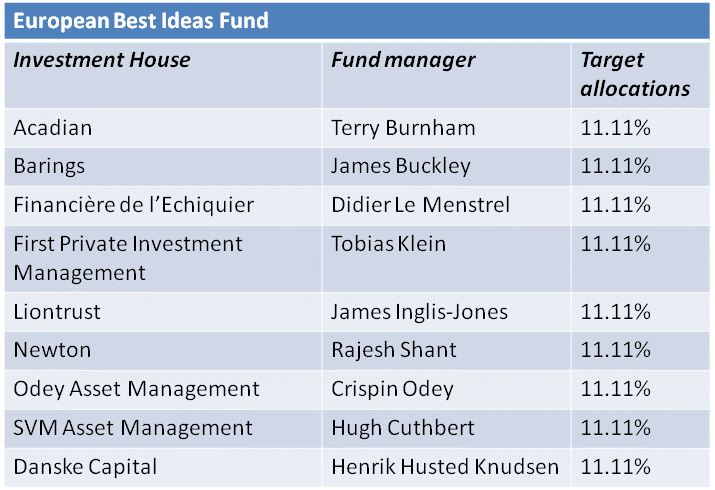
There are a number of hedge fund managers and managers of absolute return funds amongst the roster of managers employed by Skandia in the Best Ideas Funds. In fact I would go so far as to say that there is a disproportionate number of such managers amongst the portfolio managers used (see tables below). Would that be because hedge fund managers tend to apply the best portfolio management practices given by Skandia more than long-only managers?

In my case I used a numeric score of what I considered then, and still do now, the key drivers of performance. So I gave each manager a score between 1 and 10 for each of source of alpha and for risk management. Risk management included portfolio construction, position sizing, diversification, risk measurement, downside risk and use of stops. The source of alpha score took into consideration the added value of the specific person/people pulling the trigger, the breadth and depth of research, whether there was a unique or unusual information source being used, the sustainability of the manager's edge, how adaptable the approach was to change, and the richness of the opportunity set being addressed. A mid-ranking manager would score 6 for each, in the way I used the scales, but this was a closed marking system. No manager ever got 10 for either metric. I never gave any manager a score less than 4 for alpha or risk management in the time I carried out manager research. At the bottom end it is easy to understand why: managers setting up a hedge fund have nearly always has significant success previously in trading or investing. They are not neophytes; and though some learn on the job about managing capital in the hedge fund format, they have all managed capital before.
After a while meeting managers, and hearing how they do what they do, I realised that whilst the alpha score was important, risk management was a bigger differentiator. So getting into risk management issues early in the process saved a lot of time and effort: if a manager didn't have discipline and a consistent process in risk management it was time to move on to another hedge fund.
A legacy of this time is that I remain interested in how to assess managers – it is useful in my consultancy work, at the least. In the book I am reading at the moment – "Investing with the Grand Masters" by James Morton – I am engaged to see what criteria the author used for selection of the managers.
So I was interested to read about the Skandia Investment Group's Best Ideas fund range. Skandia has a fund platform and operates multi-manager funds, but the Best Ideas funds are not a standard fund of funds. Neither are they portfolios of pure hedge funds. These are portfolios of funds (mostly long-only funds) run by well-regarded portfolio managers who have been given the freedom to invest in their highest conviction investment ideas on a dedicated basis.
The lead manager on Skandia Investment Group's Best Ideas fund range, Lee Freeman-Shor, applies four key pieces of academic investment research to his selection process. These are:
1. High conviction investing: Research from Randy Cohen of the Harvard Business School, Christopher Polk and Bernhard Silli of the London School of Economics suggests that the bulk of fund manager's returns come from their highest conviction ideas. As a result the Best Ideas managers are limited to holding only ten stocks, their ten highest conviction ideas.
2. Kelly Criterion: a formula first described in 1956 by John Larry Kelly to determine the optimal betting size to maximise wealth. Perhaps the most famous Kelly practitioner is Warren Buffet who once said: 'Why not invest your assets in the companies you really like? In 1972 Buffet had 42% of Berkshires assets in American Express. Freeman-Shor allows the managers to apply Kelly to the extent that they can invest up to 25% in a single stock.
3. High Active Share: this measures the proportion of a fund's assets that differ from the benchmark index. In their 2009 paper 'How Active is your fund manager? A new measure that predicts performance' Martijn Cremers and Anti Petajisto indicated that running a fund with a high 'active share' delivers the highest and most repeatable returns. The European Best Ideas Fund has a high active share, currently 83%.
4. Behavioural science: Research by Andrea Frazzini in 2006 showed that the best performing managers realise the highest proportion of losing trades. Freeman-Shor's job as overall portfolio manager is to be a coach and work with the Best Ideas managers to ensure they do not succumb to, amongst other things, sunken cost bias when they are losing and are thus executing their ideas appropriately.
In a good hedge fund there is a competition for capital between the investment ideas – that is, all full sized positions are conviction ideas. So the concept of high conviction investing is seen in the hedge fund world. The Kelly Criterion applies in several hedge fund strategies – event driven investing, activist investing, and to a lesser extent in global macro investing. The third piece of applied research might just say why hedge funds have inherent qualities relative to long only strategies, as 100% of many hedge fund portfolios are active bets. There are no index constraints in hedge fund portfolios, though the presence of positions held only to hedge impacts the percentage of the portfolio applied to seek alpha.
The fourth piece of academic research applied to the Skandia Best Ideas funds has a very strong resonance for me. The conclusion from Frazzini is that the best performing managers realise the highest proportion of losing trades. From my work with traders I know that this can be applied with minor tweaks in hedge funds: the best traders realise their losses either early, or in line with their stated stop-loss policies. This allows winners to run, and losers to be cut. This characteristic is also often seen in systematic approaches to markets, particularly by CTAs. With good money management it is feasible to run a successful CTA with a hit-rate (percentage of winning trades) of only 35%. The hit-rate in a discretionary money manager has to be a lot higher, and for a fundamentally driven manager with a long holding period the hit-rate can get into the high 80's as a percentage.
The fruit of the application of these concepts has been good – the Skandia European Best Ideas Fund has shown some strong out-perfromance. On the third anniversary since launch the fund was 17% ahead of the MSCI Europe index and 15% ahead of its peer group (Morningstar European Large Cap Blend), putting it in the top 5% of European funds since inception and 1st quartile over all time periods.
There are a number of hedge fund managers and managers of absolute return funds amongst the roster of managers employed by Skandia in the Best Ideas Funds. In fact I would go so far as to say that there is a disproportionate number of such managers amongst the portfolio managers used (see tables below). Would that be because hedge fund managers tend to apply the best portfolio management practices given by Skandia more than long-only managers?
Monday, 18 April 2011
Past the Low Point for Funds of Hedge Funds
It has been a tough time for funds of hedge funds post the Credit Crunch. At last it looks like the aggregate assets under management are beginning to emerge from the prolonged bottoming phase. Three months ago there was a comment here on the flat-lining in asset flows for North American funds of hedge funds. But the latest survey evidence from Preqin shows a rather more constructive outlook.
Whilst the aggregate is little changed:
The detail shows that more of the fund of funds sector is experiencing positive changes in AUM:
The outlook for funds of hedge funds is the most positive we have seen for at least 3 years. Preqin's version is
The fund of funds part of the hedge fund industry is not going to return to growth in the way it experienced it before – not all funds of funds will benefit in this more mature phase of the industry. But in aggregate the low point for the sector has been passed.
Whilst the aggregate is little changed:
Graphic One: Aggregate Fund of Hedge Funds Assets under Management
Source: Preqin
The detail shows that more of the fund of funds sector is experiencing positive changes in AUM:
Graphic Two: Changes in Fund of Hedge Funds' Assets under Management since 2007
Source: Preqin
- The proportion of funds of funds experiencing a fall in assets has gone from a substantial minority last year (42%) to only a small minority (17%) this year.
- Much more of the industry has experienced stability in AUM this year – 55% of FoFs have seen no change in assets so far this year compared to last year.
- The proportion of funds of hedge funds having an increase in assets is up to 28% in the 1Q of 2011.
If these trends continue the total AUM for funds of funds could rise towards $950bn by year end, in Peqin's estimation. This would be a good fit with evidence suggesting that institutional investors will be increasing their allocations to hedge funds. According to the recent Deutsche Bank survey on hedge funds, in aggregate institutional investors do expect to increase their allocations to hedge funds in 2011. The majority of investing institutions (77%) expect to keep their allocations as they were, but more (21%) expect to increase allocations in 2011 than decrease them (2%).
"The fund of funds landscape is markedly different to the pre-crisis industry. Assets under management for the industry as a whole are much lower and there is a bimodal distribution of firms emerging, with peaks at the lower end of the scale as the smaller niche boutiques appeal to the maturing hedge fund investors, and at the larger end of the spectrum the "brand name" multi-strategy firms still prove appealing to the newer investor. After a difficult few years for funds of hedge funds, the managers that have appropriately adapted to retain investors from the institutional market have regained some lost confidence and numerous new funds are poised to be launched this year. Growth of industry assets is again in positive territory and if this new era of revived investor interest in funds of funds continues then aggregate AUM will begin to climb towards the $1 trillion mark."
The fund of funds part of the hedge fund industry is not going to return to growth in the way it experienced it before – not all funds of funds will benefit in this more mature phase of the industry. But in aggregate the low point for the sector has been passed.
Thursday, 7 April 2011
Consulting Two - No Explicit Cost v Negative Carry Option Strategies
In my consultancy work I have been surprised by the frequency with which I have come across zero-cost strategies in options. Traders and portfolio managers find them more alluring than they should. It is as if these strategies intrinsically have more merit and deserve more attention. They don't.
To take on an options strategy, in say an equity index, the trader or PM must have a view on the underlying. To have an informed view the trader must follow the instrument closely – this allows them to attach probabilities to the possible broad scenarios behind taking a view via options. So the thinking may be that the index has had a good run and is beginning to act tired; that is there is limited upside from the current level. Or it could be that a particular share has formed a double bottom, there is good value in them and selling might begin to dry up. The first scenario is one that might suit an over-writing of call options. The second might fit an underwriting near current levels by selling put options.
To simplify market activity there are three broad outcomes possible – a trading range, a further significant rise, or a significant fall. Lesser directional movements are captured in the trading range scenario. The money manager or trader will have views on the likelihood of each of these, or to put it another way, if pressed most money managers could attach probabilities to the three broad outcomes. The money manager might have a view that the odds of a significant decline are small, say 10%, but having had a good run the odds of a trading range to consolidate the rise is quite high, say 60%. And the chances of further significant upside are greater than the chances of a significant fall, given the evidence of new buyers – so the odds of a significant rise are 30%. Whatever the exact percentages, the trader will have his own take on what the probabilities are of the three possible outcomes. It is his own probabilities which need to be fed into the construction of an option strategy to make it a fit of his view.
Of course the further significant rise might follow an intermediate pause for refreshment in the price of the shares or index. The extent of time taken to consolidate or pause is a key point. This is the time frame factor, and all managers have a time frame in which they add most value. This is the period over which they generate alpha. If they are a scalper, they shouldn't be taking a view over the next quarter, and a fundamentally-driven stock selector should not be looking to implement a view over the next couple of days. If a manager has a variant perception on earnings, for example, that would normally emerge over several quarters rather than over a week. All option strategies have a time frame, fixed around the months of the option maturities. To be a good fit for the trader the option strategy has to take place over the right forecasting horizon for them.
In a commodity market traders will know the price level at which industrial users will be highly likely to come in to buy. They may know the price zone when commercial hedgers have historically increased their open interest. In the world of equities a manager will have a clear idea of where value is emerging in a particular stock, and where companies buy-in their own stock. In fixed income traders will know at what interest rate funding becomes attractive to a particular category of market participant. So the portfolio manager or trader will have his own mental map of the significant levels of the markets they follow as they see them. In contrast, traded options are bought and sold for strike prices set at intervals by the rules of the exchange on which they trade.
The currency of option trading is volatility. So it might be said that the vol on a class of options is at least a couple of points rich compared to its recent history. Or that the smile of the volatility curve is particularly skewed because of a recent freefall in prices, meaning that out-the-money puts are expensive relative to those with strike prices near-the-money. The 3-D volatility surface is what the options market maker takes his view on.
The users of options may or may not have a view on volatility per se. The users may have opinions on levels and how long it might take for moves to develop and mature, and what probabilities they attach to scenarios for their markets. Professional traders will have a view on vol. Portfolio managers who read a lot of fundamental research and meet company managements are unlikely to have a strong or well-informed view on option volatility by class, never mind by strike. So having done option training, PMs will know what implied and realised volatility are, but it is not the element on which they are typically able to take a well informed view. It is not their currency.
So it is that option strategies are often expressed in the language of levels – strike prices plus or minus net premium. For simplicity pay-off graphs tend to illustrate possible outcomes at maturity. This makes the marketing of strategies more straight forward, and expresses strategies in terms closer to those most readily understood by the widest number of portfolio managers. It does little for suitability or fitting with a manager's market view. And so we come to "zero cost" option strategies.
To take on an options strategy, in say an equity index, the trader or PM must have a view on the underlying. To have an informed view the trader must follow the instrument closely – this allows them to attach probabilities to the possible broad scenarios behind taking a view via options. So the thinking may be that the index has had a good run and is beginning to act tired; that is there is limited upside from the current level. Or it could be that a particular share has formed a double bottom, there is good value in them and selling might begin to dry up. The first scenario is one that might suit an over-writing of call options. The second might fit an underwriting near current levels by selling put options.
To simplify market activity there are three broad outcomes possible – a trading range, a further significant rise, or a significant fall. Lesser directional movements are captured in the trading range scenario. The money manager or trader will have views on the likelihood of each of these, or to put it another way, if pressed most money managers could attach probabilities to the three broad outcomes. The money manager might have a view that the odds of a significant decline are small, say 10%, but having had a good run the odds of a trading range to consolidate the rise is quite high, say 60%. And the chances of further significant upside are greater than the chances of a significant fall, given the evidence of new buyers – so the odds of a significant rise are 30%. Whatever the exact percentages, the trader will have his own take on what the probabilities are of the three possible outcomes. It is his own probabilities which need to be fed into the construction of an option strategy to make it a fit of his view.
Of course the further significant rise might follow an intermediate pause for refreshment in the price of the shares or index. The extent of time taken to consolidate or pause is a key point. This is the time frame factor, and all managers have a time frame in which they add most value. This is the period over which they generate alpha. If they are a scalper, they shouldn't be taking a view over the next quarter, and a fundamentally-driven stock selector should not be looking to implement a view over the next couple of days. If a manager has a variant perception on earnings, for example, that would normally emerge over several quarters rather than over a week. All option strategies have a time frame, fixed around the months of the option maturities. To be a good fit for the trader the option strategy has to take place over the right forecasting horizon for them.
In a commodity market traders will know the price level at which industrial users will be highly likely to come in to buy. They may know the price zone when commercial hedgers have historically increased their open interest. In the world of equities a manager will have a clear idea of where value is emerging in a particular stock, and where companies buy-in their own stock. In fixed income traders will know at what interest rate funding becomes attractive to a particular category of market participant. So the portfolio manager or trader will have his own mental map of the significant levels of the markets they follow as they see them. In contrast, traded options are bought and sold for strike prices set at intervals by the rules of the exchange on which they trade.
The currency of option trading is volatility. So it might be said that the vol on a class of options is at least a couple of points rich compared to its recent history. Or that the smile of the volatility curve is particularly skewed because of a recent freefall in prices, meaning that out-the-money puts are expensive relative to those with strike prices near-the-money. The 3-D volatility surface is what the options market maker takes his view on.
The users of options may or may not have a view on volatility per se. The users may have opinions on levels and how long it might take for moves to develop and mature, and what probabilities they attach to scenarios for their markets. Professional traders will have a view on vol. Portfolio managers who read a lot of fundamental research and meet company managements are unlikely to have a strong or well-informed view on option volatility by class, never mind by strike. So having done option training, PMs will know what implied and realised volatility are, but it is not the element on which they are typically able to take a well informed view. It is not their currency.
So it is that option strategies are often expressed in the language of levels – strike prices plus or minus net premium. For simplicity pay-off graphs tend to illustrate possible outcomes at maturity. This makes the marketing of strategies more straight forward, and expresses strategies in terms closer to those most readily understood by the widest number of portfolio managers. It does little for suitability or fitting with a manager's market view. And so we come to "zero cost" option strategies.
Zero-Cost Strategies
Zero-cost strategies would not matter much were it not for the frequency with which they are implemented. After all the PMs are all grown-ups and they can always say no to an options strategy proposal. But the allure of the cachet of no explicit cost seems to be very strong with the buy side. So a disproportionate number of strategies are created, sold and implemented based on the appeal of no up-front premium outlay.
The typical circumstances are that, for a give maturity, the premium attached to a near-the-money strike option happens to be twice the premium for an out-the-money strike option. This means that, taking account of one side being on the bid and the other on the offer, an investor can receive as much premium for selling two lots of options O-T-M as they pay for buying one lot of A-T-M options. The payoff profile is rising profit through to the OTM strike, and from that level out a declining profit.
Sometimes the ratio between the strikes dealt in is not 2:1, but say 5:2, but overwhelmingly in reality the zero cost collar or put protection is sold and implemented using a ratio of 2:1. The outcomes are then much more intuitive to comprehend (and pitch).
In the process of putting the strategy together the strike levels and maturity of options are selected to fit the template that the purchased premium outlay should be offset by the premium received from the options sold. Occasionally, when the term sheet is put together by a less experienced sell-sider, the O-T-M option is struck further out in time than the near the money option. This diagonal call spread/put spread is less elegant to sell and understand, and utilises two time horizons.
Now going back to the portfolio manager's use of options, he or she should use traded options when they efficiently implement their views on markets, and within their style of investing/trading. Their views come in several aspects: their own take on what the probabilities are of the (three) possible outcomes in the specific market; their own mental map of the significant levels of the markets; and they should take views via option positions over a time-frame that has a resonance with their own horizon for adding value.
Explicitly stating the elements going into the views on markets makes plain how specific they are to the trader or portfolio manager. It may well be possible to express the market view of a portfolio manager using options – so the time frame, probabilities and significant levels match what can be achieved and structured in the options market. That can be guaranteed to happen using over the counter options; that is, using bespoke instruments. To a degree using pre-existing strikes, dates and a given volatility surface of traded options will always be a compromise versus that ideal fit.
Lay on top of that that zero-cost strategies are put together when there is a conjunction of option maturities, skewness and strikes that just happens to give a ratio of 2:1 in premiums, and the impartial observe can see that zero cost strategies are a very artificial construct. Further it is plain that in order to put them on portfolio managers or traders are quite conceivably having to compromise their own market view in some dimension to accommodate the implied view of the zero-cost option strategy. So the real cost of the zero-cost strategy is not the premium expended, which by definition is nil, but the potential for a significant compromise with the actual market view of the risk taker. This mis-match is too often the cost of the zero-cost option strategy.
The typical circumstances are that, for a give maturity, the premium attached to a near-the-money strike option happens to be twice the premium for an out-the-money strike option. This means that, taking account of one side being on the bid and the other on the offer, an investor can receive as much premium for selling two lots of options O-T-M as they pay for buying one lot of A-T-M options. The payoff profile is rising profit through to the OTM strike, and from that level out a declining profit.
Sometimes the ratio between the strikes dealt in is not 2:1, but say 5:2, but overwhelmingly in reality the zero cost collar or put protection is sold and implemented using a ratio of 2:1. The outcomes are then much more intuitive to comprehend (and pitch).
In the process of putting the strategy together the strike levels and maturity of options are selected to fit the template that the purchased premium outlay should be offset by the premium received from the options sold. Occasionally, when the term sheet is put together by a less experienced sell-sider, the O-T-M option is struck further out in time than the near the money option. This diagonal call spread/put spread is less elegant to sell and understand, and utilises two time horizons.
Now going back to the portfolio manager's use of options, he or she should use traded options when they efficiently implement their views on markets, and within their style of investing/trading. Their views come in several aspects: their own take on what the probabilities are of the (three) possible outcomes in the specific market; their own mental map of the significant levels of the markets; and they should take views via option positions over a time-frame that has a resonance with their own horizon for adding value.
Explicitly stating the elements going into the views on markets makes plain how specific they are to the trader or portfolio manager. It may well be possible to express the market view of a portfolio manager using options – so the time frame, probabilities and significant levels match what can be achieved and structured in the options market. That can be guaranteed to happen using over the counter options; that is, using bespoke instruments. To a degree using pre-existing strikes, dates and a given volatility surface of traded options will always be a compromise versus that ideal fit.
Lay on top of that that zero-cost strategies are put together when there is a conjunction of option maturities, skewness and strikes that just happens to give a ratio of 2:1 in premiums, and the impartial observe can see that zero cost strategies are a very artificial construct. Further it is plain that in order to put them on portfolio managers or traders are quite conceivably having to compromise their own market view in some dimension to accommodate the implied view of the zero-cost option strategy. So the real cost of the zero-cost strategy is not the premium expended, which by definition is nil, but the potential for a significant compromise with the actual market view of the risk taker. This mis-match is too often the cost of the zero-cost option strategy.
Using Negative Carry Strategies
Parenthetically, the inverse of the driver of the zero-cost options strategy, has produced great returns in some hedge funds. Rather than be a net seller of gamma (through being short one unit of O-T-M delta) some of the most successful trades of all time have been long long-dated optionality. Being net long of option premium comes at a cost – there is time-value erosion to cope with. But for some patient investors there is a big attraction in having a negative carry trade which gives well defined upside/downside parameters.
The "greatest trade of all time" is the definitive example of the successful negative carry trade. Mortgage backed securities have embedded optionality in pre-payment risk, but through derivatives on MBS specific tranches and indices it was possible to construct trades that would benefit from no payment risk – when mortgagees hand back the keys on their houses. So it is that the likes of John Paulson and Kyle Bass made billions on the subprime meltdown. There was an explicit cost to the trade, but the downside was known from the outset, and at least in the mind of the originator of the trade the real risks were in rolling over the positions – the collapse was going to happen at some point, though its exact timing was not foreseeable.
A similar set up was seen by Mark Hart of Corriente Capital of Fort Worth Texas. Like Paulson he created a dedicated vehicle to run a long long-dated option strategy to play one specific investment idea for the medium term. In the case of Hart, the fund he created in 2007 with the founders of GavKal, the European Divergence Fund LP, owned credit default swaps on European sovereign risk. Hugh Hendry of Eclectica is hoping for a similar payoff (7:1 and better) from using CDSs for taking negative views on China-related plays.
Another successful manager that uses negative carry options is Jerry Haworth of 36 South Investment Managers of London. 36 South has a diversified fund, the Kohinoor Fund, that only uses long-dated options and which has a 10 year track record. Haworth has also set up funds to benefit from specific tail risk events that use the same approach – for example the Black Sawn Fund that made 234% in 2008.
For each of these managers the use of negative carry option strategies gives a very useful attribute - the left side of the distribution of returns is truncated. That is the range of possible outcomes is limited on one side, which is the classic desirable skewed distribution of hedge funds.
Finally, some successful managers will not engage in negative carry trades with optionality on a structural basis in their fund. Rather for some long established and successful managers they see themselves as earning the right to start to use these strategies once they have passed a return threshold for the year. So once they have earned 8 or 10% (and therefore have every chance of producing a double digit year as a minimum) they will invest some of their profits to give a shot at making a banner year.
When I was Head of Derivatives at Clerical Medical I used to tell the investment professionals there that derivatives should be used to implement their views on markets when the instruments allowed that to be done economically. So in specific circumstances, for a particular money manager, a zero-cost collar may exactly fit their market/stock view. But the investment concept invested in, and the fit of the option tactic with the view is more important than the explicit cost, as the successful examples of the use of negative carry option strategies show.
The first article in this series on consulting in the hedge fund business can be found at Consulting One
The "greatest trade of all time" is the definitive example of the successful negative carry trade. Mortgage backed securities have embedded optionality in pre-payment risk, but through derivatives on MBS specific tranches and indices it was possible to construct trades that would benefit from no payment risk – when mortgagees hand back the keys on their houses. So it is that the likes of John Paulson and Kyle Bass made billions on the subprime meltdown. There was an explicit cost to the trade, but the downside was known from the outset, and at least in the mind of the originator of the trade the real risks were in rolling over the positions – the collapse was going to happen at some point, though its exact timing was not foreseeable.
A similar set up was seen by Mark Hart of Corriente Capital of Fort Worth Texas. Like Paulson he created a dedicated vehicle to run a long long-dated option strategy to play one specific investment idea for the medium term. In the case of Hart, the fund he created in 2007 with the founders of GavKal, the European Divergence Fund LP, owned credit default swaps on European sovereign risk. Hugh Hendry of Eclectica is hoping for a similar payoff (7:1 and better) from using CDSs for taking negative views on China-related plays.
Another successful manager that uses negative carry options is Jerry Haworth of 36 South Investment Managers of London. 36 South has a diversified fund, the Kohinoor Fund, that only uses long-dated options and which has a 10 year track record. Haworth has also set up funds to benefit from specific tail risk events that use the same approach – for example the Black Sawn Fund that made 234% in 2008.
For each of these managers the use of negative carry option strategies gives a very useful attribute - the left side of the distribution of returns is truncated. That is the range of possible outcomes is limited on one side, which is the classic desirable skewed distribution of hedge funds.
Finally, some successful managers will not engage in negative carry trades with optionality on a structural basis in their fund. Rather for some long established and successful managers they see themselves as earning the right to start to use these strategies once they have passed a return threshold for the year. So once they have earned 8 or 10% (and therefore have every chance of producing a double digit year as a minimum) they will invest some of their profits to give a shot at making a banner year.
When I was Head of Derivatives at Clerical Medical I used to tell the investment professionals there that derivatives should be used to implement their views on markets when the instruments allowed that to be done economically. So in specific circumstances, for a particular money manager, a zero-cost collar may exactly fit their market/stock view. But the investment concept invested in, and the fit of the option tactic with the view is more important than the explicit cost, as the successful examples of the use of negative carry option strategies show.
The first article in this series on consulting in the hedge fund business can be found at Consulting One
Wednesday, 16 March 2011
Working in Equity Market-Neutral – A Q&A with ABACO Financials
ABACO Financials Fund is a market-neutral equity fund with a European bias dedicated to investing in the Financial sector. The portfolio of long/short positions is structured to generate absolute returns by capturing relative value within the sector while targeting low volatility. The return stream produced for their growing list of investors has a high proportion of alpha in it, and the returns have low correlation to markets and to most equity hedge funds. Given the significance of the finance sector to the market turmoil of 2008/9 and to the prospects of European economic recovery since, the fund has been interesting to follow, not least because of the excellent market letter the managers produce.
The three investment professionals in the team have different overlapping roles: Inigo Lecubarri comes from the sell-side and spends the majority of his time on research; Louis Rivera-Camino has a background in portfolio management and works across all aspects of running the portfolio, and the following Q&A was conducted with Martin Deurell whose primary responsibilities include trading and risk control for the fund. The interlocutor was Simon Kerr.
Q. You had a very good performance in 2008, an excellent 2009 for a market-neutral fund and somewhat disappointing 2010 to follow. What happened last year?
Out of financial funds we did okay, but we were up only 2% after fees, and we are very far from happy about that. There are a number of reasons why financial funds did not do as well as other long/short equity strategies last year, and the biggest of them was the impact of the macro environment.
The over-riding theme for financials in 2010 was definitely macro, and teams like the ones we have really concentrate on financials from the bottom-up. That is where our effort is concentrated - in building our deep understanding of the individual companies and the drivers of stock returns. Yes, we'd like to think that financial specialists like ourselves would have a better chance of understanding the impact of macro factors on the universe of stocks we follow, but that is not the same as being any better at forecasting the macro-environment.
Post fund launch in 2003 the biggest macro driver was EuroLand convergence – that lasted through to 2009 in various ways. Making money for a sector fund was mostly about the attractiveness of one stock versus another up until 2009 - and then it changed.
From the environment of 2008 onwards, only the funding issue remains the same in 2010 – so the issue for financials is not the cost of funding. The markets treated stocks the same whatever their cost of funding – they all went down without discrimination.
The second headwind we faced in 2010 was the lack of consistent, strong long-only flows and outflows in our sectors of the stockmarket. These flows are important for the well-informed investors (such as hedge funds, and prop capital) to position against and take advantage of. Investors in hedge funds correctly buy into the idea that their (hedge fund) managers are able to anticipate investing institutions moving into sectors and stocks like tracking elephants moving in a forest. But in 2010 the investing institutions didn't move – flows went into ETFs and indices (country selection) dominated. If other categories of investors buy a banking ETF to take exposures that doesn't help a fund like ours which is market-neutral, and needs differential returns within sectors to drive returns. We are starting to see signs of flows out of bond funds and into equity funds as an asset allocation switch, and if that persists at the retail, or institutional level, that is going to help us.
Q. Was there anything you could have done differently last year to take account of this macro dominance?
If I was being hyper-critical I would say that we didn't put enough effort into tracking the impacts of macro factors in real time - you know, looking at the CDS market and what they say about our stocks. I have traded options in the past, so I know that looking at the implications of CDS pricing is like a put option determining the pricing of the underlying equity. The CDS market says something about where a stock might trade, but the CDS is structured around extreme events, and in any event the CDS market is a lagging indicator. So yes the equity has tended to move in a 1:1 relationship with the CDS, but that type of relationship may be unique to the time we have just been through.
At this point it seems the analysts who follow the financials sector are putting a lot of emphasis on their own take of the macro environment. This could even be at an extreme. There is so much emphasis being put on the macro component that the macro may still drive the individual equities in the first half of 2011.
Q. Does this have any implications to how you shape your portfolio?
Well it doesn't mean that I want to take a directional net long posture to equities, or the equities of financial stocks. As a generalisation, exposure to equity in financials is less attractive than fixed income at this point.
I think you can look for a rights issue to be a trigger for individual stocks. From the time when banks raise new equity they seem to outperform – Deutsche Bank is a case in point. It has out-performed since it raised fresh equity capital. The capital-raising by Nordic banks certainly helped their stocks to perform, though admittedly the operating environment they faced was not as adverse as for banks in some of the other territories. There is going to be a lot of issuance of capital in financials – some big equity raisings are coming in the next few months because they have to happen.
Q. Is capital raising good or bad for the bank stocks then?
The capital raising helps in a couple of ways. In raising fresh capital the banks are taking positive steps to meet the tougher capital adequacy rules. Also when banks raise equity they take big write-offs – so the asset value of the remainder of the assets is perceived as a harder (more credible) number. That said a number of the banks with investment banking business are still tight on capital – Barclays, Deutsche Bank and the French (universal) banks – the Swiss banks are probably okay for capital.
There are cross currents in looking at investment banks. There are negative regulatory impacts for them – they have to raise fresh capital and/or cut the levels of leverage they employ. The margins in trading have to come down – not just outsourcing of trading, but the intermediation of exchanges in OTC will bring down margins through increased transparency. Where they do lending, the net interest income may be softer looking forward. But their commission income should be up, and the prospects for M&A are good so long as they don't get too competitive on fees. We have them in the Fund, but I don't have a strong view on them myself. I don't have to – my colleagues Inigo (Lecubarri) and Louis (Rivera-Camino) sponsor the investment holding-period positions in the investment banks into the Fund. I do trade them quite often, but as the trader of the team I can tap into the expertise of the others for a strong fundamental view.
Looking at universal banks with significant investment banking operations like Barclays is difficult – they have an investment banking operation as well as retail banking and an SME business. You can't look at your DCF model and say this is what Barclays Bank is worth. There are just so many parameters changing all the time, and such a balance sheet that you never quite know about the quality of assets. It is very difficult to pin down a risk/reward on a trade and say that this is worthwhile taking a position here, even doing peer group comparisons.
There are a lot of (sell-side) analysts working on investment banks, but they all seem to do the same thing. They want to understand how the business is doing in the next two quarters – but that only seems to be used to justify the current share price. And talking to management and reading Dealogic about issuance seems to be about as far as they go. Yes the deal flow is the gravy in the business model, but in the present environment in particular, investors have to understand the balance sheet. No -one pushes the management on the balance sheet, and management is reluctant to talk about it on a current basis.
Q. Given the American investment banks report quarterly, do they give you insight into the European banks, or they too much outside your scope?
For our scope of fund it is valid to look at Morgan Stanley and Goldman Sachs. Goldmans has proved to be a different animal than the others – it always bounces back. Their network amongst politicians is first class, and they deal for so many clients that they are right on top of what is happening in flows in sectors. So the trading record is outstanding for good reason, but then again proprietary trading will be wound down, and some top people there seem to be leaving. I have successfully traded GS shares last year, but I felt I was a child playing with fire in doing it, and I have less confidence in my risk taking there this year. In general we are not massive experts in trading things on that side of the pond.
Q. How do you work with the sell-side as an information source?
We use the sell-side analysts for generating and testing ideas on a theme, and for tactical level trading. The hedge fund world is not like private equity – so we don't have the luxury of fixing a fair value for a stock and waiting four years for that value to be realized. We have to deal with regular valuation and marking our P&L to market. That means we have to be more aware of what the market is doing to valuation in the shorter term, and what the market is thinking on a stock.
So we tap into what the sell-side comes up with for ideas – sometimes the brokers' analysts will highlight something that we have missed in our screening. Our role then is to filter what is a good idea and what is a bad idea, and do more work on them. Sometimes what you initially think of as a good long idea can turn into a short position once you have checked out the market positioning on a stock - if the idea reflects the consensus on a stock we might consider going the other way. So then it's a "Short" not a "Long" and we can investigate the timing of taking a position.
Q. So if you are not taking many recommendations what do you use the brokers' analysts for?
We think you have to know all the analysts in the sector to know where the consensus on a company is. They can tell you where "the market" is on a stock, analytically and in terms of market positioning (holdings). The brokerage analysts can plant a seed of an idea – something that could be developed. And if you can find a good analyst it is good to test our ideas with them – to bounce ideas off them. If you can find an analyst who takes the opposite view from you, that is also useful to an investor. You need to test your argument – if you are a bull you need to test out the case of a bearish analyst by talking through his thinking. So then you know whether it makes sense to go against him. That is very very useful for a sector specialist fund manager.
To give you an example in a tactical sense, when we are approaching a company's results announcement- say consensus is at one level and an analyst comes along with a forecast outside the consensus. We might look at it and say to ourselves that the non-consensus analyst is right and the consensus estimates are wrong. In that case we can go long, say, and when everyone upgrades their forecasts the stock will go up. Or maybe the nasty figures are already discounted, and again the stock will go up on the earnings release.
Q. How do you differentiate between the analysts?
Of course the longer you have been in the game the better you know which are the good, and which are the bad, amongst the sell-side analysts. Also with experience you can trust a certain analyst – I know he is good on that stock, and someone else is really good on that bank. To find the analyst that is the expert on the Street on a company is very powerful. If you know the one that has done the most work, that knows the company intimately from following them over a long period of time, it is worth a lot. You may be able to ignore the other analysts on the company. I admit that it is a rare thing, such confidence in an external analyst, where they are the clear number one or two in knowledge on a company. But it can have a good pay-off. It can put you as an investor in a psychological disposition where you can comfortably take bigger risk.
We are fortunate in that we have such an analyst working in our own team. Inigo has been the number one ranked analyst on Portugese and Spanish banks, and to some extent he can tell others about what is really going on! This gives us a genuine edge in some stocks compared to the market.
Q. Would you say there are differences between how a hedge fund would use a buy side analyst and a sell-side analyst?
There is a substantial difference between the buy-side and the sell-side analysts on the risk/reward for a view on a stock. The sell side analyst has to live with his recommendation for a lot longer period of time. We have the luxury on our side of being able to moderate our view, as expressed in our position size, as we go along.
Q. Your presentation shows you as having specific responsibility for risk control. Are you the one that has to place the stops on positions?
It is not just my input on this. I carry out the dealing for the Fund but my colleagues put their own ideas into the Fund, and they propose how wide the stops should be. I don't apply a blanket hard stop. What I prefer to do is to place the stop in proportion to the volatility of the stock. So a more highly volatile financial stock will have a wider stop on it than a stock which acts in a less volatile way.
Also it is not as straight-forward as it sounds - looking at one position in isolation. We have related positions in our portfolio, so we may have put on two (hedging) short positions against one long position. So the catalyst for action can't be one share price in isolation, even if the P&L on that may be negative – there could be a long position down 40% and the shorts are down 35%, for a net loss of 5%. So the trigger level of an 8% loss has not been reached and so the stop would not be effective even if the three stocks are each down more than 30%!
There is another factor in the frequency of taking losses - the size of the P&L of the whole Fund has an impact. When the fund is doing well, and the P&L is positive, it is natural that the balance sheet of the fund is higher than when we have had to take losses. So it is much easier to run the profitable positions, and not be compelled to close the losers when the whole fund has a positive P&L (for the year).
Investors in the fund should also appreciate that there are some exit tactics to be deployed. So even where there is a stop level, not the whole of the position is changed all at once. I prefer to sell, say, half a long position at a level and then wait to see how it reacts for the remainder.
Q. Thanks for your time, Martin. You have given us a good insight into how you work with the Street, and how you manage the volatility of your fund so well. Good luck with the alpha harvesting in 2011.
Thanks.
Terms: Management Fee: 1.5%, Performance Fee: 20%, Redemptions: Monthly, Lock Up: No
The interview was conducted on the 12th January 2011.
Another article on ABACO Financials Fund can be found here.
The three investment professionals in the team have different overlapping roles: Inigo Lecubarri comes from the sell-side and spends the majority of his time on research; Louis Rivera-Camino has a background in portfolio management and works across all aspects of running the portfolio, and the following Q&A was conducted with Martin Deurell whose primary responsibilities include trading and risk control for the fund. The interlocutor was Simon Kerr.
Q. You had a very good performance in 2008, an excellent 2009 for a market-neutral fund and somewhat disappointing 2010 to follow. What happened last year?
Out of financial funds we did okay, but we were up only 2% after fees, and we are very far from happy about that. There are a number of reasons why financial funds did not do as well as other long/short equity strategies last year, and the biggest of them was the impact of the macro environment.
The over-riding theme for financials in 2010 was definitely macro, and teams like the ones we have really concentrate on financials from the bottom-up. That is where our effort is concentrated - in building our deep understanding of the individual companies and the drivers of stock returns. Yes, we'd like to think that financial specialists like ourselves would have a better chance of understanding the impact of macro factors on the universe of stocks we follow, but that is not the same as being any better at forecasting the macro-environment.
Post fund launch in 2003 the biggest macro driver was EuroLand convergence – that lasted through to 2009 in various ways. Making money for a sector fund was mostly about the attractiveness of one stock versus another up until 2009 - and then it changed.
From the environment of 2008 onwards, only the funding issue remains the same in 2010 – so the issue for financials is not the cost of funding. The markets treated stocks the same whatever their cost of funding – they all went down without discrimination.
The second headwind we faced in 2010 was the lack of consistent, strong long-only flows and outflows in our sectors of the stockmarket. These flows are important for the well-informed investors (such as hedge funds, and prop capital) to position against and take advantage of. Investors in hedge funds correctly buy into the idea that their (hedge fund) managers are able to anticipate investing institutions moving into sectors and stocks like tracking elephants moving in a forest. But in 2010 the investing institutions didn't move – flows went into ETFs and indices (country selection) dominated. If other categories of investors buy a banking ETF to take exposures that doesn't help a fund like ours which is market-neutral, and needs differential returns within sectors to drive returns. We are starting to see signs of flows out of bond funds and into equity funds as an asset allocation switch, and if that persists at the retail, or institutional level, that is going to help us.
Q. Was there anything you could have done differently last year to take account of this macro dominance?
If I was being hyper-critical I would say that we didn't put enough effort into tracking the impacts of macro factors in real time - you know, looking at the CDS market and what they say about our stocks. I have traded options in the past, so I know that looking at the implications of CDS pricing is like a put option determining the pricing of the underlying equity. The CDS market says something about where a stock might trade, but the CDS is structured around extreme events, and in any event the CDS market is a lagging indicator. So yes the equity has tended to move in a 1:1 relationship with the CDS, but that type of relationship may be unique to the time we have just been through.
At this point it seems the analysts who follow the financials sector are putting a lot of emphasis on their own take of the macro environment. This could even be at an extreme. There is so much emphasis being put on the macro component that the macro may still drive the individual equities in the first half of 2011.
Q. Does this have any implications to how you shape your portfolio?
Well it doesn't mean that I want to take a directional net long posture to equities, or the equities of financial stocks. As a generalisation, exposure to equity in financials is less attractive than fixed income at this point.
I think you can look for a rights issue to be a trigger for individual stocks. From the time when banks raise new equity they seem to outperform – Deutsche Bank is a case in point. It has out-performed since it raised fresh equity capital. The capital-raising by Nordic banks certainly helped their stocks to perform, though admittedly the operating environment they faced was not as adverse as for banks in some of the other territories. There is going to be a lot of issuance of capital in financials – some big equity raisings are coming in the next few months because they have to happen.
Q. Is capital raising good or bad for the bank stocks then?
The capital raising helps in a couple of ways. In raising fresh capital the banks are taking positive steps to meet the tougher capital adequacy rules. Also when banks raise equity they take big write-offs – so the asset value of the remainder of the assets is perceived as a harder (more credible) number. That said a number of the banks with investment banking business are still tight on capital – Barclays, Deutsche Bank and the French (universal) banks – the Swiss banks are probably okay for capital.
There are cross currents in looking at investment banks. There are negative regulatory impacts for them – they have to raise fresh capital and/or cut the levels of leverage they employ. The margins in trading have to come down – not just outsourcing of trading, but the intermediation of exchanges in OTC will bring down margins through increased transparency. Where they do lending, the net interest income may be softer looking forward. But their commission income should be up, and the prospects for M&A are good so long as they don't get too competitive on fees. We have them in the Fund, but I don't have a strong view on them myself. I don't have to – my colleagues Inigo (Lecubarri) and Louis (Rivera-Camino) sponsor the investment holding-period positions in the investment banks into the Fund. I do trade them quite often, but as the trader of the team I can tap into the expertise of the others for a strong fundamental view.
Looking at universal banks with significant investment banking operations like Barclays is difficult – they have an investment banking operation as well as retail banking and an SME business. You can't look at your DCF model and say this is what Barclays Bank is worth. There are just so many parameters changing all the time, and such a balance sheet that you never quite know about the quality of assets. It is very difficult to pin down a risk/reward on a trade and say that this is worthwhile taking a position here, even doing peer group comparisons.
There are a lot of (sell-side) analysts working on investment banks, but they all seem to do the same thing. They want to understand how the business is doing in the next two quarters – but that only seems to be used to justify the current share price. And talking to management and reading Dealogic about issuance seems to be about as far as they go. Yes the deal flow is the gravy in the business model, but in the present environment in particular, investors have to understand the balance sheet. No -one pushes the management on the balance sheet, and management is reluctant to talk about it on a current basis.
Q. Given the American investment banks report quarterly, do they give you insight into the European banks, or they too much outside your scope?
For our scope of fund it is valid to look at Morgan Stanley and Goldman Sachs. Goldmans has proved to be a different animal than the others – it always bounces back. Their network amongst politicians is first class, and they deal for so many clients that they are right on top of what is happening in flows in sectors. So the trading record is outstanding for good reason, but then again proprietary trading will be wound down, and some top people there seem to be leaving. I have successfully traded GS shares last year, but I felt I was a child playing with fire in doing it, and I have less confidence in my risk taking there this year. In general we are not massive experts in trading things on that side of the pond.
Q. How do you work with the sell-side as an information source?
We use the sell-side analysts for generating and testing ideas on a theme, and for tactical level trading. The hedge fund world is not like private equity – so we don't have the luxury of fixing a fair value for a stock and waiting four years for that value to be realized. We have to deal with regular valuation and marking our P&L to market. That means we have to be more aware of what the market is doing to valuation in the shorter term, and what the market is thinking on a stock.
So we tap into what the sell-side comes up with for ideas – sometimes the brokers' analysts will highlight something that we have missed in our screening. Our role then is to filter what is a good idea and what is a bad idea, and do more work on them. Sometimes what you initially think of as a good long idea can turn into a short position once you have checked out the market positioning on a stock - if the idea reflects the consensus on a stock we might consider going the other way. So then it's a "Short" not a "Long" and we can investigate the timing of taking a position.
Q. So if you are not taking many recommendations what do you use the brokers' analysts for?
We think you have to know all the analysts in the sector to know where the consensus on a company is. They can tell you where "the market" is on a stock, analytically and in terms of market positioning (holdings). The brokerage analysts can plant a seed of an idea – something that could be developed. And if you can find a good analyst it is good to test our ideas with them – to bounce ideas off them. If you can find an analyst who takes the opposite view from you, that is also useful to an investor. You need to test your argument – if you are a bull you need to test out the case of a bearish analyst by talking through his thinking. So then you know whether it makes sense to go against him. That is very very useful for a sector specialist fund manager.
To give you an example in a tactical sense, when we are approaching a company's results announcement- say consensus is at one level and an analyst comes along with a forecast outside the consensus. We might look at it and say to ourselves that the non-consensus analyst is right and the consensus estimates are wrong. In that case we can go long, say, and when everyone upgrades their forecasts the stock will go up. Or maybe the nasty figures are already discounted, and again the stock will go up on the earnings release.
Q. How do you differentiate between the analysts?
Of course the longer you have been in the game the better you know which are the good, and which are the bad, amongst the sell-side analysts. Also with experience you can trust a certain analyst – I know he is good on that stock, and someone else is really good on that bank. To find the analyst that is the expert on the Street on a company is very powerful. If you know the one that has done the most work, that knows the company intimately from following them over a long period of time, it is worth a lot. You may be able to ignore the other analysts on the company. I admit that it is a rare thing, such confidence in an external analyst, where they are the clear number one or two in knowledge on a company. But it can have a good pay-off. It can put you as an investor in a psychological disposition where you can comfortably take bigger risk.
We are fortunate in that we have such an analyst working in our own team. Inigo has been the number one ranked analyst on Portugese and Spanish banks, and to some extent he can tell others about what is really going on! This gives us a genuine edge in some stocks compared to the market.
Q. Would you say there are differences between how a hedge fund would use a buy side analyst and a sell-side analyst?
There is a substantial difference between the buy-side and the sell-side analysts on the risk/reward for a view on a stock. The sell side analyst has to live with his recommendation for a lot longer period of time. We have the luxury on our side of being able to moderate our view, as expressed in our position size, as we go along.
Q. Your presentation shows you as having specific responsibility for risk control. Are you the one that has to place the stops on positions?
It is not just my input on this. I carry out the dealing for the Fund but my colleagues put their own ideas into the Fund, and they propose how wide the stops should be. I don't apply a blanket hard stop. What I prefer to do is to place the stop in proportion to the volatility of the stock. So a more highly volatile financial stock will have a wider stop on it than a stock which acts in a less volatile way.
Also it is not as straight-forward as it sounds - looking at one position in isolation. We have related positions in our portfolio, so we may have put on two (hedging) short positions against one long position. So the catalyst for action can't be one share price in isolation, even if the P&L on that may be negative – there could be a long position down 40% and the shorts are down 35%, for a net loss of 5%. So the trigger level of an 8% loss has not been reached and so the stop would not be effective even if the three stocks are each down more than 30%!
There is another factor in the frequency of taking losses - the size of the P&L of the whole Fund has an impact. When the fund is doing well, and the P&L is positive, it is natural that the balance sheet of the fund is higher than when we have had to take losses. So it is much easier to run the profitable positions, and not be compelled to close the losers when the whole fund has a positive P&L (for the year).
Investors in the fund should also appreciate that there are some exit tactics to be deployed. So even where there is a stop level, not the whole of the position is changed all at once. I prefer to sell, say, half a long position at a level and then wait to see how it reacts for the remainder.
Q. Thanks for your time, Martin. You have given us a good insight into how you work with the Street, and how you manage the volatility of your fund so well. Good luck with the alpha harvesting in 2011.
Thanks.
Terms: Management Fee: 1.5%, Performance Fee: 20%, Redemptions: Monthly, Lock Up: No
The interview was conducted on the 12th January 2011.
Another article on ABACO Financials Fund can be found here.
Subscribe to:
Comments (Atom)